


Secure test environment
You don't need to install any secure software when you operate our SEND test engine because our online version is secure and easy to download. When you receive our download link of SEND lead4pass questions, you just need to click the link and install our app.
We are fully aware of the fact that MRCPUK SEND actual test is a very challenging and technical exam, which needs to be prepared seriously by the candidates if they want to ensure SEND pass test. But with our latest learning materials, one-year free update, free download demo, 24/7 live chat support, valid SEND lead4pass questions, you can absolutely get high passing score in the real exam and other related exam like SEND actual test . We are proudly working with more than 50,000 customers, which show our ability and competency in IT field. Our SEND valid braindumps focused on delivering best quality questions and answers for customers. And our SEND test engine will make your preparation easier. So don't hesitate, just place order in your online training materials and package now.

The best reason for choosing our SEND lead4pass review as your first preparation materials is its reliability and authenticity. The latest MRCPUK Certification test questions are perfect in all respects in catering your exam needs and making it easy for you to clear exam with Endocrinology and Diabetes (Specialty Certificate Examination) test answers. Our learning materials corresponds with all key points of the SEND actual test and provides you updated SEND pass test guide and current certification exam information, which trains you face the difficulties of real exam with your best.
Our SEND test engine is the great choice to achieve good results for the actual test. We deliver guaranteed preparation materials for your exam preparation, holding the promise for reimbursement to reduce your loss. All SEND test questions are based on the certification exam and SEND test answers are tested and verified by our IT experts who are profession in the IT certification exam guide. You can download the free demo of SEND lead4pass review in our exam page to make sure the accuracy of our products.
Money back guaranteed
Our SEND valid braindumps can ensure you get high passing mark in the real exam. We promise that you will get money back if you failed SEND actual test with our latest questions and answers. Just send your score report to our support when you failed, we will refund after confirmation.
Instant Download SEND Exam Braindumps: Upon successful payment, Our systems will automatically send the product you have purchased to your mailbox by email. (If not received within 12 hours, please contact us. Note: don't forget to check your spam.)
Download free demo
There are free demo of SEND lead4pass questions in our exam page for you download before you buy. The demos of trial are chosen from the SEND valid braindumps which contains accurate SEND test answers and some detailed explanations.
Exam simulation
Our online test engine is an exam simulation that makes you feel the atmosphere of SEND actual test and you can know the result after you finished SEND test questions. Most IT personnel prefer to use it because it allows practicing MRCPUK valid braindumps in any electronic equipment. With the assistance of SEND test engine, you can not only save time and energy in the SEND pass test, but also get high score in the real exam.
MRCPUK SEND Exam Syllabus Topics:
| Section | Objectives |
|---|---|
| Topic 1: Reproductive Endocrinology | - Gonadal Disorders
|
| Topic 2: Diabetes Mellitus | - Complications
|
| Topic 3: Calcium and Bone Metabolism | - Parathyroid and Metabolic Bone Disease
|
| Topic 4: Pituitary and Hypothalamic Disorders | - Pituitary Disease
|
| Topic 5: Thyroid Disorders | - Thyroid Disease
|
| Topic 6: Adrenal Disorders | - Adrenal Disease
|
| Topic 7: General Endocrinology | - Integrated Clinical Practice
|
MRCPUK Endocrinology and Diabetes (Specialty Certificate Examination) Sample Questions:
1. A 17-year-old boy with a 7-year history of type 1 diabetes mellitus was transferred to the adolescent diabetes clinic. He had a history of poor clinic attendance. He admitted to having lost weight recently. His eyes had been photographed by a community ophthalmologist 1 week previously. A photograph of the right fundus is shown (see image).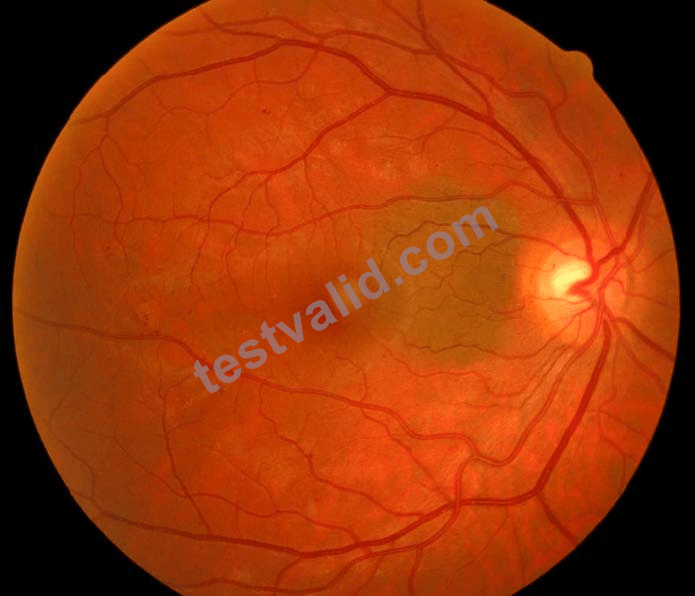
Investigations:
haemoglobin A1c104 mmol/mol (20-42)
What is the most likely explanation for the retinal appearance?
A) retinitis pigmentosa
B) drusen
C) macular oedema
D) preproliferative diabetic retinopathy
E) benign choroidal naevus
2. A 44-year-old man was referred for investigation of cortisol excess. He had poorly controlled hypertension, and a long history of type 2 diabetes mellitus with retinopathy and peripheral neuropathy. His medication comprised aspirin, ramipril, atenolol, carbamazepine, metformin and simvastatin.
Initial investigations:
serum cortisol (09.00 h)350 nmol/L (200-700)
serum cortisol (22.00 h)48 nmol/L (50-250)
overnight dexamethasone suppression test (after 1 mg dexamethasone):
serum cortisol93 nmol/L (<50)
24-h urinary free cortisol (day 1)225 nmol (55-250)
24-h urinary free cortisol (day 2)200 nmol (55-250)
24-h urinary free cortisol (day 3)185 nmol (55-250)
What is the most appropriate next step in management?
A) CT scan of adrenal glands
B) dexamethasone-suppressed corticotrophin-releasing hormone test
C) MR scan of pituitary
D) reassure and discharge
E) high-dose 48-h dexamethasone suppression test
3. A 17-year-old girl was referred to the transition clinic. She was taking hydrocortisone 10 mg twice daily and fludrocortisone 150 micrograms daily following a failed short tetracosactide (Synacthen@) test 5years previously. She had entered puberty at the age of 10 but had never achieved adult breast development or menarche.
Investigations:
haemoglobin95 g/L (115-165)
MCV124 fL (80-96)
white cell count8.4 ? 109/L (4.0-11.0)
platelet count334 ? 109/L (150-400)
serum sodium138 mmol/L (137-144)
serum potassium4.4 mmol/L (3.5-4.9)
serum urea3.5 mmol/L (2.5-7.0)
serum corrected calcium1.80 mmol/L (2.20-2.60)
serum follicle-stimulating hormone67.9 U/L (2.5-10.0)
serum luteinising hormone56.4 U/L (2.5-10.0)
What is the most likely diagnosis?
A) autoimmune polyglandular syndrome type 1
B) hypothalamic germinoma
C) Turner's syndrome
D) pituitary stalk interruption syndrome
E) atypical congenital adrenal hyperplasia
4. An 85-year-old woman was referred with a lump in her neck. She had no symptoms of thyroid disease.
On examination, she had a 2 ? 3-cm firm mass at the lower pole in the right thyroid lobe. Her resting pulse was 90 beats per minute and regular.
Investigations:
serum thyroid-stimulating hormone3.5 mU/L (0.4-5.0)
serum free T415.0 pmol/L (10.0-22.0)
serum free T36.2 pmol/L (3.0-7.0)
anti-thyroid peroxidase antibodies28 IU/mL (<50) ultrasound scan of thyroidmixed cystic/solid mass with scattered microcalcifications
fine-needle aspiration biopsyThy 3a
What is the most appropriate next step in her management?
A) subtotal thyroidectomy
B) CT scan of neck
C) repeat fine-needle aspiration
D) ablative radioiodine treatment
E) PET scan of thyroid
5. A 37-year-old woman presented with a 2-year history of increasingly frequent flushing episodes. She described alternating loose bowel motions and constipation. She had also noted menstrual irregularity. She had no respiratory symptoms. She denied headache or chest pain, but complained of palpitations.
On examination, she appeared well. Her blood pressure was 128/82 mmHg.
Investigations:
serum thyroid-stimulating hormone0.8 mU/L (0.4-5.0)
What is the most appropriate next investigation?
A) fasting plasma gut hormones
B) serum gonadotrophins
C) urinary metanephrines
D) urinary 5-hydroxyindoleacetic acid
E) plasma metanephrines
Solutions:
| Question # 1 Answer: E | Question # 2 Answer: D | Question # 3 Answer: A | Question # 4 Answer: C | Question # 5 Answer: B |

 1105 Customer Reviews


