

[2025] Pass Key features of 3V0-21.23 Course with Updated 94 Questions
3V0-21.23 Sample Practice Exam Questions 2025 Updated Verified
NEW QUESTION # 51
An architect is designing a new vSphere solution. The customer has provided the following information to describe how the solution will be used:
The solution will host development workloads
Administrators will utilize snapshots frequently, with snapshots sometimes retained for extended periods of time Some of the workloads are sensitive to latency on the I/O of the storage Storage for the workloads will be provided by a physical array The physical array does not include a storage provider All workloads must be hosted on the solution, there are no other vSphere environments available for use Which design decision should the architect make to meet the needs of the customer?
- A. Use a storage array which supports vSphere Storage APIs - Storage Awareness (VASA) to configure Virtual Volumes (vVols) datastores for the workloads
- B. On workloads which are sensitive to latency, set the latency-sensitivity=high advanced setting
- C. On workloads which will use snapshots, set the latency-sensitivity=high advanced setting
- D. Use a storage array which supports VMware vSphere APIs: Array Integration (VAAI) to configure VMFS datastores for the workloads
Answer: A
NEW QUESTION # 52
Which vSphere feature is used to allocate CPU and memory resources dynamically among virtual machines within a cluster, based on predefined resource allocation rules?
- A. Fault Tolerance (FT)
- B. Storage DRS (SDRS)
- C. Distributed Resource Scheduler (DRS)
- D. vSphere High Availability (HA)
Answer: C
NEW QUESTION # 53
A company has a requirement that all production applications must have a maximum tolerable downtime (MTD) of one hour per month.
Which statement would be included in the physical design to support this requirement?
- A. vSphere Fault Tolerance (FT) will not be enabled for the production applications.
- B. Server hardware has already been purchased for the production applications.
- C. vSphere HA Host Failure Response will be set to Restart VMs.
- D. vSphere HA will be enabled on all clusters.
Answer: C
Explanation:
To meet the requirement of a maximum tolerable downtime (MTD) of one hour per month for production applications, the solution must ensure high availability and quick recovery of virtual machines (VMs) in the event of a host failure. Enabling vSphere High Availability (HA) with the Host Failure Response set to Restart VMs will automatically restart VMs on other hosts within the cluster inthe event of a host failure. This minimizes downtime and helps meet the MTD requirement by ensuring minimal disruption to production workloads.
NEW QUESTION # 54
During a requirements gathering workshop, the customer's Chief Information Security Office (CISO) provides the following requirements that are pertinent to the design of a new vSphere environment:
- All operating system critical patches must be installed within 24 hours of release.
- All virtual machine templates must be updated every three months in line with company policy.
Which requirement classification is being gathered for the design documentation?
- A. Manageability
- B. Availability
- C. Recoverability
- D. Security
Answer: A
Explanation:
Lifecycle managment and patch definition is cover by Manageability Nonfunctional requirement.
https://securityboulevard.com/2020/12/building-non-functional-requirements-framework- requirements-categories/
NEW QUESTION # 55
An architect is reviewing the information gathered from an initial requirements gathering workshop.
The following requirements have been identified:
REQ001 - The architecture must support tracking of administrative logons and actions.
REQ002 - The architecture must support class three (three nines or 99.9%) system availability.
REQ003 - The architecture must report on system usage in terms of CPU, memory, storage and network.
REQ004 - The architecture must provide for system recovery point objective (RPO) of two hours.
REQ005 - The architecture must provide access to a precision time protocol (PTP) for time synchronization.
Which two of the listed requirements would be classified as business (formerly functional) requirements?
(Choose two.)
- A. The architecture must support class three (Three nines or 99.9%) system availability.
- B. The architecture must report on system usage in terms of CPU, memory, storage and network.
- C. The architecture must provide for system recovery point objective (RPO) of two hours.
- D. The architecture must support tracking of administrative logons and actions.
- E. The architecture must provide access to a precision time protocol (PTP) for time synchronization.
Answer: A,C
Explanation:
The architecture must support class three (three nines or 99.9%) system availability.
This requirement focuses on the availability of the system, which is a business goal related to ensuring that the system is operational for a specified percentage of time (99.9% uptime). It is a high-level operational requirement that is tied to business continuity and meeting customer service expectations.
The architecture must provide for system recovery point objective (RPO) of two hours.
The RPO is a business requirement related to disaster recovery. It specifies how much data loss is acceptable in the event of a failure. This requirement ensures that business processes are protected by minimizing the potential impact of data loss, making it a key business consideration.
NEW QUESTION # 56
An architect is tasked with designing a new VMware software-defined data center (SDDC) using VMware vSAN. The architect uses a storage assessment tool to determine the storage requirements for the new vSAN cluster. The new SDDC is going to be deployed into the existing data center and must be connected to a shared core network switch.
The architect decides to use vSAN ReadyNodes with the following configuration:
Two disk groups with:
- Write Intensive NVMe 800 GB drive for cache
- Four 3.84 TB Mixed Use NVMe for capacity
- Four 10 GbE ports
Which element represents a risk that should be included in this design?
- A. The use of NVMe drives for cache and capacity
- B. The use of vSAN ReadyNodes
- C. The number of 10 GbE capable ports in the vSAN ReadyNode
- D. The existing network is 10 GbE capable
Answer: D
NEW QUESTION # 57
During a requirements gathering workshop, the customer provides the following requirement that is pertinent to the design of a new vSphere environment:
- The Maximum Tolerable Downtime (MTD) for all Tier 1 applications is
one hour.
Which requirement classification is being gathered for the design documentation?
- A. Recoverability
- B. Performance
- C. Manageability
- D. Availability
Answer: A
Explanation:
MTD - Maximum Tolerable Downtime: Sum of the RTO and WRT, which is the total time required to recover from a disaster and start serving the business again.
https://vcdx133.com/2015/01/28/vcdx-availability-explained/
NEW QUESTION # 58
An architect is designing an environment for a retail customer. The design will use a single small vCenter Server Appliance and a cluster of eight ESXi hosts at a remote site. There is a single 10 GbE connected network at the remote site to support all management services. It is not possible to create additional management networks at the remote site. Virtual machine backups at the site will be dependent on the vCenter Server being available.
Which design decision should the architect make to maximize availability for backups?
- A. The vCenter Server Appliance will be protected with vSphere Fault Tolerance.
- B. The cluster will be configured with vSphere HA and set to restart virtual machines based on guest operating system heartbeat monitoring.
- C. The cluster will be configured to use vSphere DRS in fully automated mode.
- D. vCenter Server High Availability will be configured.
Answer: A
NEW QUESTION # 59
During a workshop for a design project, the following information is shared:
Develop and maintain strong relationships with key stakeholders and partners to promote collaboration.
Maintain high standards of quality and professionalism in all aspects of the project.
Build a strong foundation for future projects, including cloud infrastructures.
Ensure project timelines and milestones are met by effectively managing resources and priorities.
Which of these would be classified as a business outcome of the project?
- A. Ensure project timelines and milestones are met by effectively managing resources and priorities.
- B. Maintain high standards of quality and professionalism in all aspects of the project.
- C. iDevelop and maintain strong relationships with key stakeholders and partners to promote collaboration.
- D. Build a strong foundation for future projects, including cloud infrastructures.
Answer: D
Explanation:
A business outcome refers to a result or impact that directly contributes to the strategic goals of the organization, typically focusing on long-term objectives or future benefits. In this case, building a strong foundation for future projects, including cloud infrastructures, aligns with the business goal of positioning the organization for future success and scalability. This outcome is about preparing the organization for the future, which is a key business-driven result.
NEW QUESTION # 60
What do data protection requirements for a vSphere design focus on?
- A. Determining the number of virtual machines and cores needed.
- B. Specifying the hardware specifications required for the vSphere environment.
- C. Ensuring the security of sensitive data stored in the vSphere system.
- D. Identifying the specific tasks and operations the vSphere system should perform.
Answer: C
NEW QUESTION # 61
An architect is designing a new vSphere environment to meet the following requirements:
- The environment must support 5,000 virtual machines.
- The environment will be built initially using 350 hosts.
Which vCenter Server appliance deployment size should the architect specify for the design?
- A. Large
- B. Small
- C. Medium
- D. Tiny
Answer: A
Explanation:
The environment "must" support "5,000" virtual machines.
https://docs.vmware.com/en/VMware-vSphere/7.0/com.vmware.vcenter.upgrade.doc/GUID- FB268055-5D36-4624-A64C-9800D3FCB689.html Large environment (up to 1,000 hosts or 10,000 virtual machines)
NEW QUESTION # 62
How do you determine compute resource requirements for vSphere hosts?
- A. By optimizing the hardware specifications and infrastructure of the hosts.
- B. By specifying the amount of storage required for the vSphere hosts.
- C. By identifying the number and type of virtual machines that will run on the hosts.
- D. By calculating the network bandwidth needed for data transfer.
Answer: C
NEW QUESTION # 63
Refer to the exhibit.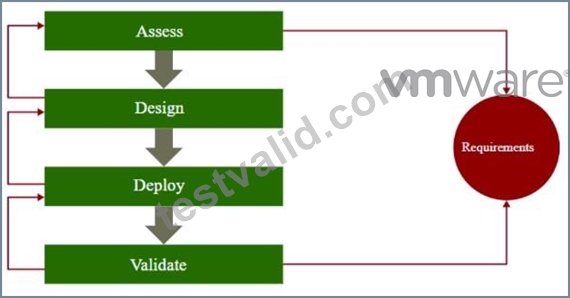
An architect is assigned a new project to design a VMware hybrid cloud solution.
The project is following a proven design methodology following the V-Model of systems engineering and verification. The selected methodology follows these phases: Assess, Design, Deploy and Validate.
Which activity would be conducted during the Design phase?
- A. The architect conducts a series of group interviews with stakeholders
- B. The architect defines the scope of the project
- C. The architect resolves configuration issues and addresses concerns
- D. The architect helps stakeholders learn the mechanics of the solution
Answer: A
Explanation:
Design phase: The purpose of the Design phase is to define how the solution will meet the specific requirements. During this phase, the architect works closely with stakeholders to understand their needs and translate those needs into a technical design. A key activity in this phase often involves refining the solution details through interviews and discussions with key stakeholders to ensure that the design aligns with the business and technical requirements.
NEW QUESTION # 64
What is an example of an availability design quality?
- A. A vSphere cluster is configured to stage patches on ESXi hosts before applying them.
- B. A vSphere cluster is configured to use a dedicated network adapter for vMotion traffic.
- C. A vSphere cluster is configured to support an N + 1 level of redundancy.
- D. A vSphere cluster is configured to support a maximum tolerated downtime of one hour.
Answer: C
Explanation:
Availability design quality refers to the capacity of a system or infrastructure to remain operational, minimizing downtime, and ensuring continuous service delivery, especially in the event of a failure. The concept of N + 1 redundancy ensures that if one component fails (such as a host or a power supply), there is always an additional, spare component available to take over the workload, maintaining the system's availability.
N + 1 redundancy in a vSphere cluster means that the cluster has enough resources to tolerate the failure of one host without affecting the availability of the workloads. This setup provides high availability and resilience in the event of a host failure.
NEW QUESTION # 65
Which of the following is a functional requirement?
- A. The system must generate monthly sales reports.
- B. The system must be compatible with Windows and macOS.
- C. The system must be user-friendly and intuitive.
- D. The system must handle 5000 concurrent transactions.
Answer: A
NEW QUESTION # 66
The following is a list of requirements from a discovery workshop for a new VMware hosting platform system design:
REQ001 - The architecture must support recoverability to the VMware Cloud Disaster Recovery (VCDR) service.
REQ002 - The architecture must support high availability (HA) and fault tolerance (FT).
REQ003 - The architecture must support reducing existing energy consumption and carbon footprint.
REQ004 - The architecture must provide support for network virtualization using distributed virtual switches.
Which requirement would be classified as a business (formerly functional) requirement?
- A. The architecture must support high availability (HA) and fault tolerance (FT).
- B. The architecture must support recoverability to the VMware Cloud Disaster Recovery (VCDR) service.
- C. The architecture must provide support for network virtualization using distributed virtual switches.
- D. The architecture must support reducing existing energy consumption and carbon footprint.
Answer: D
Explanation:
This is a business requirement because it aligns with corporate sustainability goals, focusing on reducing environmental impact. It is a high-level goal that can drive design decisions but is not directly related to the technical function or features of the system.
NEW QUESTION # 67
Following a company merger, there are two data centers running vSphere environments. Both data centers are leveraging separate Layer 3 vMotion networks.
Which requirement must be met in order to enable vMotion migration between these locations?
- A. A stretched vMotion network must be configured between data centers
- B. Virtual machines must be powered off in order to migrate them between data centers
- C. The vMotion service must be configured on the Management VMkernel adapter
- D. A dedicated TCP/IP stack for vMotion with a dedicated gateway must be configured
Answer: D
NEW QUESTION # 68
When considering server consolidation, plan on running ___________ vCPUs per core.
- A. 1 to 2
- B. 3 to 4
- C. 4 to 6
- D. 6 to 8
Answer: A
NEW QUESTION # 69
An architect is tasked with updating the design of an existing vSphere-based solution for a pharmaceuticals customer. The update will include upgrade to VMware vCenter 8 and VMware vSphere 8 and the creation of a new cluster that will be used for ongoing research projects. The research project that is driving the need for an update includes a number of applications that are latency-sensitive.
The customer has confirmed the following information during the initial workshop:
The customer recently completed a right sizing exercise using VMware Aria Operations that resulted in a number of ESXi hosts becoming available for use.
Each of the VMware ESXi host servers is configured with:
-- 2 x 20-core Intel Xeon CPU sockets
-- 1024 GB RAM divided evenly between sockets
There is no additional budget for purchasing hardware.
After confirming the existing hardware is still listed on the VMware Hardware Compatibility List (HCL), the architect makes the following design decisions with regard to the workload design:
The solution will support a maximum of 20 combined cores and sockets per virtual machine.
The solution will support a maximum of 512 GB RAM per virtual machine.
What should the architect document as justification for these design decisions?
- A. The maximum supported configuration will allow the creation of virtual machines that cross NUMA node boundaries resulting in improved overall performance.
- B. The maximum supported configuration will ensure each virtual machine will exclusively consume a whole CPU socket.
- C. The maximum supported configuration will ensure efficient use of RAM by sharing memory pages between virtual machines.
- D. The maximum supported configuration will ensure the virtual machines will adhere to a single Non- Uniform Memory Access (NUMA) node boundary.
Answer: D
Explanation:
NUMA (Non-Uniform Memory Access) is a system architecture in which a multiprocessor system is divided into multiple memory nodes. Each NUMA node typically has its own local memory that is faster to access than remote memory from other nodes.
In this case, each ESXi host has two CPU sockets (each with 20 cores) and 1024 GB of RAM divided evenly between the two sockets, meaning there are two NUMA nodes in each host.
By limiting the virtual machine to a maximum of 20 cores and sockets per virtual machine, and 512 GB of RAM, this ensures that each virtual machine will fit within a single NUMA node, preventing the virtual machine from crossing NUMA node boundaries. This design helps maintain better memory access performance and avoids potential performance degradation that can occur when a VM accesses memory across NUMA nodes.
NEW QUESTION # 70
......
VMware 3V0-21.23 Exam Syllabus Topics:
| Topic | Details |
|---|---|
| Topic 1 |
|
| Topic 2 |
|
| Topic 3 |
|
The New 3V0-21.23 2025 Updated Verified Study Guides & Best Courses: https://lead2pass.testvalid.com/3V0-21.23-valid-exam-test.html