

[2025] Valid CBAP test answers & IIBA CBAP exam pdf
Verified CBAP dumps Q&As - Pass Guarantee or Full Refund
Certification Path
There is no prerequisite for this exam.
The CBAP exam covers a broad range of knowledge areas related to business analysis, including business analysis planning and monitoring, elicitation and collaboration, requirements management and communication, enterprise analysis, and solution assessment and validation. CBAP exam consists of 120 multiple-choice questions and takes three and a half hours to complete.
NEW QUESTION # 176
The business analyst (BA) presented a concept model during a requirements walk through to the project sponsor, implementation subject matter expert and operational support start. While the presentation was clear to the project sponsor the other stakeholders were unsure about the impacts to their respective daily tasks.
What should the BA include in the next walk through, so that all stakeholders have a better understanding of the requirements?
- A. An information management model to identify requirement gaps
- B. A capability model to illustrate strategic objectives
- C. An appropriate level of abstraction to support differing viewports
- D. A governance architecture to contextual^ toe business analysis approach
Answer: C
NEW QUESTION # 177
A large insurance company wants to buy a new claims processing system or upgrade one of its two existing systems. Each year the claims department is given a $3,5 million budget to spend. Time is of the essence since there are some regulatory changes that will be coming the following year that will require several features that currently neither one of the two claims systems currently support.
There are eight stakeholders involved in this initiative. There are local to where the claim systems are managed, while five are located across the country. The business analyst (BA) struggled to get all stakeholders to agree on the desired features but ultimately got agreement on ten identified key features for the new claims systems. The BA was able to build a current state and future state process model which included all ten key features.
System A processes 75% of the company's claims. It is 5 years old and the claim processors love it because it is easy to use. However it must go offline for two hours each day. The code is very modular so it does have flexibility to be modified. To upgrade system A to have all ten features it would cost %5 million. System A would be at capacity if it were to process all of the company's claims.
System B processes 25% of the company's claims. It is an older mainframe system, but rarely goes offline. It could easily handle double the number of claims that system A processes. However, it has a lot of legacy code and would cost $6 million to upgrade.
Both systems have some of the ten desired key features. But neither system has all ten. The cost to buy a new system would be $7 million.
Below is the estimated cost for each feature in priority order.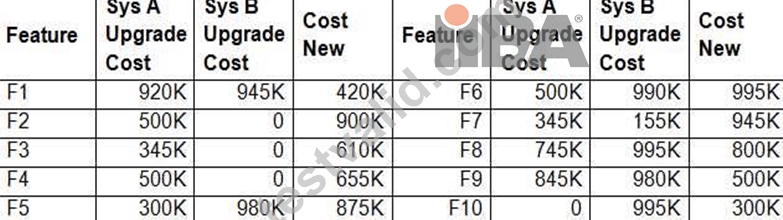
During elicitation the BA must understand the non-functional requirements. What non-functional requirements does System B support over System A?
- A. Usability
- B. Compatibility
- C. Scalability
- D. Compliance
Answer: A
NEW QUESTION # 178
A company that specialized in manufacturing vending machines for books has been in business for 10 years.
As the e-book and online retailing grow, the company perceived that a change is required to respond to the new emerging market forces. However, the change should focus on reusability as much as possible to reduce expenses. After analyzing the current state with the business subject matter experts, the business analyst (BA) proposed investing in a new business line of vending machines that sell pay per use mobile device phone fast charging stations.
Due to the urgency of this change, the BA was asked to finalize requirements elicitation in the shortest possible time.
The BA was able to complete requirements elicitation activities in a short period of time. Which type of elicitation approach did the BA use?
- A. Collaborative
- B. Experiment
- C. Estimation
- D. Research
Answer: B
NEW QUESTION # 179
Before the start of a large, cross functional change effort the team of Business analysts (BAs) assigned decided they need something to help them ensure requirements collectively support one another and do not conflict. What option would provide the consistency they are looking for?
- A. Process modeling
- B. plate Architecture
- C. Functional decomposition
- D. Checklist
Answer: A
NEW QUESTION # 180
An organization is trying to streamline its current processes to improve performance and reduce costs. A business analyst (BA) conducted a process improvement workshop and identified the following issues as the top three items to be addressed:
1. There are multiple teams to define systems, functionality, and content. In many instances multiple teams are defining the same functionalities while other functionalities are not being defined at all, leading to unclear understanding of business requirements.
2. Product specification forms are published each year. A comparison tool is used to evaluate specification between yearly releases, but does not adequately identify changes between versions and needs to be improved.
3. Training consists of a new team member shadowing a seasoned team member. There are not written training materials for formal training sources therefore training is inconsistent and not meeting the needs of the organization.
What approach would help the BA to understand the functionality definition issues?
- A. Business Analysis Performance Assessment
- B. Business Analysis Communication Plan
- C. Requirements Traceability Repository
- D. Risk Register
Answer: A
NEW QUESTION # 181
You are the business analyst for the NGQ Company. Management is concerned that their company is not able to meet an identified business need with their current existing structure, people, processes and technology.
They've asked you to complete an analysis of their organization's ability to meet the identified business need.
What business analysis process are you completing for your organization?
- A. Assessing the capability gaps
- B. Verifying the requirements
- C. Requirements elicitation
- D. Determining the solution approach
Answer: A
Explanation:
Section: Volume A
Explanation/Reference:
NEW QUESTION # 182
In a requirements elicitation effort, the business analyst (BA) needs to define boundaries for business domains, categorize and create a hierarchy of items, and show data sources and their relationships for specific audiences.
Which of the following modeling formats should the BA use?
- A. Diagrams
- B. Graphics
- C. Matrices
- D. Prototype
Answer: A
Explanation:
Diagrams are visual representations of information that can be used to define boundaries for business domains, categorize and create a hierarchy of items, and show data sources and their relationships for specific audiences. Diagrams can include various types of models, such as context diagrams, class diagrams, data flow diagrams, entity relationship diagrams, use case diagrams, and swimlane diagrams. Diagrams can help the BA to communicate complex information in a clear and concise way, and to elicit, analyze, and validate requirements with stakeholders. References: CBAP Handbook, CBAP Study Guide, BABOK Guide
NEW QUESTION # 183
The table illustrate the statement of cash flower for a courier company for the last fiscal year:
Due to aggressive market competition the management of the company performed a strategy review and based on their0-findings and the current market conditions, they came up with strategic and tactical changes in order to keep a competitive market position.
In order to strength customer retention strategies through a new competitive advantage, the company is considering implementing a live parcel tracking system. The added value will be that the customers may determine the exact location on of the parcel whether it is in a warehouse, crossing the ocean through an overseas the exact location of th parcel whether it is in a warehouse, crossing the ocean through an overseas the ship, or travelling in a delivery truck at any time. The system tracks the location of the parcel by tracking the vehicle in which it is contained. However, for a group of old delivery trucks, it was noticed that the engine sound and vibration disturbed the tracking signal and caused of management would like to sell these vehicles and replace them with newer ones, the Chief Financial Officer (CFO) was strongly against that approach. The CFO argoad that instead of hanging tracking devices on the trucks body they can have the truck drivers manually send the truck send the truck location from a hand held mobile device every 20 minutes.
The CFO's resistance to replacing the older vehicles represents which type of cost?
- A. Sunk
- B. Opportunity
- C. Maintenance
- D. Operating
Answer: D
NEW QUESTION # 184
A business analyst (BA) has been writing requirements for a project that has several stakeholders with varying levels of product expertise.
What must the BA take into consideration to meet stakeholder perspectives?
- A. The format of the requirements
- B. The competency of individual stakeholders
- C. The types of diagrams produced
- D. The level of decomposition needed
Answer: D
NEW QUESTION # 185
You are the business analyst for your organization. You are preparing the business needs documentation for a new solution to an identified problem. Parts of your input for this process are the business goals and objectives set by your organization. What approach can you use to assess the business goal and their validity and longevity?
- A. POLDAT
- B. SMART
- C. Functional decomposition
- D. Root cause analysis
Answer: B
Explanation:
Section: Volume A
Explanation:
NEW QUESTION # 186
Which of the following is mandatory in most software development projects?
- A. Communication Management plan
- B. Test plan
- C. Disaster recovery plan
- D. Procurement plan
Answer: B
Explanation:
Explanation/Reference:
NEW QUESTION # 187
Which of the following requirement attributes lacks any ambiguous characteristics?
- A. Understandable
- B. Unambiguous
- C. Urgency
- D. User Requirements Document (URD)
Answer: A
Explanation:
Section: Volume C
Explanation/Reference:
NEW QUESTION # 188
Which of the following reports is generated whenever the project is slipping off the project schedule and includes an explanation of the problem?
- A. Cost variance report
- B. Schedule variance report
- C. Status report
- D. Delay report
Answer: B
NEW QUESTION # 189
You are the business analyst for your organization and are preparing for the conduct elicitation activity. You'll need several stakeholders' roles as you prepare for this activity in your organization.
Which one of the following stakeholders may be responsible to dictate that a specific process or technique be followed during your requirements elicitation activities?
- A. Regulator
- B. Project sponsor
- C. Project manager
- D. Functional management
Answer: A
NEW QUESTION # 190
Mary is the business analyst for your organization. She asks you what the purpose of the assess capability gaps task is.
Which of the following is the best response to give Mary?
- A. It identifies new capabilities required by the organization to meet the business need.
- B. It identifies the causal factors that are contributing to an effect the solution will solve.
- C. It identifies the skill gaps in the existing resources.
- D. It describes the ends that the organization wants to improve.
Answer: A
Explanation:
Explanation
Assessing capability gaps is a task of enterprise analysis that involves analyzing the current state of the organization and comparing it with the desired future state. The purpose of this task is to identify the new capabilities that the organization needs to acquire or enhance in order to meet the business need and achieve the organizational goals and objectives. These new capabilities can be related to processes, systems, people, or resources. Assessing capability gaps can help to determine the scope and feasibility of the solution, as well as the risks and benefits associated with it. References: BABOK Guide v3, page 25; CBAP / CCBA Certified Business Analysis Study Guide, page 69.
NEW QUESTION # 191
Ben is the business analyst for his organization. Ben is currently working on a solution to improve a laser printer. He has taken the laser printer apart, identified each component, and documented each component's purpose.
What type of requirements organization is Ben doing in this scenario?
- A. Data modeling
- B. Scope modeling
- C. Process modeling
- D. Functional decomposition
Answer: D
Explanation:
Explanation
Functional decomposition is a technique that breaks down a complex system or process into smaller and simpler parts, each with a specific function or purpose. By doing so, it helps to understand the structure, behavior, and functionality of the system or process, and to identify the requirements for each part. In this scenario, Ben is doing functional decomposition by taking the laser printer apart and documenting the purpose of each component. This can help him to improve the performance, quality, or efficiency of the laser printer by analyzing and optimizing each component's function. References:
[A Guide to the Business Analysis Body of Knowledge (BABOK Guide)], version 3, page 402, section
10.31.2.11
[CBAP Certification Study Guide v3.0], Chapter 6: Requirements Analysis and Design Definition, Section 6.3: Organize Requirements, page 2502 Project Management: Different Types of Requirement - Visual Paradigm, paragraph 4
NEW QUESTION # 192
As a program manager, you decided to overlap two phases of your program. Which of the following terms best describe your act?
- A. Fast tracking
- B. Rolling
- C. Lead time
- D. Crashing
Answer: A
NEW QUESTION # 193
Jenni is the business analyst for the UHQ Organization. She is preparing to complete the conduct elicitation activity for her organization. Jenni can use all of the following techniques as part of this activity except for which one?
- A. Document analysis
- B. Interviews
- C. Problem tracking
- D. Requirements workshops
Answer: C
Explanation:
Section: Volume B
Explanation/Reference:
NEW QUESTION # 194
Which of the following is the comparison of planned project results with actual project results?
- A. Statistical Sampling
- B. Cost-benefit analysis
- C. Variance analysis
- D. Trend analysis
Answer: C
Explanation:
Explanation
Variance analysis is the process of comparing the planned project results with the actual project results and identifying the causes and impacts of any deviations. Variance analysis helps project managers to monitor and control the project performance, identify and mitigate risks, and implement corrective actions or changes if needed. Variance analysis can be applied to various aspects of the project, such as scope, schedule, cost, quality, and resources. References:
A Guide to the Project Management Body of Knowledge (PMBOK Guide) - Sixth Edition, Chapter
4.5.3, p. 123
Planned vs. Actual Progress Explained - SmartPM
NEW QUESTION # 195
Which of the following processes measures the maturity level of the security program?
- A. Risk analysis
- B. Risk assessment
- C. GAP analysis
- D. Risk mitigation
Answer: C
Explanation:
Section: Volume C
Explanation/Reference:
NEW QUESTION # 196
When do change requests generally increase in a project?
- A. Towards the end of the project.
- B. Towards the beginning of the project.
- C. During the project's launch.
- D. During the project scope management processes.
Answer: B
Explanation:
Change requests are more likely to occur in the early stages of a project, when the requirements are being elicited, analyzed, and validated. During this time, stakeholders may discover new needs, identify gaps, or revise their expectations. Change requests may also arise due to changes in the business environment, such as new regulations, market trends, or competitor actions. Change requests are less frequent in the later stages of a project, when the requirements are more stable and the solution is being designed, developed, and tested.
References:
* A Guide to the Business Analysis Body of Knowledge (BABOK Guide), Version 3, Chapter 4:
Requirements Life Cycle Management, Section 4.5: Manage Changes1
* CBAP Certification Study Guide v3.0, Chapter 4: Requirements Life Cycle Management, Section 4.5:
Manage Changes2
NEW QUESTION # 197
......
The CBAP certification exam is a four-hour, computer-based exam, consisting of 120 multiple-choice questions. CBAP exam is designed to test the candidate's knowledge, skills, and abilities in business analysis. Candidates must score a minimum of 70% to pass the exam.
CBAP Exam Questions – Valid CBAP Dumps Pdf: https://lead2pass.testvalid.com/CBAP-valid-exam-test.html