

Based on Official Syllabus Topics of Actual SAP C_ABAPD_2309 Exam
Free C_ABAPD_2309 Dumps are Available for Instant Access
SAP C_ABAPD_2309 Exam Syllabus Topics:
| Topic | Details |
|---|---|
| Topic 1 |
|
| Topic 2 |
|
| Topic 3 |
|
NEW QUESTION # 26
Class super has subclass sub. Which rules are valid for the sub constructor? Note: There are 2 correct answers to this question.
- A. Import parameters can only be evaluated after calling the constructor of super.
- B. The method signature can be changed.
- C. Events of your own instance cannot be raised before the registration of a handler in super.
- D. The constructor of super must be called before using any components of your own instance.
Answer: B,D
Explanation:
The sub constructor is the instance constructor of the subclass sub that inherits from the superclass super. The sub constructor has some rules that it must follow when it is defined and implemented12. Some of the valid rules are:
* The method signature can be changed: This is true. The sub constructor can have a different method signature than the super constructor, which means that it can have different input parameters, output parameters, or exceptions. However, the sub constructor must still call the super constructor with appropriate actual parameters that match its interface12.
* The constructor of super must be called before using any components of your own instance: This is true.
The sub constructor must ensure that the super constructor is called explicitly using super->constructor before accessing any instance components of its own class, such as attributes or methods. This is because the super constructor initializes the inherited components of the subclass and sets the self-reference me-> to the current instance12.
You cannot do any of the following:
* Import parameters can only be evaluated after calling the constructor of super: This is false. The sub constructor can evaluate its own import parameters before calling the constructor of super, as long as it does not access any instance components of its own class. For example, the sub constructor can use its import parameters to calculate some values or check some conditions that are needed for calling the super constructor12.
* Events of your own instance cannot be raised before the registration of a handler in super: This is false.
* The sub constructor can raise events of its own instance before calling the constructor of super, as long as it does not access any instance components of its own class. For example, the sub constructor can raise an event to notify the consumers of the subclass about some status or error that occurred during the initialization of the subclass12.
References: 1: Inheritance and Constructors - ABAP Keyword Documentation - SAP Online Help 2: Using Static and Instance constructor methods | SAP Blogs
NEW QUESTION # 27
Which of the following integration frameworks have been released for ABAP cloud development? Note:
There are 3 correct answers to this question.
- A. Business Add-ins (BAdls)
- B. Business Events
- C. OData services
- D. SOAP consumption
- E. CDS Views
Answer: B,C,D
Explanation:
Explanation
The following are the integration frameworks that have been released for ABAP cloud development:
SOAP consumption: This framework allows you to consume SOAP web services from ABAP cloud applications. You can use the ABAP Development Tools in Eclipse to create a service consumption model based on a WSDL file or URL. The service consumption model generates the required ABAP artifacts, such as proxy classes, data types, and constants, to access the web service. You can then use the proxy classes to call the web service operations from your ABAP code1 Business Events: This framework allows you to publish and subscribe to business events from ABAP cloud applications. Business events are messages that represent a change in the state of a business object or process. You can use the ABAP Development Tools in Eclipse to create a business event definition based on a CDS view entity or a projection view. The business event definition specifies the event key, the event payload, and the event metadata. You can then use the ABAP Messaging Channel (AMC) framework to publish and subscribe to business events using the AMC API2 OData services: This framework allows you to expose and consume OData services from ABAP cloud applications. OData is a standardized protocol for creating and consuming RESTful APIs. You can use the ABAP RESTful Application Programming Model (RAP) to create OData services based on CDS view entities or projection views. The RAP framework generates the required OData metadata and runtime artifacts, such as service definitions, service bindings, and service implementations. You can then use the SAP Gateway framework to register and activate your OData services. You can also use the ABAP Development Tools in Eclipse to consume OData services from other sources using the service consumption model3 The other integration frameworks are not released for ABAP cloud development, as they are either not supported or not recommended for cloud scenarios. These frameworks are:
CDS Views: CDS views are not an integration framework, but a data modeling framework. CDS views are used to define data models based on database tables or other CDS view entities. CDS views can have associations, aggregations, filters, parameters, and annotations. CDS views can also be used as the basis for other integration frameworks, such as OData services or business events4 Business Add-ins (BAdls): BAdls are not supported for ABAP cloud development, as they are part of the classic ABAP enhancement framework. BAdls are used to implement custom logic in predefined enhancement spots in the standard SAP code. BAdls are not compatible with the cloud strategy and the clean core paradigm, as they modify the SAP code and can cause upgrade and maintenance issues. For ABAP cloud development, SAP recommends using the key user extensibility tools or the side-by-side extensibility approach instead of BAdls.
References: Consuming SOAP Services - ABAP Keyword Documentation, Business Events - ABAP Keyword Documentation, OData Services - ABAP Keyword Documentation, CDS Data Model Views - ABAP Keyword Documentation, [Business Add-Ins (BAdIs) - ABAP Keyword Documentation]
NEW QUESTION # 28
/DMO/I_Connection is a CDS view.
What variable type is connection full based on the following code? DATA connection full TYPE
/DMD/I_Connection.
- A. Structure
- B. Internal Table
- C. Simple variable
Answer: A
NEW QUESTION # 29
In an Access Control Object, which clauses are used? Note: There are 3 correct answers to this question.
- A. Crant (to identify the data source)
- B. Define role (to specify the role name)
- C. Where (to specify the access conditions)
- D. Revoke (to remove access to the data source)
- E. Return code (to assign the return code of the authority check)
Answer: B,C,D
Explanation:
Explanation
An Access Control Object (ACO) is a CDS annotation that defines the access control rules for a CDS view entity. An ACO consists of one or more clauses that specify the role name, the data source, the access conditions, and the return code of the authority check12. Some of the clauses that are used in an ACO are:
Where (to specify the access conditions): This clause is used to define the logical expression that determines whether a user has access to the data source or not. The expression can use the fields of the data source, the parameters of the CDS view entity, or the predefined variables $user and $session. The expression can also use the functions check_authorization and check_role to perform additional authority checks12.
Define role (to specify the role name): This clause is used to assign a name to the role that is defined by the ACO. The role name must be unique within the namespace of the CDS view entity and must not contain any special characters. The role name can be used to reference the ACO in other annotations, such as @AccessControl.authorizationCheck or @AccessControl.grant12.
Revoke (to remove access to the data source): This clause is used to explicitly deny access to the data source for a user who meets the conditions of the where clause. The revoke clause overrides any grant clause that might grant access to the same user. The revoke clause can be used to implement the principle of least privilege or to enforce data segregation12.
You cannot do any of the following:
Grant (to identify the data source): This is not a valid clause in an ACO. The grant clause is a separate annotation that is used to grant access to a CDS view entity or a data source for a user who has a specific role. The grant clause can reference an ACO by its role name to apply the access conditions defined by the ACO12.
Return code (to assign the return code of the authority check): This is not a valid clause in an ACO. The return code of the authority check is a predefined variable that is set by the system after performing the access control check. The return code can be used in the where clause of the ACO to specify different access conditions based on the outcome of the check12.
References: 1: Access Control Objects - ABAP Keyword Documentation - SAP Online Help 2: Access Control in Core Data Services (CDS) | SAP Help Portal
NEW QUESTION # 30
In a subclass subl you want to redefine a component of a superclass superl. How do you achieve this? Note:
There are 2 correct answers to this question.
- A. You add the clause REDEFINITION to the component in subl.
- B. You implement the redefined component for a second time in superl.
- C. You implement the redefined component in subl.
- D. You add the clause REDEFINITION to the component in superl.
Answer: A,C
Explanation:
Explanation
To redefine a component of a superclass in a subclass, you need to do the following12:
You add the clause REDEFINITION to the component declaration in the subclass. This indicates that the component is inherited from the superclass and needs to be reimplemented in the subclass. The redefinition must happen in the same visibility section as the component declaration in the superclass.
For example, if the superclass has a public method m1, the subclass must also declare the redefined method m1 as public with the REDEFINITION clause.
You implement the redefined component in the subclass. This means that you provide the new logic or behavior for the component that is specific to the subclass. The redefined component in the subclass will override the original component in the superclass when the subclass object is used. For example, if the superclass has a method m1 that returns 'Hello', the subclass can redefine the method m1 to return 'Hi' instead.
You cannot do any of the following:
You implement the redefined component for a second time in the superclass. This is not possible, because the superclass already has an implementation for the component that is inherited by the subclass. The subclass is responsible for providing the new implementation for the redefined component, not the superclass.
You add the clause REDEFINITION to the component in the superclass. This is not necessary, because the superclass does not need to indicate that the component can be redefined by the subclass. The subclass is the one that needs to indicate that the component is redefined by adding the REDEFINITION clause to the component declaration in the subclass.
References: 1: METHODS - REDEFINITION - ABAP Keyword Documentation - SAP Online Help 2:
Redefining Methods - ABAP Keyword Documentation - SAP Online Help
NEW QUESTION # 31
For what kind of applications would you consider using on-stack developer extensions? Note: There are 2 correct answers to this question.
- A. Applications that run separate from SAP S/4HANA
- B. Applications that access SAP S/4HANA data using complex SQL
- C. Applications that integrate data from several different systems
- D. Applications that provide APIs for side by side SAP BTP apps
Answer: B,D
Explanation:
On-stack developer extensibility is a type of extensibility that allows you to create development projects directly on the SAP S/4HANA Cloud technology stack. It gives you the opportunity to develop cloud-ready and upgrade-stable custom ABAP applications and services inside the SAP S/4HANA Cloud, public edition system. You can use the ABAP Development Tools in Eclipse to create and deploy your on-stack extensions.
On-stack developer extensibility is suitable for the following kinds of applications:
* Applications that provide APIs for side by side SAP BTP apps. On-stack developer extensibility allows you to create OData services or RESTful APIs based on CDS view entities or projection views. These services or APIs can expose SAP S/4HANA data and logic to other applications that run on the SAP Business Technology Platform (SAP BTP) or other platforms. This way, you can create a loosely coupled integration between your SAP S/4HANA system and your side by side SAP BTP apps.
* Applications that access SAP S/4HANA data using complex SQL. On-stack developer extensibility allows you to use ABAP SQL to access SAP S/4HANA data using complex queries, such as joins, aggregations, filters, parameters, and code pushdown techniques. You can also use ABAP SQL to perform data manipulation operations, such as insert, update, delete, and upsert. This way, you can create applications that require advanced data processing and analysis on SAP S/4HANA data.
The other kinds of applications are not suitable for on-stack developer extensibility, as they have different requirements and challenges. These kinds of applications are:
* Applications that integrate data from several different systems. On-stack developer extensibility is not meant for creating applications that integrate data from multiple sources, such as other SAP systems, third-party systems, or cloud services. This is because on-stack developer extensibility does not support remote access or data replication, and it may cause performance or security issues. For this kind of applications, you should use side by side extensibility, which allows you to create applications that run on the SAP BTP and communicate with the SAP S/4HANA system via public APIs or events.
* Applications that run separate from SAP S/4HANA. On-stack developer extensibility is not meant for creating applications that run independently from the SAP S/4HANA system, such as standalone apps, microservices, or web apps. This is because on-stack developer extensibility requires a tight coupling with the SAP S/4HANA system, and it may limit the scalability, flexibility, and portability of the applications. For this kind of applications, you should use side by side extensibility, which allows you to create applications that run on the SAP BTP and leverage the cloud-native features and services of the platform.
References: Developer Extensibility in SAP S/4HANA Cloud ABAP Environment, SAP S/4HANA Extensibility - Simplified Guide for Beginners
NEW QUESTION # 32
/DMO/I_Connection is a CDS view.
What variable type is connection full based on the following code? DATA connection full TYPE
/DMD/I_Connection.
- A. Structure
- B. Internal Table
- C. Simple variable
Answer: A
Explanation:
Explanation
Based on the following code, the variable type of connection_full is a structure. A structure is a complex data type that consists of a group of related data objects, called components, that have their own data types and names. A structure can be defined using the TYPES statement or based on an existing structure type, such as a CDS view entity or a CDS DDIC-based view. In this case, the variable connection_full is declared using the TYPE addition, which means that it has the same structure type as the CDS view entity /DMO/I_Connection.
The CDS view entity /DMO/I_Connection is a data model view that defines a data model based on the database table /DMO/Connection. The CDS view entity /DMO/I_Connection has the following components:
carrid, connid, airpfrom, airpto, distance, and fltime. Therefore, the variable connection_full has the same components as the CDS view entity /DMO/I_Connection, and each component has the same data type and length as the corresponding field in the database table /DMO/Connection.
References: CDS Data Model Views - ABAP Keyword Documentation, DATA - ABAP Keyword Documentation, Structure Types - ABAP Keyword Documentation
NEW QUESTION # 33
What are the effects of this annotation? Note: There are 2 correct answers to this question.
- A. You can still override the default value with a value of your own.
- B. It is no longer possible to pass your own value to the parameter.
- C. The value of sy-langu will be passed to the CDS view automatically when you use the CDS view in ABAP but not when you use it in another view entity
- D. The value of sy-langu will be passed to the CDS view automatically both when you use the -1 CDS view in ABAP and in another CDS view entity (view on view).
Answer: A,D
Explanation:
Explanation
The annotation @Environment.systemField: #LANGUAGE is used to assign the ABAP system field sy-langu to an input parameter of a CDS view or a CDS table function. This enables the implicit parameter passing in Open SQL, which means that the value of sy-langu will be automatically passed to the CDS view without explicitly specifying it in the WHERE clause. This also applies to the CDS views that use the annotated CDS view as a data source, which means that the value of sy-langu will be propagated to the nested CDS views (view on view)12. For example:
The following code snippet defines a CDS view ZI_FLIGHT_TEXTS with an input parameter p_langu that is annotated with @Environment.systemField: #LANGUAGE:
define view ZI_FLIGHT_TEXTS with parameters p_langu : syst_langu @<Environment.systemField:
#LANGUAGE as select from sflight left outer join scarr on sflight.carrid = scarr.carrid left outer join stext on scarr.carrid = stext.carrid { sflight.carrid, sflight.connid, sflight.fldate, scarr.carrname, stext.text as carrtext } where stext.langu = :p_langu The following code snippet shows how to use the CDS view ZI_FLIGHT_TEXTS in ABAP without specifying the value of p_langu in the WHERE clause. The value of sy-langu will be automatically passed to the CDS view:
SELECT carrid, connid, fldate, carrname, carrtext FROM zi_flight_texts INTO TABLE @DATA(lt_flights).
The following code snippet shows how to use the CDS view ZI_FLIGHT_TEXTS in another CDS view ZI_FLIGHT_REPORT. The value of sy-langu will be automatically passed to the nested CDS view ZI_FLIGHT_TEXTS:
define view ZI_FLIGHT_REPORT with parameters p_langu : syst_langu @<Environment.systemField:
#LANGUAGE as select from zi_flight_texts(p_langu) { carrid, connid, fldate, carrname, carrtext, count(*) as flight_count } group by carrid, connid, fldate, carrname, carrtext The annotation @Environment.systemField: #LANGUAGE does not prevent the possibility of overriding the default value with a value of your own. You can still specify a different value for the input parameter p_langu in the WHERE clause, either in ABAP or in another CDS view. This will override the value of sy-langu and pass the specified value to the CDS view12. For example:
The following code snippet shows how to use the CDS view ZI_FLIGHT_TEXTS in ABAP with a specified value of p_langu in the WHERE clause. The value 'E' will be passed to the CDS view instead of the value of sy-langu:
SELECT carrid, connid, fldate, carrname, carrtext FROM zi_flight_texts WHERE p_langu = 'E' INTO TABLE @DATA(lt_flights).
The following code snippet shows how to use the CDS view ZI_FLIGHT_TEXTS in another CDS view ZI_FLIGHT_REPORT with a specified value of p_langu in the WHERE clause. The value 'E' will be passed to the nested CDS view ZI_FLIGHT_TEXTS instead of the value of sy-langu:
define view ZI_FLIGHT_REPORT with parameters p_langu : syst_langu @<Environment.systemField:
#LANGUAGE as select from zi_flight_texts(p_langu) { carrid, connid, fldate, carrname, carrtext, count(*) as flight_count } where p_langu = 'E' group by carrid, connid, fldate, carrname, carrtext References: 1: ABAP CDS - parameter_annot - ABAP Keyword Documentation - SAP Online Help 2: ABAP CDS - session_variable - ABAP Keyword Documentation - SAP Online Help
NEW QUESTION # 34 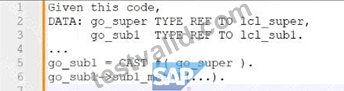
with which predicate condition can you ensure that the CAST will work?
- A. IS INSTANCE OF
- B. IS SUPPLIED
- C. IS NOT INITIAL
- D. IS BOUND
Answer: A
Explanation:
The predicate condition that can be used to ensure that the CAST will work is IS INSTANCE OF. The IS INSTANCE OF predicate condition checks whether the operand is an instance of the specified class or interface. This is useful when you want to perform a downcast, which is a conversion from a more general type to a more specific type. A downcast can fail if the operand is not an instance of the target type, and this can cause a runtime error. Therefore, you can use the IS INSTANCE OF predicate condition to check whether the downcast is possible before using the CAST operator12. For example:
* The following code snippet uses the IS INSTANCE OF predicate condition to check whether the variable g_super is an instance of the class lcl_super. If it is, the CAST will work and the variable g_sub1 will be assigned the value of g_super.
DATA: g_super TYPE REF TO lcl_super, g_sub1 TYPE REF TO lcl_sub1. IF g_super IS INSTANCE OF lcl_super. g_sub1 = CAST #( g_super ). g_sub1->method( ... ). ENDIF.
You cannot do any of the following:
* IS SUPPLIED: The IS SUPPLIED predicate condition checks whether an optional parameter of a method or a function module has been supplied by the caller. This is useful when you want to handle different cases depending on whether the parameter has a value or not. However, this predicate condition has nothing to do with the CAST operator or the type of the operand12.
* IS NOT INITIAL: The IS NOT INITIAL predicate condition checks whether the operand has a non-initial value. This is useful when you want to check whether the operand has been assigned a value
* or not. However, this predicate condition does not guarantee that the CAST will work, because the operand may have a value but not be an instance of the target type12.
* IS BOUND: The IS BOUND predicate condition checks whether the operand is a bound reference variable. This is useful when you want to check whether the operand points to an existing object or not. However, this predicate condition does not guarantee that the CAST will work, because the operand may point to an object but not be an instance of the target type12.
References: 1: Predicate Expressions - ABAP Keyword Documentation - SAP Online Help 2: ABAP - Predicates | SAP Community
NEW QUESTION # 35
Which restrictions exist for ABAP SQL arithmetic expressions? Note: There are 2 correct answers to this question.
- A. The operator is allowed only in floating point expressions.
- B. Floating point types and integer types can NOT be used in the same expression.
- C. Decimal types and integer types can NOT be used in the same expression.
- D. The operator/is allowed only in floating point expressions.
Answer: A,D
Explanation:
Explanation
ABAP SQL arithmetic expressions have different restrictions depending on the data type of the operands. The following are some of the restrictions:
Floating point types and integer types can be used in the same expression, as long as the integer types are cast to floating point types using the cast function. For example, CAST ( num1 AS FLTP ) / CAST ( num2 AS FLTP ) is a valid expression, where num1 and num2 are integer types.
The operator / is allowed only in floating point expressions, where both operands have the type FLTP or f. For example, num1 / num2 is a valid expression, where num1 and num2 are floating point types. If the operator / is used in an integer expression or a decimal expression, a syntax error occurs.
Decimal types and integer types can be used in the same expression, as long as the expression is a decimal expression. A decimal expression has at least one operand with the type DEC, CURR, or QUAN or p with decimal places. For example, num1 + num2 is a valid expression, where num1 is a decimal type and num2 is an integer type.
The operator ** is allowed only in floating point expressions, where both operands have the type FLTP or f. For example, num1 ** num2 is a valid expression, where num1 and num2 are floating point types.
If the operator ** is used in an integer expression or a decimal expression, a syntax error occurs.
References: sql_exp - sql_arith - ABAP Keyword Documentation, SQL Expressions, Arithmetic Calculations - ABAP Keyword Documentation
NEW QUESTION # 36
Why would you use Access Controls with CDS Views? Note: There are 2 correct answers to this question.
- A. Only the data corresponding to the user's authorization is transferred from the database to the application layer.
- B. You do not have to remember to implement AUTHORITY CHECK statements.
- C. All of the data from the data sources is loaded into your application automatically and filtered there according to the user's authorization.
- D. The system field sy-subrc is set, giving you the result of the authorization check
Answer: A,B
Explanation:
You would use Access Controls with CDS Views for the following reasons:
* A. Only the data corresponding to the user's authorization is transferred from the database to the application layer. This is true because Access Controls allow you to define CDS roles that specify the authorization conditions for accessing a CDS view. The CDS roles are evaluated for every user at runtime and the system automatically adds the restrictions to the selection conditions of the CDS view.
This ensures that only the data that the user is authorized to see is read from the database and transferred to the application layer. This improves the security and the performance of the data access1.
* C. You do not have to remember to implement AUTHORITY CHECK statements. This is true because Access Controls provide a declarative and centralized way of defining the authorization logic for a CDS
* view. You do not have to write any procedural code or use the AUTHORITY CHECK statement to check the user's authorization for each data source or field. The system handles the authorization check automatically and transparently for you2.
The following reasons are not valid for using Access Controls with CDS Views:
* B. The system field sy-subrc is set, giving you the result of the authorization check. This is false because the system field sy-subrc is not used by Access Controls. The sy-subrc field is used by the AUTHORITY CHECK statement to indicate the result of the authorization check, but Access Controls do not use this statement. Instead, Access Controls use CDS roles to filter the data according to the user's authorization2.
* D. All of the data from the data sources is loaded into your application automatically and filtered there according to the user's authorization. This is false because Access Controls do not load all the data from the data sources into the application layer. Access Controls filter the data at the database layer, where the data resides, and only transfer the data that the user is authorized to see to the application layer. This reduces the data transfer and the memory consumption of the application layer1.
References: 1: Access Controls | SAP Help Portal 2: ABAP CDS - Access Control - ABAP Keyword Documentation
NEW QUESTION # 37
when you attempt to activate the definition, what will be the response?
- A. Activation successful
- B. Activation error because the key fields of the union do not match
- C. Activation error because the field types of the union do not match
- D. Activation error because the field names of the union do not match
Answer: D
Explanation:
The response will be an activation error because the field names of the union do not match. This is because the field names of the union must match in order for the definition to be activated. The union operator combines the result sets of two or more queries into a single result set. The queries that are joined by the union operator must have the same number and type of fields, and the fields must have the same names1. In the given code, the field names of the union do not match, because the first query has the fields carrname, connid, cityfrom, and cityto, while the second query has the fields carrname, carrier_id, cityfrom, and cityto.
The field connid in the first query does not match the field carrier_id in the second query. Therefore, the definition cannot be activated.
References: 1: UNION - ABAP Keyword Documentation
NEW QUESTION # 38
What are some of the reasons that Core Data Services are preferable to the classical approach to data modeling? Note: There are 2 correct answers to this question.
- A. They implement code pushdown.
- B. They compute results on the application server.
- C. They avoid data transfer completely.
- D. They transfer computational results to the application server.
Answer: A,D
Explanation:
Explanation
Core Data Services (CDS) are preferable to the classical approach to data modeling for several reasons, but two of them are:
They implement code pushdown. Code pushdown is the principle of moving data-intensive logic from the application server to the database server, where the data resides. This reduces the data transfer between the application server and the database server, which improves the performance and scalability of the application. CDS enable code pushdown by allowing the definition of semantic data models and business logic in the database layer, using SQL and SQL-based expressions1.
They transfer computational results to the application server. CDS allow the application server to access the data and the logic defined in the database layer by using Open SQL statements. Open SQL is a standardized and simplified subset of SQL that can be used across different database platforms. Open SQL statements are translated into native SQL statements by the ABAP runtime environment and executed on the database server. The results of the computation are then transferred to the application server, where they can be further processed or displayed2.
References: 1: ABAP - Core Data Services (ABAP CDS) - ABAP Keyword Documentation 2: Open SQL - ABAP Keyword Documentation
NEW QUESTION # 39
When processing an internal table with the statement LOOP AT itab... ENDLOOP, what system variable contains the current row number?
- A. sy-linno
- B. sy-tabix
- C. sy-subrc
- D. sy-index
Answer: B
Explanation:
When processing an internal table with the statement LOOP AT itab... ENDLOOP, the system variable that contains the current row number is sy-tabix. The sy-tabix variable is a predefined field of the system structure sy that holds the index or the row number of the current line in an internal table loop. The sy-tabix variable is initialized with the value 1 for the first loop pass and is incremented by 1 for each subsequent loop pass. The sy-tabix variable can be used to access or modify the current line of the internal table using the index access12.
NEW QUESTION # 40
Which field is defined incorrectly?
- A. field2
- B. field1
- C. field3
- D. field4
Answer: D
Explanation:
The field4 is defined incorrectly in the ABAP code snippet. The reason is that the data type c (character) cannot have a decimal places specification. The decimal places specification is only valid for the data types p (packed number) and f (floating point number)1. Therefore, the field4 definition should either omit the decimal places specification or change the data type to p or f.
References: 1: Data Types and Data Objects - ABAP Keyword Documentation - SAP Online Help
NEW QUESTION # 41
Exhibit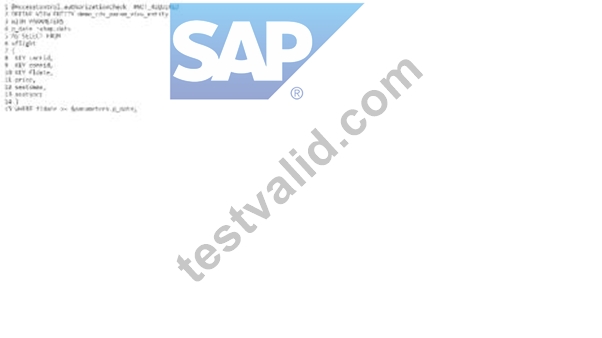
Which of the following ABAP SQL snippets are syntactically correct ways to provide a value for the parameter on line #4? Note: There are 2 correct answers to this question
- A. ...SELECT * FROM demo_cds_param_view entity (p_date: $session.system_date)...
- B. ...SELECT * FROM demo_cds_param_view_entity (p_date: 20238181')... )
- C. ...SELECT * FROM deno_cds_param_view_entity (p_date = @
(cl_abap_context_info->get_system_date ())... - D. ...SELECT * FROM deno_cds_param_view_entity (p_date - '20230101')... )
Answer: C,D
NEW QUESTION # 42
When processing a loop with the statement DO... ENDDO, what system variable contains the implicit loop counter?
- A. sy-index
- B. sy-labix
- C. sy-linno
- D. sy-subrc
Answer: A
Explanation:
Explanation
When processing a loop with the statement DO... ENDDO, the system variable that contains the implicit loop counter is sy-index. The loop counter is a numeric value that indicates how many times the loop has been executed. The loop counter is initialized to 1 before the first execution of the loop and is incremented by 1 after each execution. The loop counter can be used to control the number of loop iterations or to access the loop elements by index. The loop counter can also be accessed or modified within the loop body, but this is not recommended as it may cause unexpected results or errors1.
For example, the following code snippet uses the loop counter sy-index to display the numbers from 1 to 10:
DO 10 TIMES. WRITE: / sy-index. ENDDO.
The output of this code is:
1 2 3 4 5 6 7 8 9 10
References: 1: DO - ABAP Keyword Documentation
NEW QUESTION # 43
After you created a database table in the RESTful Application Programming model, what do you create next?
- A. A metadata extension
- B. A projection view
- C. A data model view
- D. A service definition
Answer: B
Explanation:
After you created a database table in the RESTful Application Programming model (RAP), the next step is to create a projection view on the database table. A projection view is a CDS artefact that defines a view on one or more data sources, such as tables, views, or associations. A projection view can select, rename, or aggregate the fields of the data sources, but it cannot change the properties of the fields, such as whether they are read-only or not. The properties of the fields are inherited from the data sources or the behaviour definitions of the business objects12. For example:
The following code snippet defines a projection view ZI_AGENCY on the database table /DMO/AGENCY:
define view ZI_AGENCY as select from /dmo/agency { key agency_id, agency_name, street, city, region, postal_code, country, phone_number, url } The projection view is used to expose the data of the database table to the service definition, which is the next step in the RAP. The service definition is a CDS artefact that defines the interface and the binding of a service. A service is a CDS entity that exposes the data and the functionality of one or more business objects as OData, InA, or SQL services. A service definition can specify the properties of the fields of a service, such as whether they are filterable, sortable, or aggregatable12. For example:
The following code snippet defines a service definition ZI_AGENCY_SRV that exposes the projection view ZI_AGENCY as an OData service:
define service ZI_AGENCY_SRV { expose ZI_AGENCY as Agency; }
You cannot do any of the following:
A) A metadata extension: A metadata extension is a CDS artefact that defines additional annotations for a CDS entity, such as a business object, a service, or a projection view. A metadata extension can specify the properties of the fields of a CDS entity for UI or analytical purposes, such as whether they are visible, editable, or hidden. However, a metadata extension is not the next step after creating a database table in the RAP, as it is not required to expose the data of the database table to the service definition. A metadata extension can be created later to customize the UI or analytical application that uses the service12.
C) A data model view: A data model view is a CDS artefact that defines a view on one or more data sources, such as tables, views, or associations. A data model view can select, rename, or aggregate the fields of the data sources, and it can also change the properties of the fields, such as whether they are read-only or not. The properties of the fields are defined by the annotations or the behaviour definitions of the data model view. A data model view is used to define the data model of a business object, which is a CDS entity that represents a business entity or concept, such as a customer, an order, or a product. However, a data model view is not the next step after creating a database table in the RAP, as it is not required to expose the data of the database table to the service definition. A data model view can be created later to define a business object that uses the database table as a data source12.
D) A service definition: A service definition is a CDS artefact that defines the interface and the binding of a service. A service is a CDS entity that exposes the data and the functionality of one or more business objects as OData, InA, or SQL services. A service definition can specify the properties of the fields of a service, such as whether they are filterable, sortable, or aggregatable. However, a service definition is not the next step after creating a database table in the RAP, as it requires a projection view or a data model view to expose the data of the database table. A service definition can be created after creating a projection view or a data model view on the database table12.
NEW QUESTION # 44
......
The Most In-Demand C_ABAPD_2309 Pass Guaranteed Quiz : https://lead2pass.testvalid.com/C_ABAPD_2309-valid-exam-test.html