

CCP Study Guide Brilliant CCP Exam Dumps PDF
View CCP Exam Question Dumps With Latest Demo
To qualify for the CCP, candidates must meet certain education and experience requirements, including a minimum of a bachelor's degree and four years of relevant work experience, or an equivalent combination of education and experience. Once eligible, candidates must pass a rigorous four-part exam, covering topics such as cost estimating, planning and scheduling, earned value management, and risk management. CCP exam is designed to assess practical knowledge and skills, and requires a combination of multiple-choice and written answers.
NEW QUESTION # 106
A major theme park is expanding the existing facility over a five-year period. The design phase will be completed one year after the contract is awarded. Major engineering drawings will be finalized two years after the design contract is awarded and construction will begin three years after the award of the design contract. New, unique ride technology will be used and an estimate will need to be developed to identify these costs that have no historical data.
After an individual's safety needs are met, what needs would the individual be motivated to fulfill next in Maslow's hierarchy of needs?
- A. Self-actualization
- B. Pay and compensation
- C. Knowledge
- D. Belonging needs
Answer: D
Explanation:
After an individual's safety needs are met, Maslow's hierarchy indicates the next needs to be fulfilled.
Maslow's Hierarchy of Needs:
Once safety needs are met, the next level in the hierarchy is Belongingness needs, which includes the need for social connections, relationships, and feeling part of a group.
NEW QUESTION # 107
An agricultural corporation that paid 53% in income tax wanted to build a grain elevator designed to last twenty-five (25) years at a cost of $80,000 with no salvage value. Annual income generated would be $22,500 and annual expenditures were to be $12,000.
Answer the question using a straight line depreciation and a 10% interest rate.
Which of the following interest rates disregards the effects of compounding periods that occur more frequent than annually?
- A. Minimum attractive rate of return
- B. Continuous compounding rate
- C. Nominal interest rate
- D. Simple interest rate
Answer: C
NEW QUESTION # 108
An American company plans to acquire a new press machine from a Dutch manufacturer under the following conditions. One question remaining to be answered is the expected amount of capital recovery when salvage is accounted for.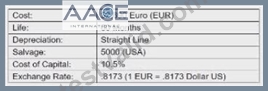
The following question requires your selection el Scenario 1.4.150 from the right side of your split screen. using the drop down menu to reference during your response/choice of responses.
Based on your analysis, should the press be purchased?
- A. Not enough data to determine
- B. CR is not a factor in this decision
- C. Yes
- D. No
Answer: C
Explanation:
Based on the capital recovery analysis and considering the salvage value and the cost of capital, if the calculated capital recovery value is favorable and meets the investment criteria, the correct conclusion is that the press should be purchased. Thus, the correct answer is D. Yes.
Top of Form
Bottom of Form
NEW QUESTION # 109
A major theme park is expanding the existing facility over a five-year period. The design phase will be completed one year after the contract is awarded. Major engineering drawings will be finalized two years after the design contract is awarded and construction will begin three years after the award of the design contract. New, unique ride technology will be used and an estimate will need to be developed to identify these costs that have no historical data.
When analyzing a precedence diagram schedule, the "backward pass"
- A. Calculates the earliest allowable start and finish times for the activities in the schedule
- B. Allows activities to finish as soon as all their 'predecessor' relationships are satisfied
- C. Allows total float to be calculated
- D. Determines the duration of each activity
Answer: C
Explanation:
In project scheduling, performing a backward pass through a precedence diagram allows the project manager to calculate the total float for each activity. The backward pass starts from the project's end date and works backward to determine the latest possible start and finish times for each activity without delaying the project. This calculation is essential for identifying critical path activities and understanding where there is flexibility in the schedule (i.e., float) for non-critical tasks.
Top of Form
Bottom of Form
NEW QUESTION # 110 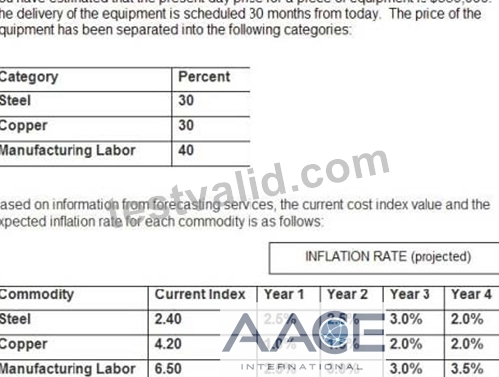
The following question requires your selection of CCC/CCE Scenario 6 (2.7.50.1.3) from the right side of your split screen., using the drop down menu, to reference during your response/choice of responses.
What is the range of unit costs?
- A. $48.22
- B. $26.65
- C. $485.00
- D. $21.57
Answer: C
NEW QUESTION # 111
A major theme park is expanding the existing facility over a five-year period. The design phase will be completed one year after the contract is awarded. Major engineering drawings will be finalized two years after the design contract is awarded and construction will begin three years after the award of the design contract. New, unique ride technology will be used and an estimate will need to be developed to identify these costs that have no historical data.
When analyzing a precedence diagram schedule, the "backward pass"
- A. Calculates the earliest allowable start and finish times for the activities in the schedule
- B. Allows activities to finish as soon as all their 'predecessor' relationships are satisfied
- C. Determines the duration of each activity
- D. Allows total float to be calculated
Answer: A
NEW QUESTION # 112
The following question requires your selection of CCC/CCE Scenario 6 (2.7.50.1.3) from the right side of your split screen, using the drop down menu, to reference during your response/choice of responses.
What is the relative frequency of unit costs from Atlanta, GA?
- A. 33.33%
- B. 0
- C. $40.59
- D. $48.33
Answer: B
Explanation:
You need to find the relative frequency of unit costs from Atlanta, GA.
Steps:
Identify the number of bids from Atlanta, GA:
8/31/05: 530 units at $55.00/unit
11/19/04: 308 units at $40.00/unit
1/26/05: 45 units at $26.78/unit
Total number of instances: 3
NEW QUESTION # 113
After collecting the control information on a light rail project within an original budget of 200.000work hours, the construction contractor is ready for their monthly progress meeting with the client.
A total of 100.000 work hours have boon scheduled to date. with 105.000 work hours earned, and 110.000 work hours paid. The stated progress by the contractor Is 60%.
What is the schedule variance (SV)?
- A. BCWP - BCWS = 105.000 - 100.000 =- 5,000
- B. ACWP - BCWS = 110.000 - 100,000 = 10,000
- C. BCWS -ACWP = 100.000 - 110,000 - -10,000
- D. BCWS - BCWP = 100.000 - 105,000 = -5,000
Answer: A
Explanation:
Schedule Variance (SV) is another EVM metric that measures the difference between the work performed and the work scheduled.
Key Points:
SV Formula:
SV = BCWP - BCWS
BCWP = 105,000 work hours
BCWS = 100,000 work hours
Calculation:
SV = 105,000 - 100,000 = 5,000 work hours
Interpretation:
A positive SV indicates that the project is ahead of schedule, as more work has been performed than was planned.
Conclusion: The correct answer is D. BCWP - BCWS = 105,000 - 100,000 = 5,000 because this calculation accurately reflects the schedule variance of the project.
NEW QUESTION # 114
You have recently been appointed as the Cost Engineer to oversee process improvement projects for a Discrete Part Manufacturer. You have been asked to calculate the CPI on a project initiated to implement a Value Stream Mapping Initiative. The accountant is only able to provide you with BAC and EAC figures of $ 5000 and 57500 respectively. The CPI is:
unable to be calculated from the information given
- A. <1
- B. =1
- C. =1
- D. >1
Answer: A
Explanation:
The Cost Performance Index (CPI) is calculated using the formula:
CPI = BAC / EAC
Given:
Budget at Completion (BAC) = $50,000
Estimate at Completion (EAC) = $57,500
CPI = $50,000 / $57,500 = 0.8696
Since CPI < 1, it indicates that the project is over budget. The correct answer is A. <1.
NEW QUESTION # 115
AACE International defines _____________as a technique of economic evaluation that sums over a given study period, the costs of initial investment, replacements, operations, and maintenance/repair; expressed in either present or annual value terms.
- A. Life cycle costs method (LCC)
- B. Risk analysis
- C. Benefit/Cost ratio (B/C) method
- D. Net present worth method
Answer: A
NEW QUESTION # 116
Money is value. Having money when you need it is very important. Money can also be valuable when used wisely by knowing when to spend and when to conserve Also, planning now for future expenses can be a plus to the company rather than a debit.
There are several ways to capitalize money and spending. Basically there is the single payment method that has a compound amount factor and a present worth factor. There is the uniform annual series that has a sinking fund factor, capital recovery factor and also the compound amount factor and present worth factor. At this point, we can assure money is worth 10%.
The following question requires your selection of CCC/CCE Scenario 7 (4.8.50.1.1) from the right side of your split screen, using the drop down menu, to reference during your response/choice of responses.
If $20,000 is invested at the end of each fiscal year for the next 10 years, how much would our total investment be worth assuming the interest is at 10%?
- A. $318,740
- B. $289,370
- C. $420,236
- D. $265,798
Answer: A
NEW QUESTION # 117
Which of the following is NOT an aspect of quality management?
- A. Quality assurance
- B. Quality checking
- C. Quality control
- D. Quality planning
Answer: B
NEW QUESTION # 118
_____________is defined as the budget for the cost (work) account times the percent complete for that account.
- A. Percent complete
- B. Forecast
- C. Cost to complete
- D. Earned value
Answer: D
Explanation:
Earned Value (EV) is a key concept in project management, particularly in cost management and performance measurement. It is defined as the budgeted amount for the work actually completed by a specific point in time. This is calculated as the budget for the cost (work) account multiplied by the percentage of completion for that account.
For example, if a work package has a total budget of $100,000 and is 50% complete, the earned value for that work package would be $50,000. EV is essential in performance measurement because it allows project managers to assess how much of the planned work has been completed at a certain cost, providing a clear indicator of project progress and efficiency.
NEW QUESTION # 119
The following question requires your selection of CCC/CCE Scenario 6 (2.7.50.1.3) from the right side of your split screen, using the drop down menu, to reference during your response/choice of responses.
Calculate the mean unit cost.
- A. $48.35
- B. $48.09
- C. $48.22
- D. $46.59
Answer: D
NEW QUESTION # 120
Listening to what is being said by all members of a group or audience and then summarizing or interpreting is called______________.
- A. Facilitative listening
- B. Visual listening
- C. Non-listening
- D. Directive listening
Answer: A
Explanation:
Facilitative listening is a form of listening where the listener not only pays attention to what each member of a group or audience is saying but also summarizes or interprets the information to facilitate understanding among the group. This type of listening is crucial in group settings, such as meetings or discussions, where it helps to ensure that all perspectives are considered and that the conversation remains productive and focused.
NEW QUESTION # 121
A major theme park is expanding the existing facility over a five-year period. The design phase will be completed one year after the contract is awarded. Major engineering drawings will be finalized two years after the design contract is awarded and construction will begin three years after the award of the design contract. New, unique ride technology will be used and an estimate will need to be developed to identify these costs that have no historical data.
Resource planning must take all of the following into account except:
- A. Time available to complete the project
- B. Earned value techniques established for the project
- C. Types of materials, equipment and labor skills required to complete the project
- D. Cash flow (expenditures) limitations for completing work on the project
Answer: B
Explanation:
Given Scenario:
Factors for resource planning are being considered.
Resource planning typically involves considering materials, labor, equipment, and time constraints. Earned Value Techniques are related to project performance measurement and control rather than direct resource planning.
Answer : D. Earned value techniques established for the project
NEW QUESTION # 122
The following question requires your selection of CCC/CCE Scenario 6 (2.7.50.1.3) from the right side of your split screen, using the drop down menu, to reference during your response/choice of responses.
What is the range of estimated quantities?
- A. $26.78 to $75.00
- B. $45 to $530
- C. $48.22
- D. $485
Answer: B
Explanation:
The range of estimated quantities is the difference between the largest and smallest quantities in the dataset.
Smallest Quantity = 45 Largest Quantity = 530
So, the range is from 45 to 530, making C. $45 to $530 the correct answer.
NEW QUESTION # 123
The following question requires your selection of CCC/CCE Scenario 6 (2.7.50.1.3) from the right side of your split screen, using the drop down menu, to reference during your response/choice of responses.
Calculate the mean unit cost.
- A. $48.35
- B. $48.09
- C. $46.59
- D. $48.22
Answer: D
Explanation:
To calculate the mean unit cost, you add up all the unit costs and divide by the number of data points.
Mean Unit Cost=Sum of All Unit CostsNumber of Data Points\text{Mean Unit Cost} = \frac{\text{Sum of All Unit Costs}}{\text{Number of Data Points}}Mean Unit Cost=Number of Data PointsSum of All Unit Costs Adding the unit costs:
55.00+34.50+37.30+55.00+40.00+26.78+46.59+75.00+65.00=434.1755.00 + 34.50 + 37.30 + 55.00 + 40.00 + 26.78 + 46.59 + 75.00 + 65.00 = 434.1755.00+34.50+37.30+55.00+40.00+26.78+46.59+75.00+65.00=434.17 Number of data points: 9 Mean Unit Cost=434.179≈48.24\text{Mean Unit Cost} = \frac{434.17}{9} \approx 48.24Mean Unit Cost=9434.17≈48.24 The closest match to the available options is B. $48.22.
NEW QUESTION # 124
A systematic coding structure for organizing and managing scope, assets, cost, resources, work and schedule activity information is a______________.
- A. Cost estimate classification
- B. Code of accounts
- C. Schedule identification number
- D. Cost breakdown structure
Answer: B
NEW QUESTION # 125
A used concrete pumping truck can be purchased for $125,000. The operation costs are expected to be $65,000 the first year and increase 5% each year thereafter. As a result of the purchase, the company will see an increase in income of $100,000 the first year and 5% more each subsequent year. The company uses straight-line depreciation. The truck will have a useful life of five (5) years and no salvage value. Management would like to see a 10% return on any investment. The company's tax rate is 28%.
Which numerical method of describing quantitative data is best suited in targeted marketing?
- A. Mean
- B. Mode
- C. Range
- D. Median
Answer: B
Explanation:
In targeted marketing, the mode is often the best measure of central tendency because it identifies the most frequently occurring value in a data set. This can be crucial in marketing to determine the most common preferences or behaviors among a target audience, such as the most popular product size, color, or price point. Therefore, the correct answer is B. Mode.
NEW QUESTION # 126
A major theme park is expanding the existing facility over a five-year period. The design phase will be completed one year after the contract is awarded. Major engineering drawings will be finalized two years after the design contract is awarded and construction will begin three years after the award of the design contract. New, unique ride technology will be used and an estimate will need to be developed to identify these costs that have no historical data.
Resource planning must take all of the following into account except:
- A. Time available to complete the project
- B. Earned value techniques established for the project
- C. Types of materials, equipment and labor skills required to complete the project
- D. Cash flow (expenditures) limitations for completing work on the project
Answer: B
NEW QUESTION # 127
____________ is defined as covering work whose component activities are less defined and whose interrelationships are conditional.
- A. Hard logic
- B. Soft logic
- C. Inductive logic
- D. Deductive logic
Answer: B
Explanation:
Soft logic refers to the sequencing of project activities that is flexible, based on discretionary decisions about the order of activities. It is used in situations where the component activities are less defined, and the relationships between these activities are conditional rather than strictly dictated by the project's physical constraints. This approach allows for flexibility in project scheduling, accommodating changes in the sequence of activities without significantly impacting the project's overall timeline.
For example, if certain tasks can be performed in parallel or in a different sequence without affecting the project outcome, soft logic would apply. This contrasts with hard logic, where activities must occur in a specific order due to the physical or technical constraints of the project.
NEW QUESTION # 128
After collecting the control information on a light rail project within an original budget of 200.000 work hours, the construction contractor is ready for their monthly progress meeting with the client.
A total of 100.000 work hours have boon scheduled to date. with 105.000 work hours earned, and 110.000 work hours paid. The stated progress by the contractor Is 60%.
What is a method for figuring estimate at completion (EAC)?
- A. ACWP + (BAC - BCWP)
- B. ACWP + (BAC - BCWS)
- C. BCWP + (BAG - ACWP)
- D. BCWS + (BAG -ACWP)
Answer: A
Explanation:
Estimate at Completion (EAC) is a forecasting tool in EVM that predicts the total cost of the project at completion based on current performance.
Key Points:
EAC Formula:
One common method to calculate EAC is:
EAC = ACWP + (BAC - BCWP)
Where:
ACWP is the Actual Cost of Work Performed,
BAC is the Budget at Completion,
BCWP is the Budgeted Cost of Work Performed.
This formula assumes that the remaining work will be performed at the budgeted rate (i.e., future work will follow the planned performance), and it adjusts the total estimate by adding the cost of the remaining work to the actual costs incurred so far.
Conclusion: The correct answer is D. ACWP + (BAC - BCWP) because this method provides a reliable estimate for the total project cost at completion, considering current performance.
NEW QUESTION # 129
The following question requires your selection of CCC/CCE Scenario 28 (3.7.50.1.7) from the right side of your split screen, using the drop down menu, to reference during your response/choice of responses.
Given a unit price contract between the owner and contractor, each assumes the following:
- A. Bid unit rate, owner quantities are within estimate range
- B. Bid unit rate, owner quantities can exceed estimate range Contractor can perform above
- C. Contractor can perform at or below bid unit rate, owner quantities are within estimate range
- D. Contractor can perform at or below bid unit rate, owner quantities can exceed estimate range
Answer: C
Explanation:
Given Scenario:
The scenario involves a unit price contract between the owner and the contractor.
A unit price contract stipulates that the owner will pay the contractor for the actual quantities used at the bid unit rates. Typically, the contractor agrees to perform at or below the bid unit rate, while the owner may account for the possibility that the quantities could exceed the estimated range. The scenario best fits with the concept that:
The contractor can perform at or below the bid unit rate.
The owner recognizes that quantities may vary but are expected to be within an estimated range.
NEW QUESTION # 130
......
The CCP certification examination has maintained its reputation over the years as a rigorous assessment of an individual's expertise, as it requires a minimum of 8 years of work experience in cost engineering, a bachelor's degree in any field plus 7 years of experience or an advanced degree plus 4 years of experience. After successfully completing the exams, you will join a network of professionals and contributors to the advancement of cost management in well-established organizations.
Free CCP Test Questions Real Practice Test Questions: https://lead2pass.testvalid.com/CCP-valid-exam-test.html