

Get Prepared for Your JN0-336 Exam With Actual 105 Questions
Valid JN0-336 Test Answers Full-length Practice Certification Exams
NEW QUESTION # 44
Your JIMS server is unable to view event logs.
Which two actions would you take to solve this issue? (Choose two.)
- A. Enable the correct host-inbound-traffic rules on the SRX Series devices.
- B. Enable remote event log management within Windows Firewall on the necessary Exchange servers.
- C. Enable remote event log management within Windows Firewall on the necessary domain controllers.
- D. Enable remote event log management within Windows Firewall on the JIMS server.
Answer: C,D
Explanation:
JIMS needs to access the event logs from domain controllers to function properly, as it relies on these logs to track user and device activity across the network. If the Windows Firewall on the domain controllers is blocking this access, enabling remote event log management will allow JIMS to retrieve the necessary information.
While it's less common, ensuring that any firewall settings on the JIMS server itself do not block outgoing requests or responses related to event log management is also crucial. This ensures that JIMS can send out requests and receive responses without any hindrance from its own firewall.
NEW QUESTION # 45
You want to manually failover the primary Routing Engine in an SRX Series high availability cluster pair.
Which step is necessary to accomplish this task?
- A. Manually request the failover and identify the secondary node
- B. Issue the set chassis cluster disable reboot command on the primary node.
- C. Implement the control link recover/ solution before adjusting the priorities.
- D. Adjust the priority in the configuration on the secondary node.
Answer: A
Explanation:
This step involves issuing a command to manually initiate a failover from the primary Routing Engine to the secondary. This can typically be done using a command like request chassis cluster failover redundancy-group <group-number> node <node-id>, where <group-number> is the redundancy group you are failing over, and <node-id> specifies the node to which you want to failover (usually the secondary node). This command forces the designated node to take over as primary for the specified redundancy group.
NEW QUESTION # 46
Which two statements about SRX Series device chassis clusters are true? (Choose two.)
- A. Redundancy group 0 is only active on the cluster backup node.
- B. Chassis cluster member devices must be the same model.
- C. Each chassis cluster member device can host active redundancy groups
- D. Each chassis cluster member requires a unique cluster ID value.
Answer: B,C
Explanation:
In a chassis cluster, both nodes can host active redundancy groups. The active redundancy groups can be distributed between the two nodes, depending on the configuration and failover status, allowing each node to handle traffic for different sets of services or interfaces.
For the chassis clustering to function correctly, both nodes in the cluster must be of the same model.
This requirement ensures that the hardware capabilities, such as processing power and interface compatibility, are identical, which is crucial for maintaining consistent performance and behavior between cluster nodes.
NEW QUESTION # 47
You have deployed an SRX300 Series device and determined that files have stopped being scanned.
In this scenario, what is a reason for this problem?
- A. The file is too small to have a virus.
- B. You have exceeded the maximum files submission for your SRX platform size.
- C. The infected host communicated with a command-and-control server, but it did not download malware.
- D. The software license is a free model and only scans executable type files.
Answer: B
Explanation:
You have exceeded the maximum files submission for your SRX platform size: This statement is correct because file scanning on SRX300 Series device has a limit on the number of files that can be submitted per minute based on the platform size3. For example, SRX320 has a limit of 10 files per minute3.
NEW QUESTION # 48
Which two statements are correct about the cSRX? (Choose two.)
- A. The cSRX supports firewall, NAT, IPS, and UTM services.
- B. The cSRX has three default zones: trust, untrust, and management
- C. The cSRX only supports Layer 2 "bump-in-the-wire" deployments.
- D. The cSRX supports BGP, OSPF. and IS-IS routing services.
Answer: A,B
Explanation:
The two statements that are correct about the cSRX are that it supports firewall, NAT, IPS, and UTM services, and that it has three default zones: trust, untrust, and management. The cSRX is a software- defined security solution that provides comprehensive network security capabilities and is designed for virtualized environments. It supports firewall, NAT, IPS, and UTM services to protect against threats, as well as BGP, OSPF, and IS-IS routing services for routing functionality. Additionally, the cSRX has three default zones: trust, untrust, and management. The trust zone is used to define traffic that is allowed to enter the network, the untrust zone is used to define traffic that should be blocked from entering the network, and the management zone is used to manage the device itself. The cSRX does not support Layer 2 "bump-in-the-wire" deployments.
NEW QUESTION # 49
You are experiencing excessive packet loss on one of your two WAN links route traffic from the degraded link to the working link Which AppSecure component would you use to accomplish this task?
- A. AppQoS
- B. AppFW
- C. APBR
- D. AppQoE
Answer: C
Explanation:
APBR (Application Path-Based Routing) is an AppSecure component which can be used to route traffic from the degraded link to the working link in order to reduce packet loss. APBR is a policy-based routing solution that allows you to configure rules to direct traffic to the most appropriate path, based on application, user, or network metrics.
NEW QUESTION # 50
Click the Exhibit button.
Which two statements describe the output shown in the exhibit? (Choose two.)
- A. Redundancy group 1 experienced an operational failure.
- B. Redundancy group 1 was administratively failed over.
- C. Node 0 is controlling traffic for redundancy group 1.
- D. Node 1 is controlling traffic for redundancy group 1.
Answer: C,D
Explanation:
The output indicates that node1 has a priority of 200 and is marked as "Primary," which means it is currently the active node controlling traffic for redundancy group 1. The "Primary" status designates that this node is handling the traffic for the specified redundancy group.
According to the exhibit, node0 is listed with a priority of 0 and is marked as "Secondary." This status indicates that node0 is currently not controlling traffic for redundancy group 1, serving instead in a standby role ready to take over should node1 fail or become unavailable.
NEW QUESTION # 51
Which two statements about SRX Series device chassis clusters are correct? (Choose two.)
- A. The chassis cluster can contain a maximum of two devices.
- B. The chassis cluster data plane is connected with SPC ports.
- C. The chassis cluster data plane is connected with revenue ports.
- D. The chassis cluster can contain a maximum of three devices.
Answer: A,C
Explanation:
Two statements that are correct about SRX Series device chassis clusters are:
The chassis cluster data plane is connected with revenue ports: A chassis cluster is a high-availability feature that groups two identical SRX Series devices into a cluster that acts as a single device. The cluster has two types of links: control links and fabric links. The control links are used for exchanging heartbeat messages and configuration synchronization between the nodes. The fabric links are used for forwarding data traffic between the nodes. The fabric links are connected with revenue ports, which are regular Ethernet interfaces that can also be used for normal traffic when not in cluster mode.
The chassis cluster can contain a maximum of two devices: A chassis cluster can only consist of two nodes: node 0 and node 1. The nodes must be the same model, have the same hardware configuration, run the same software version, and have the same license keys. The nodes share a common configuration and act as backup for each other in case of failure.
Reference: = Configuring Chassis Clustering on SRX Series Devices, SRX Series Chassis Cluster Configuration Overview, Connecting SRX Series Firewalls to Create a Chassis Cluster
NEW QUESTION # 52
You are preparing a proposal for a new customer who has submitted the following requirements for a vSRX deployment:
-- globally distributed,
-- rapid provisioning,
-- scale based on demand,
-- and low CapEx.
Which solution satisfies these requirements?
- A. AWS
- B. Network Director
- C. VMWare ESXi
- D. Juniper ATP Cloud
Answer: A
Explanation:
The solution that satisfies the requirements for a vSRX deployment is AWS. AWS (Amazon Web Services) is a cloud computing platform that provides on-demand services such as infrastructure, platform, software, and database as a service. AWS is globally distributed, meaning that it has data centers in multiple regions around the world. AWS also allows rapid provisioning, meaning that you can launch vSRX instances in minutes using preconfigured Amazon Machine Images (AMIs) or custom templates. AWS also enables scaling based on demand, meaning that you can adjust the number and size of vSRX instances according to your network traffic and performance needs. AWS also has low CapEx (capital expenditure), meaning that you only pay for what you use and do not need to invest in hardware or maintenance costs.
Reference: = vSRX Deployment Guide for AWS, Understand vSRX Virtual Firewall with AWS, What Is Amazon Web Services?
NEW QUESTION # 53
Click the Exhibit button.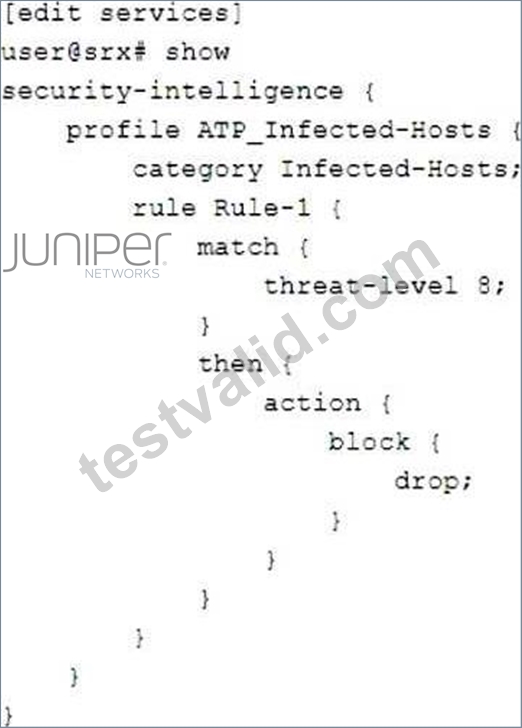
Referring to the exhibit, what will the SRX Series device do in this configuration?
- A. Packets from the infected hosts with a threat level of 8 or above will be dropped and no log message will be generated.
- B. Packets from the infected hosts with a threat level of 8 will be dropped and no log message will be generated.
- C. Packets from the infected hosts with a threat level of 8 will be dropped and a log message will be generated.
- D. Packets from the infected hosts with a threat level of 8 or above will be dropped and a log message will be generated.
Answer: A
Explanation:
The exhibit shows a configuration snippet for security intelligence on an SRX Series device. Security intelligence is a feature that allows you to block or monitor traffic from malicious sources based on threat intelligence feeds from Juniper ATP Cloud or other providers. The configuration defines a profile for ATP Infected-Hosts, which is a feed that contains IP addresses of hosts that are infected with malware and communicate with command-and-control servers. The configuration also defines a rule for threat level 8, which is a parameter that indicates the severity of the threat.
Based on this configuration, the SRX Series device will do the following:
Packets from the infected hosts with a threat level of 8 or above will be dropped: The action block-and- drop under the rule means that the device will block any traffic from the infected hosts that have a threat level equal to or higher than 8. This will prevent the hosts from sending or receiving malicious commands or data.
No log message will be generated: The absence of any log option under the rule means that the device will not generate any log message for the blocked traffic. This may reduce the load on the device and the logging server, but it may also limit the visibility and analysis of the security events. Reference: = Security Intelligence Theory, Firewall Filter Support on Loopback Interface
NEW QUESTION # 54
Regarding static attack object groups, which two statements are true? (Choose two.)
- A. Matching attack objects are automatically added to a custom group.
- B. Group membership does not automatically change when Juniper updates the IPS signature database.
- C. Group membership automatically changes when Juniper updates the IPS signature database.
- D. You must manually add matching attack objects to a custom group.
Answer: B,D
NEW QUESTION # 55
Which statement defines the function of an Application Layer Gateway (ALG)?
- A. The ALG uses software processes for managing specific protocols.
- B. The ALG uses software that is used by a single TCP session using the same port numbers as the application.
- C. The ALG contains protocols that use one application session for each TCP session.
- D. The ALG uses software processes for permitting or disallowing specific IP address ranges.
Answer: A
Explanation:
The statement that defines the function of an Application Layer Gateway (ALG) is: The ALG uses software processes for managing specific protocols. An ALG is a security component that operates at the application layer (layer 7) of the OSI model and handles data associated with certain application protocols, such as SIP, FTP, RTSP, etc. An ALG acts as a proxy or intermediary between the client and the server applications and performs various functions, such as address and port translation, resource allocation, application response control, and synchronization of data and control traffic. An ALG can also inspect and modify the application payload to enable firewall or NAT traversal, prevent spoofing or DoS attacks, or enforce granular security policies based on application-specific commands. Reference: = Application-level gateway - Wikipedia, What Is an Application Layer Gateway (ALG)? | F5, What is ALG
** Application Layer Gateway | 3CX
NEW QUESTION # 56
Which method does the loT Security feature use to identify traffic sourced from IoT devices?
- A. The SRX Series device identifies loT devices using their MAC address.
- B. The SRX Series device identifies loT devices from metadata extracted from their transit traffic.
- C. The SRX Series device streams metadata from the loT device transit traffic to Juniper ATP Cloud Juniper ATP Cloud.
- D. The SRX Series device streams transit traffic received from the IoT device to Juniper ATP Cloud.
Answer: B
Explanation:
The metadata is used to identify the type of device, its associated activities and its threat profile. This information is used to determine the appropriate security policy for the device. For more information on loT Security, please refer to the Juniper Security, Specialist (JNCIS-SEC) study guide.
NEW QUESTION # 57
Which three statements about SRX Series device chassis clusters are true? (Choose three.)
- A. Recovery from a control link failure requires that the secondary member device be rebooted.
- B. A control link failure causes the secondary cluster node to be disabled.
- C. Heartbeat messages verify that the chassis cluster control link is working.
- D. Chassis cluster control links must be configured using RFC 1918 IP addresses.
- E. Chassis cluster member devices synchronize configuration using the control link.
Answer: B,C,E
Explanation:
B: Chassis cluster member devices synchronize configuration using the control link: This statement is correct because the control link is used for configuration synchronization among other functions.
C: A control link failure causes the secondary cluster node to be disabled: This statement is correct because a control link failure causes the secondary node to become ineligible for primary role and remain in secondary role until the control link is restored.
E: Heartbeat messages verify that the chassis cluster control link is working: This statement is correct because heartbeat messages are sent periodically over the control link to monitor its status.
NEW QUESTION # 58
On an SRX Series firewall, what are two ways that Encrypted Traffic Insights assess the threat of the traffic? (Choose two.)
- A. It decrypts the data to validate the hash.
- B. It reviews the timing and frequency of the connections.
- C. It decrypts the file in a sandbox.
- D. It validates the certificates used.
Answer: B,D
Explanation:
Encrypted Traffic Insights is a feature that enables the SRX Series firewall and the ATP Cloud to detect malicious threats that are hidden in encrypted traffic without decrypting the traffic. It does so by analyzing the metadata and connection patterns of the encrypted sessions.
Two ways that Encrypted Traffic Insights assess the threat of the traffic are:
It validates the certificates used: The SRX Series firewall extracts the server certificate from the encrypted session and compares its signature with a blocklist of known malicious certificates provided by ATP Cloud. If there is a match, the session is blocked and reported as a threat.
It reviews the timing and frequency of the connections: The SRX Series firewall sends the connection details, such as source and destination IP addresses, ports, protocols, and timestamps, to ATP Cloud.
ATP Cloud applies behavior analysis and machine learning algorithms to detect anomalous or suspicious patterns of connections, such as high frequency, low duration, or unusual timing. Reference: = Juniper Networks Expands Connected Security Portfolio with Encrypted Traffic Analysis for Juniper Advanced Threat Prevention and SecIntel for Mist Wireless, Encrypted Traffic Insights Overview, Configure Encrypted Traffic Insights
NEW QUESTION # 59
Which two statements are true about the vSRX? (Choose two.)
- A. Linux is the base OS.
- B. UNIX is the base OS.
- C. It does not have VMXNET3 vNIC support.
- D. It has VMXNET3 vNIC support.
Answer: A,D
Explanation:
Reference: Juniper Networks Security, Specialist (JNCIS-SEC) Study Guide, Chapter 1: Introduction to Junos Security, page 1-8.
The vSRX is a virtual security appliance that runs on a virtual machine. It provides firewall, VPN, and other security services in a virtualized environment.
The vSRX is based on a version of Junos OS that is optimized for virtualization. It runs on a Linux kernel and uses a KVM hypervisor. It supports VMware ESXi and KVM hypervisors.
The vSRX has support for VMXNET3 vNICs, which are high-performance virtual network interfaces provided by VMware. These interfaces can provide higher throughput and lower CPU utilization than other virtual NIC types.
NEW QUESTION # 60
You are currenty using a third-party threat analyzer. You want your SRX Series device to send decrypted SSE traffic to......
In this scenario, which feature should you configure on the SRX device?
- A. SSL decryption mirroring
- B. JSA vulnerability assessment
- C. Phase 2 proxy ID
- D. IPS IPanotify action
Answer: B,D
NEW QUESTION # 61
......
Accurate & Verified 2026 New JN0-336 Answers As Experienced in the Actual Test!: https://lead2pass.testvalid.com/JN0-336-valid-exam-test.html