

HPE7-A01 100% Pass Guaranteed Download Aruba Certified Professional Exam PDF Q&A
HPE7-A01 Practice Test Dumps with 100% Passing Guarantee
HP HPE7-A01 certification exam is an important credential that validates the skills and knowledge of IT professionals in designing and implementing enterprise-level wireless LAN solutions. HPE7-A01 exam is intended for individuals who have experience in configuring and troubleshooting Aruba products and solutions in complex environments. Aruba Certified Campus Access Professional Exam certification is ideal for network professionals, wireless engineers, and system administrators who want to enhance their skills in wireless networking and become Aruba Certified Campus Access Professionals.
HP HPE7-A01 certification exam is an essential credential for IT professionals who specialize in enterprise-level wireless networks. Aruba Certified Campus Access Professional Exam certification, also known as the Aruba Certified Campus Access Professional, validates an individual's skills and knowledge in designing, implementing, and managing secure wireless networks in large organizations. The HPE7-A01 exam focuses on Aruba's wireless access solutions and is intended for IT professionals who work with Aruba products and technologies.
NEW QUESTION # 38
Match the terms below to their characteristics (Options may be used more than once or not at all.)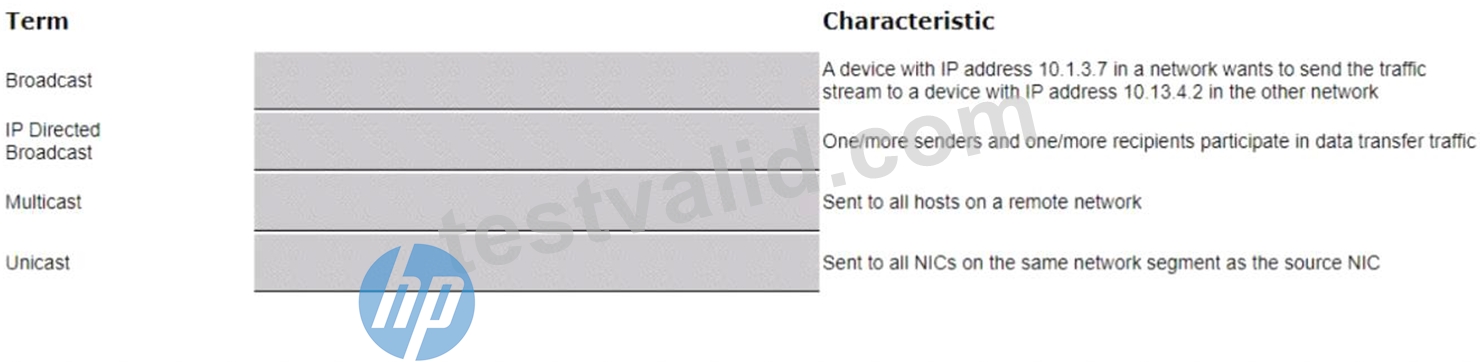
Answer:
Explanation: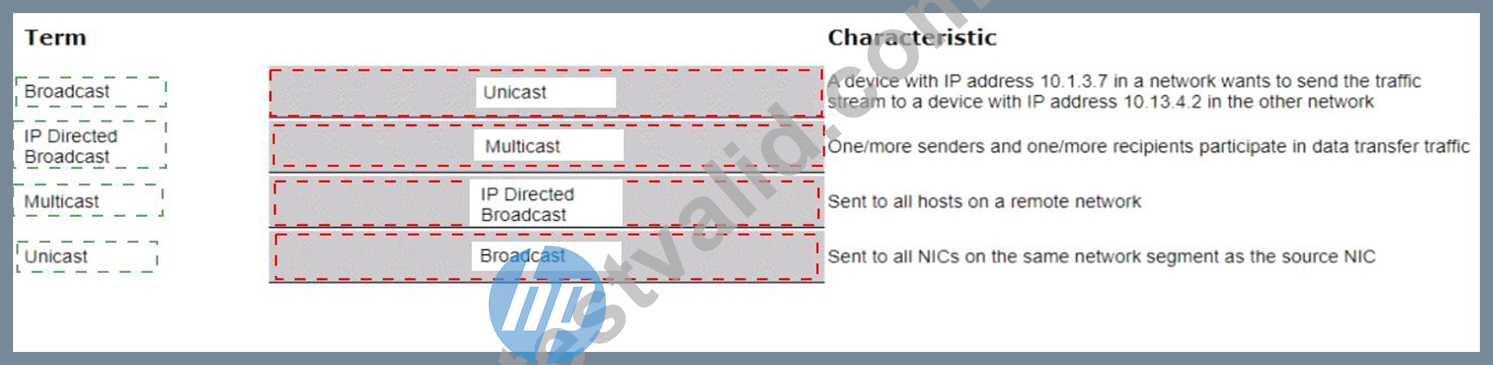
Explanation:
a) A device with IP address 10.1.3.7 in a network wants to send the traffic stream to a device with IP address
10.13.4.2 in the other network -> Unicast
b) One/more senders and one/more recipients participate in data transfer traffic -> Multicast c) Sent to all hosts on a remote network -> IP Directed Broadcast d) Sent to all NICs on the same network segment as the source NIC -> Broadcast References: 1 https://www.thestudygenius.com/unicast-broadcast-multicast/ The terms broadcast, IP directed broadcast, multicast, and unicast are different types of communication or data transmission over a network. They differ in how many devices are involved in the communication and how they address the messages. The following table summarizes the characteristics of each term1:
A screenshot of a computer Description automatically generated with medium confidence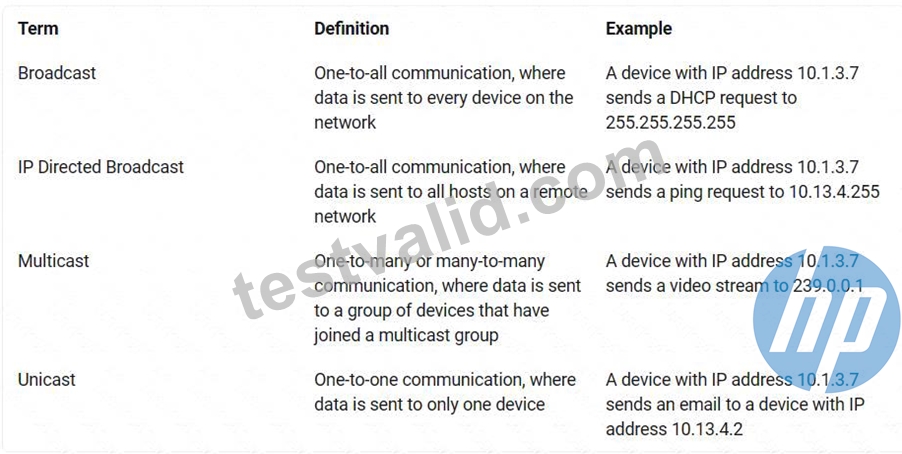
NEW QUESTION # 39
Your customer is interested in hearing more about how roles can help keep consistent policy enforcement in a distributed overlay fabric How would you explain this concept to them''
- A. Group Based Policy ID is applied on ingress VTEP after device authentication and policy is enforced on egress VTEP
- B. Role-based policies are tied to IP addresses which have an advantage over IP-based policies and role names are sent between VTEPs
- C. Group Based Policy ID is applied on egress VTEP after device authentication and policy is enforced on ingress VTEP
- D. Role-based policies enhance User Based Tunneling across the campus network and the policy traffic is protected with iPsec
Answer: A
Explanation:
This is the correct explanation of how roles can help keep consistent policy enforcement in a distributed overlay fabric. Roles are used to assign group based policy IDs (GBPs) to devices after they authenticate with ClearPass or a local database. GBPs are then used to tag the traffic from the devices and send them to the ingress VTEP, which applies the GBP on the VXLAN header. The egress VTEP then enforces the policy based on the GBP and the destination device. The other options are incorrect because they either do not describe the correct sequence of events or do not use the correct terms. Reference: https://www.arubanetworks.com/techdocs/AOS-CX/10.04/HTML/5200-6728/bk01-ch03.html https://www.arubanetworks.com/techdocs/AOS-CX/10.04/HTML/5200-6728/bk01-ch05.html
NEW QUESTION # 40
With the Aruba CX switch configuration, what is the first-hop protocol feature that is used for VSX L3 gateway as per Aruba recommendation?
- A. SVI with vsx-sync
- B. Active-Active VRRP
- C. VRRP
- D. Active Gateway
Answer: D
Explanation:
Active Gateway is the first-hop protocol feature that is used for VSX L3 gateway as per Aruba recommendation. Active Gateway is a feature that allows both VSX peers to act as active gateways for different subnets, eliminating the need for VRRP or other first-hop redundancy protocols. Active Gateway also provides fast failover and load balancing for L3 traffic across the VSX peers. The other options are incorrect because they are either not recommended or not supported by Aruba CX VSX. References:
https://www.arubanetworks.com/techdocs/AOS-CX/10.04/HTML/5200-6728/bk01-ch07.htmlhttps://www.aruba
NEW QUESTION # 41
What is the order of operations tor Key Management service for a wireless client roaming from AP1 to AP2?
Answer:
Explanation:
Explanation
https://www.arubanetworks.com/techdocs/Instant_85_WebHelp/Content/instant-ug/wlan-ssid-conf/conf-fast-roa
NEW QUESTION # 42
What steps are part of the Key Management workflow when a wireless device is roaming from AP1 to AP2?
(Select two.)
- A. The Key Management service receives from AirMatch a list of all AP2's neighbors
- B. AP1 will cache the client's information and send it to the Key Management service
- C. The Key Management service then generates R1 keys for AP2's neighbors.
- D. A client associates and authenticates with the AP2 after roaming from AP1
- E. The Key Management service receives a list of all AP1 s neighbors from AirMatch.
Answer: C,E
Explanation:
Explanation
Key Management is a service that runs on Aruba Mobility Controllers (MCs) or Mobility Master (MM) to optimize roaming performance for wireless clients. Key Management works with AirMatch, a service that optimizes radio resource management for Aruba APs, to pre-generate and distribute R1 keys for neighboring APs before a client roams. When a wireless device is roaming from AP1 to AP2, the following steps are part of the Key Management workflow3:
* The client associates and authenticates with AP1 using 802.1X or PSK methods.
* The Key Management service caches the client's information and generates an R0 key for the client.
* The Key Management service receives a list of all AP1's neighbors from AirMatch.
* The Key Management service then generates R1 keys for AP1's neighbors using the R0 key and sends them to the corresponding APs.
* When the client roams to AP2, one of AP1's neighbors, it performs an 802.11r fast transition using the pre-generated R1 key without needing to re-authenticate.
References: 3 https://www.arubanetworks.com/assets/tg/TB_KeyManagement.pdf
NEW QUESTION # 43
How do you allow a new VLAN 100 between VSX pair inter-switch-link 256 for port 1/45 and 2/45?
- A. vlan trunk allowed 100 for ports 1/45 and 1/46
- B. vlan trunk allowed 100 in LAG256
- C. vlan trunk add 100 in LAG256
- D. vlan trunk add 100 in MLAG256
Answer: B
Explanation:
To allow a new VLAN 100 between VSX pair inter-switch-link 256 for port 1/45 and 2/45, you need to use the command vlan trunk allowed 100 in LAG256. This will add VLAN 100 to the list of allowed VLANs on the trunk port LAG256, which is part of the inter-switch-link between VSX peers. The other options are incorrect because they either do not use the correct command or do not specify the correct port or VLAN. Reference: https://www.arubanetworks.com/techdocs/AOS-CX/10.04/HTML/5200-6728/bk01-ch07.html https://www.arubanetworks.com/techdocs/AOS-CX/10.04/HTML/5200-6728/bk01-ch02.html
NEW QUESTION # 44
Your customer has four (4) Aruba 7200 Series Gateways and two (2) 7000 Series Gateways. The customer wants to form a cluster with these Gateways. What design consideration would prevent you from using all of those Gateways?
- A. Multiple versions between Gateways in the same cluster profile are not allowed AOS 10.x.
- B. A combination of 7200 series and 7000 series gateways supports up to 4 nodes
- C. The AP load should be lowest value of worst-case scenario load.
- D. A heterogeneous cluster is not supported in AOS 10.x.
Answer: A
Explanation:
The reason is that AOS 10.x does not support clustering gateways with different versions in the same cluster profile. A cluster profile defines the configuration settings for a group of gateways that are managed by Aruba Central.
NEW QUESTION # 45
A new network design is being considered to minimize client latency in a high-density environment. The design needs to do this by eliminating contention overhead by dedicating subcarriers to clients.
Which technology is the best match for this use case?
- A. Channel Bonding
- B. MU-MIMO
- C. QWMM
- D. OFDMA
Answer: D
Explanation:
Explanation
OFDMA (Orthogonal Frequency Division Multiple Access) is a technology that can minimize client latency in a high-density environment by eliminating contention overhead by dedicating subcarriers to clients. OFDMA allows multiple clients to transmit simultaneously on different subcarriers within the same channel, reducing contention and increasing efficiency. MU-MIMO (Multi-User Multiple Input Multiple Output) is a technology that allows multiple clients to transmit simultaneously on different spatial streams within the same channel, but it does not eliminate contention overhead. QWMM (Quality of Service Wireless Multimedia) is a technology that prioritizes traffic based on four access categories, but it does not eliminate contention overhead. Channel Bonding is a technology that combines two adjacent channels into one wider channel, increasing bandwidth but not eliminating contention overhead. References:
https://www.arubanetworks.com/assets/ds/DS_AP510Series.pdf
https://www.arubanetworks.com/assets/wp/WP_WiFi6.pdf
NEW QUESTION # 46
What is enabled by LLDP-MED? (Select two.)
- A. Voice VLANs can be automatically configured for VoIP phones
- B. GVRP VLAN information can be used to dynamically add VLANs to a trunk
- C. iSCSl client devices can request to have flow control enabled
- D. iSCSl client devices can set the required MTU setting for the port.
- E. APs can request power as needed from PoE-enabled switch ports
Answer: A,E
Explanation:
These are two benefits enabled by LLDP-MED (Link Layer Discovery Protocol - Media Endpoint Discovery). LLDP-MED is an extension of LLDP that provides additional capabilities for network devices such as VoIP phones and APs. One of the capabilities is to automatically configure voice VLANs for VoIP phones, which allows them to be placed in a separate VLAN from data devices and receive QoS and security policies. Another capability is to request power as needed from PoE-enabled switch ports, which allows APs to adjust their power consumption and performance based on the available power budget. The other options are incorrect because they are either not enabled by LLDP-MED or not related to LLDP-MED. Reference: https://www.arubanetworks.com/techdocs/ArubaOS_86_Web_Help/Content/arubaos-solutions/wlan-qos/lldp-med.htm https://www.arubanetworks.com/techdocs/ArubaOS_86_Web_Help/Content/arubaos-solutions/wlan-rf/poe.htm
NEW QUESTION # 47
On AOS10 Gateways, which device persona is only available when configuring a Gateway-only group'?
- A. Mobility
- B. VPN Concentrator
- C. Branch
- D. Edge
Answer: B
Explanation:
Explanation
VPN Concentrator is the device persona that is only available when configuring a Gateway-only group on AOS10 Gateways. A device persona defines the role and functionality of a Gateway in a network. A Gateway-only group is a group that contains only Gateways and no APs. A VPN Concentrator persona enables a Gateway to terminate VPN tunnels from remote APs or clients and provide secure access to corporate resources. The other options are incorrect because they are either not device personas or not exclusive to Gateway-only groups. References:
https://www.arubanetworks.com/techdocs/ArubaOS_86_Web_Help/Content/arubaos-solutions/gateways/gatewa
https://www.arubanetworks.com/techdocs/ArubaOS_86_Web_Help/Content/arubaos-solutions/gateways/vpn-co
NEW QUESTION # 48
A company recently deployed new Aruba Access Points at different branch offices Wireless 802.1X authentication will be against a RADIUS server in the cloud. The security team is concerned that the traffic between the AP and the RADIUS server will be exposed.
What is the appropriate solution for this scenario?
- A. Configure RadSec on the AP and the RADIUS server
- B. Enable EAP-TLS on all wireless devices
- C. Configure RadSec on the AP and Aruba Central.
- D. Enable EAP-TTLS on all wireless devices.
Answer: A
Explanation:
Explanation
This is the appropriate solution for this scenario where wireless 802.1X authentication will be against a RADIUS server in the cloud and the security team is concerned that the traffic between the AP and the RADIUS server will be exposed. RadSec, also known as RADIUS over TLS, is a protocol that provides encryption and authentication for RADIUS traffic over TCP and TLS. RadSec can be configured on both the AP and the RADIUS server to establish a secure tunnel for exchanging RADIUS packets. The other options are incorrect because they either do not provide encryption or authentication for RADIUS traffic or do not involve RadSec. References: https://www.securew2.com/blog/what-is-radsec/
https://www.cloudradius.com/radsec-vs-radius/
NEW QUESTION # 49
Your customer has asked you to assign a switch management role for a new user. The customer requires the user role to View switch configuration information and have access to the PUT and POST meth0ds for REST API.
Which default AOS-CX user role meets these requirements?
- A. administrators
- B. sysops
- C. auditors
- D. helpdesk
Answer: B
Explanation:
The sysops user role is a predefined role that allows users to view switch configuration information and have access to the PUT and POST methods for REST API. The sysops user role can also use the PATCH and DELETE methods for REST API, but not for all resources. The sysops user role is suitable for users who need to perform system operations on the switch, such as backup, restore, upgrade, or reboot.
NEW QUESTION # 50
Due to a shipping error, five (5) Aruba AP-515S and one (1) Aruba CX 6300 were sent directly to your new branch office You have configured a new group persona for the new branch office devices in Central, but you do not know their MAC addresses or serial numbers The office manager is instructed via text message on their smartphone to onboard all the new hardware into Aruba Central What application must the office manager use on their phone to complete this task?
- A. Aruba Central App
- B. Aruba Onboard App
- C. Aruba CX Mobile App
- D. Aruba installer App
Answer: D
Explanation:
Explanation
Aruba Installer App is a mobile app that simplifies site installations and enables network connectivity for Aruba devices. The app allows the user to scan the barcode of the device and add it to the network using Aruba Central. The app also automates importing Aruba devices into Aruba NetEdit for intelligent configuration management and continuous conformance validation
NEW QUESTION # 51
With the Aruba CX 6100 48G switch with uplinks of 1/1/47 and 1/1/48. how do you automate the process of resuming the port operational state once a loop on a client port is cleared?
- A. Configure int 1/1/1-1/1/46 loop-protect re-enable-timer.
- B. Configure global loop-protect disable timer.
- C. Configure int 1/1/1-1/1/52 loop-protect disable timer.
- D. Configure global loop-protect re-enable-timer.
Answer: A
Explanation:
Loop protection is a feature that detects and prevents loops in layer 2 networks. Loop protection can be enabled on ports, LAGs, or VLANs. When loop protection is enabled, the switch sends periodic loop protection messages on the interface and expects to receive them back. If a loop protection message is received back on the same interface, it indicates a loop and the switch takes an action to disable the interface or block traffic on it3. The loop-protect re-enable-timer command is used to configure the length of time the switch waits before re-enabling an interface that was disabled due to loop detection. The default value is 0, which means that the interface remains disabled until manually re-enabled3. To automate the process of resuming the port operational state once a loop on a client port is cleared, the loop-protect re-enable-timer command can be used with a non-zero value on the interface range that includes the client ports3. Therefore, answer C is correct.
NEW QUESTION # 52
With the Aruba CX 6000 24G switch with uplinks of 1/1/25 and what does the switch do when a client port detects a loop and the do-not-disabie parameter is used?
- A. Port status will be validated once status is cleared
- B. An event log message is created.
- C. The network analytics engine is triggered.
- D. Port status led blinks in amber with 100hz.
Answer: B
Explanation:
The correct answer is B. An event log message is created.
The do-not-disable parameter is used to prevent the switch from disabling the port when a loop is detected by the loop-protect feature. Instead, the switch will generate an event log message that indicates the port number and the VLAN ID where the loop was detected. The switch will also send a trap to the SNMP manager, if configured1.
The other options are incorrect because:
A) Port status will not be validated once status is cleared. The port will remain enabled even if a loop is detected, unless the loop-protect action is changed to tx-disable or tx-rx-disable1.
C) The network analytics engine will not be triggered by a loop detection. The network analytics engine is a feature that allows users to monitor and troubleshoot network issues using scripts and agents2.
D) Port status LED will not blink in amber with 100Hz. The port status LED will indicate the normal port status, such as link speed and activity, regardless of the loop detection3.
NEW QUESTION # 53
Refer to the exhibit.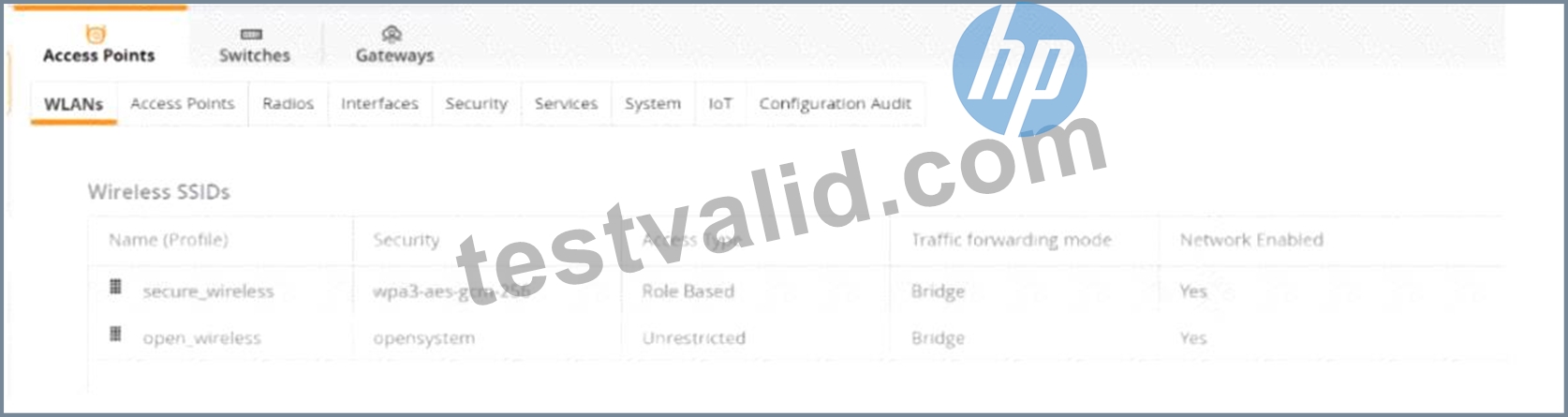
A company has deployed 200 AP-635 access points. To but is not working as expected What would be the correct action to fix the issue?
- A. Change the SSID to WPA3-Enhanced Open
- B. Change the SSID to WPA3-Enterprise (CCM).
- C. Change the SSID to WPA3-Personal
- D. Change the SSID to WPA3-Enterpnse (CNSA).
Answer: D
Explanation:
According to the Aruba Campus Access Professional documents1, WPA3-Enterprise is a security mode that supports 802.1X authentication and encryption with either AES-CCM or AES-GCMP. WPA3-Enterprise also optionally adds usage of Suite-B 192-bit minimum-level security suite that is aligned with Commercial National Security Algorithm (CNSA) for enterprise networks2. This mode provides the highest level of security and is suitable for government and financial institutions.
The exhibit shows that the SSID is configured with WPA3-Enterprise (CCM), which uses AES-CCM as the encryption protocol. However, this mode is not compatible with some devices that require CNSA compliance.
Therefore, changing the SSID to WPA3-Enterprise (CNSA) would fix the issue and allow all devices to connect to the network.
NEW QUESTION # 54
What is an Aruba-recommended best practice for hardening that only applies to Aruba CX 6300 series switches with dedicated management ports?
- A. Create a dedicated management VRF, and assign the management port to it.
- B. Disable all management services on the default VRF.
- C. Implement a control plane ACL to limit access to approved IPs and/or subnets
- D. Manually enable Enhanced Security Mode from a console session.
Answer: A
Explanation:
This is an Aruba-recommended best practice for hardening that only applies to Aruba CX 6300 series switches with dedicated management ports. A dedicated management port is a physical port that is used exclusively for out-of-band management access to the switch. A dedicated management VRF is a virtual routing and forwarding instance that isolates the management traffic from other traffic on the switch. By creating a dedicated management VRF and assigning the management port to it, the administrator can enhance the security and performance of the management access to the switch. The other options are incorrect because they either do not apply to switches with dedicated management ports or do not follow Aruba-recommended best practices.
NEW QUESTION # 55
List the WPA 4-Way Handshake functions in the correct order.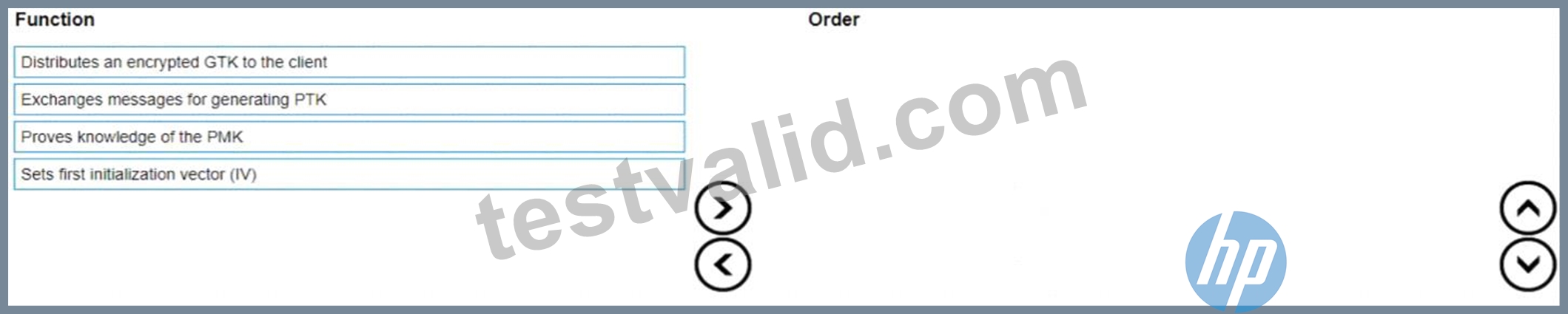
Answer:
Explanation: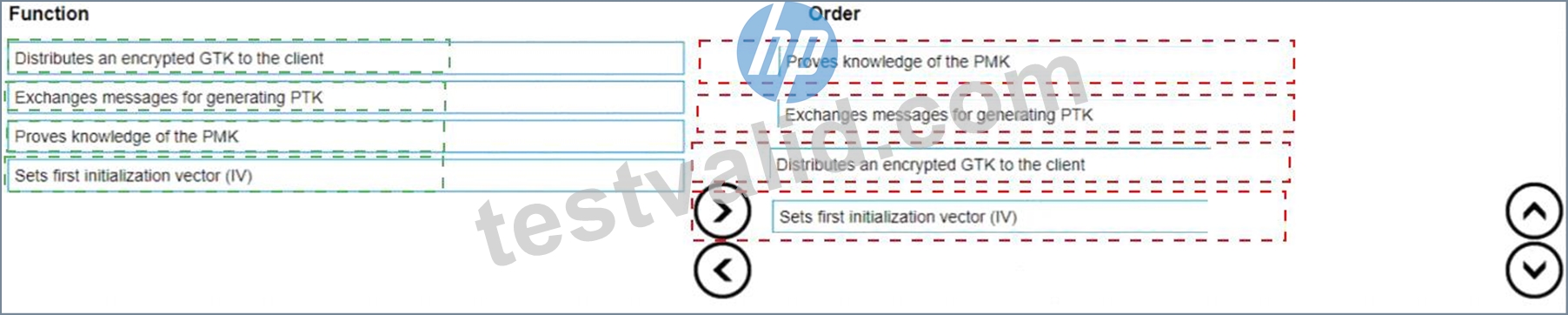
* Proves knowledge of the PMK
* Exchanges messages for generating PTK
* Distributes an encrypted GTK to the client
* Sets first initialization vector (IV)
NEW QUESTION # 56
......
HP HPE7-A01 exam is an excellent opportunity for IT professionals to prove their expertise in Aruba network solutions. With comprehensive knowledge of wireless system administration, design, and operation, certified professionals are better equipped to perform their job duties, earn recognition for their knowledge, move ahead in their career, and provide real value to the organizations they work for.
HPE7-A01 PDF Dumps Are Helpful To produce Your Dreams Correct QA's: https://lead2pass.testvalid.com/HPE7-A01-valid-exam-test.html