

HPE7-J01 Self-Study Guide for Becoming an Advanced HPE Storage Architect Solutions Written Exam Expert
HPE7-J01 Study Guide Realistic Verified HPE7-J01 Dumps
NEW QUESTION # 25
A customer needs to replace its HPE Alletra 6000 storage array with either an HPE Alletra 9000 managed with GreenLake or an IBM FlashSystem solution. Which two advantages should an HPE Partner share with the customer as to why the customer should opt for the HPE storage solution? (Choose two.)
- A. Granular disaster recovery
- B. Ransomware detection
- C. Fractional scaling
- D. AIOps for infrastructure
- E. Full stack automation with hybrid cloud
Answer: D,E
Explanation:
When competing against IBM FlashSystem, HPE's primary differentiators lie in the intelligence of the management platform and the integration into the broader hybrid cloud ecosystem.
The first major advantage is AIOps for infrastructure, pioneered by HPE InfoSight. While IBM has Storage Insights, HPE InfoSight is widely considered the industry benchmark for deep-stack predictive analytics. It uses machine learning to analyze millions of sensor points across the global install base to predict and prevent up to 86% of problems before they occur. This goes beyond simple storage monitoring; it provides visibility into the "noisy neighbor" VMs and host-side issues that impact storage performance, providing a level of autonomous management that IBM's portfolio currently lacks.
The second advantage is Full stack automation with hybrid cloud. By managing the Alletra 9000 through the HPE GreenLake Data Services Cloud Console (DSCC), the customer transitions from managing a
"box" to a cloud-native operational model. This provides a unified API and a consistent management experience whether the data is on-premises or in the cloud. DSCC enables "Intent-Based Provisioning," where the user simply specifies the workload type and the cloud console automatically selects the best-suited array and volume parameters, ensuring optimal performance without manual tuning. This "Cloud Ops" model is a cornerstone of the HPE GreenLake strategy, offering a more streamlined, automated experience than the traditional management software typically associated with the IBM FlashSystem line. While IBM does offer ransomware features (Option C), HPE's focus on AIOps and hybrid cloud integration provides a more transformative operational benefit for most enterprise customers.
NEW QUESTION # 26
Which HPE system can be integrated into a factory-built HPE Qumulo solution for a customer?
- A. HPE Apollo 4200
- B. HPE Apollo 4500
- C. HPE ProLiant 360
- D. HPE Alletra 5000
Answer: A
Explanation:
The HPE Solutions for Qumulo are a result of a strategic partnership designed to provide a high-performance, scale-out NAS (Network Attached Storage) platform for unstructured data. According to the HPE Solutions with Qumulo Reference Architecture, the primary hardware platform utilized for these factory-built, integrated solutions is the HPE Apollo 4000 series, specifically the HPE Apollo 4200.
The Apollo 4200 is chosen for this role because it is a density-optimized, storage-centric server that provides an ideal balance of compute and massive internal storage capacity within a standard 2U rack footprint.
Architecturally, the Apollo 4200 supports an "SSD-first" hybrid configuration or an all-flash configuration, which aligns perfectly with Qumulo's file system requirements. Qumulo's software uses the SSDs for a high- speed metadata layer and write-cache, while utilizing high-capacity HDDs for the data plane, ensuring that even with billions of files, the system maintains near-flash performance.
While the HPE ProLiant DL325 is also used for specific all-NVMe nodes in the Qumulo portfolio, the Apollo
4200 remains the foundational building block for the hybrid and archive nodes that comprise the bulk of enterprise deployments. The HPE Apollo 4500 (Option D) is a 4U system that, while part of the Apollo family, is not the standard integrated platform for the mainstream Qumulo joint offering. The HPE Alletra
5000 (Option B) is a block-storage-focused platform derived from the Nimble lineage, and the ProLiant DL360 (Option C) is a general-purpose 1U compute server that lacks the internal drive density required for a high-capacity scale-out file storage solution. By selecting the Apollo 4200, customers benefit from a pre- validated, factory-integrated solution that simplifies the deployment of massive file lakes for workloads like video surveillance, medical imaging, and big data analytics.
NEW QUESTION # 27
A storage administrator will be implementing the HPE Peer Persistence feature between many arrays at many different sites across the company. The administrator will be using the Quorum Witness (QW) solution to determine when automatic failover will occur between the primary and secondary arrays. Which statement is correct regarding the use of this feature?
- A. The QW is active and will initiate a failover when a split-brain situation occurs between two HPE Peer Persistence storage arrays.
- B. The QW requires IP and fibre channel (FC) connectivity between the QW and the storage arrays.
- C. The QW can only be installed as a VM solution on Red Hat Enterprise Linux or SUSE Linux.
- D. The QW should be installed at a site that is different from where the primary and secondary storage arrays are located.
Answer: D
Explanation:
The HPE Quorum Witness (QW) is a critical component for facilitating Automatic Transparent Failover (ATF) in Peer Persistence, Active Peer Persistence, and Active Sync Replication configurations. Its primary architectural purpose is to act as an independent "tie-breaker" during a split-brain scenario-a situation where the storage arrays lose their heartbeat/replication links and both attempt to claim primary ownership of the volumes.
According to HPE documentation, the Quorum Witness must be installed at a third, neutral site that is geographically separate and failure-independent from the sites hosting the primary and secondary arrays. This
"Third Site" placement ensures that if either site hosting an array experiences a total power or network failure, the remaining array can still reach the Quorum Witness via the network to obtain a "quorum vote" and safely assume the primary role without manual intervention. If the QW were placed at the same site as one of the arrays, a failure at that site would take down both the storage and the witness, preventing the surviving array at the other site from achieving quorum for an automatic failover.
Connectivity to the Quorum Witness is strictly over IP (Ethernet); it does not require Fibre Channel (FC) connectivity. While Option B suggests a limitation to specific Linux VMs, the QW is a self-contained application that can be installed on either physical or virtual machines running a variety of supported Linux host OS versions listed in the HPE SPOCK matrix (including RHEL, SUSE, and CentOS). Option A is slightly imprecise because the arrays themselves initiate the failover logic after querying the QW, rather than the QW "initiating" it autonomously. Therefore, the recommendation for third-site placement remains the most essential architectural requirement.
NEW QUESTION # 28
An HPE Partner is designing a software-defined storage (SDS) solution that includes HPE Alletra 4000 storage servers and the HPE Ezmeral Data Fabric software solution. The customer wants to manage the HPE Alletra 4000 storage servers using HPE GreenLake. Which component in HPE GreenLake should the customer use?
- A. Compute Ops Manager
- B. Data Ops Manager
- C. Block Storage
- D. File Storage
Answer: A
Explanation:
The HPE Alletra 4000 series (specifically the Alletra 4110 and 4120) are technically classified as Storage Servers. Unlike traditional "closed" storage arrays like the Alletra 6000 or 9000, the Alletra 4000s are open platforms derived from the HPE Apollo lineage, designed to run Software-Defined Storage (SDS) stacks such as HPE Ezmeral Data Fabric, Scality, or Qumulo.
Because these systems are fundamentally high-density servers, their lifecycle management-including firmware updates (BIOS, iLO, controllers), health monitoring, and remote configuration-is integrated into the HPE GreenLake for Compute Ops Management (COM) service. COM provides a cloud-native console designed specifically for server administrators to manage fleets of ProLiant and Alletra 4000 servers from a single pane of glass.
While the customer is building a storage solution, the Data Ops Manager (DOM) (Option D) is the control plane for HPE's specialized block and file arrays (managed via DSCC) and is not the tool used for raw storage server hardware management. Similarly, the "File Storage" and "Block Storage" tiles in GreenLake refer to specific Storage-as-a-Service (STaaS) offerings rather than the underlying hardware management for SDS building blocks. For a partner designing an Ezmeral solution on Alletra 4000, Compute Ops Management is the correct tool to ensure the hardware stays compliant with the latest HPE Service Pack for ProLiant (SPP) and firmware baselines required for stable SDS operations.
NEW QUESTION # 29
A customer is concerned about the long distances between their data centers and significant latencies that might exist between the SAN fabrics at the two data centers. Since SCSI write operations can involve multiple handshake messages between the target and initiator, which Brocade feature should be used to double the recommended distance, but maintain the same latency as a shorter haul link?
- A. Leave Fast
- B. FCIP trunking
- C. Write Acceleration
- D. FastWrite
Answer: D
Explanation:
Standard SCSI write operations are inherently sensitive to distance because they require multiple round-trip handshakes before data is actually transmitted. A typical write involves: 1) the Command, 2) a Transfer Ready (XFER_RDY) response from the target, 3) the Data, and 4) the Status. In a long-distance SAN, each of these round trips adds significant "latency wait time," severely degrading performance as distance increases.
To solve this, Brocade (HPE B-series) utilizes a protocol optimization feature known as FastWrite. FastWrite works by creating a Proxy Target (PT) local to the initiator host and a Proxy Initiator (PI) local to the target storage device. When the host issues a SCSI write command, the local Brocade switch (acting as the Proxy Target) immediately sends the XFER_RDY back to the host without waiting for the signal to travel across the long-distance link. This allows the host to send the data segment immediately.
By eliminating the need for every handshake message to traverse the distance multiple times, FastWrite significantly reduces the aggregate latency felt by the application. Architecturally, this enables customers to extend their SAN fabrics over double the distance (and often much further) while maintaining performance comparable to a significantly shorter link. This is critical for asynchronous replication and remote copy applications that issue large I/O blocks. Option C (Write Acceleration) is a generic term often used by other vendors, while FastWrite is the specific, validated Brocade feature name used in HPE Master ASE documentation for this protocol optimization.
NEW QUESTION # 30
A storage administrator wants to set up NAS replication between two HPE StoreOnce appliances. A corresponding NAS library was created between the two systems, primary and secondary, where the secondary will receive the replicated information. When the administrator tries to create the NAS mapping on the primary StoreOnce solution, the administrator is presented with an error stating they do not have permission. What should the administrator do to solve this issue?
- A. On the primary StoreOnce appliance, generate an access token and configure this token on the secondary StoreOnce appliance.
- B. On the secondary StoreOnce appliance, define the primary StoreOnce appliance, along with the respective username and password.
- C. On the primary StoreOnce appliance, define the secondary StoreOnce appliance, along with the respective username and password.
- D. On the secondary StoreOnce appliance, set the Replication Permissions to allow Enabled Public Access.
Answer: B
Explanation:
In the context of HPE StoreOnce Catalyst and NAS replication, security is governed by a bi-directional trust or permission-based handshake. When configuring replication between two StoreOnce appliances, the
"Target" (Secondary) system acts as the gatekeeper. The error described occurs because the primary system is attempting to push data or create a mapping to a destination that has not authorized it.
According to the HPE StoreOnce documentation regarding Replication Permissions, the secondary appliance must explicitly grant permission to the source appliance before any mapping or data transfer can occur. This is a security measure designed to prevent unauthorized data ingestion or "rogue" replication tasks from consuming storage resources on the target system. To resolve the permission error, the administrator must log into the Secondary StoreOnce appliance (the target) and navigate to the replication settings. There, they must add the Primary StoreOnce appliance as an authorized "source" by specifying its network address (FQDN or IP) and providing the necessary credentials (username and password) that the primary system will use to authenticate.
Unlike simpler protocols where a "Public Access" setting (Option B) might exist, HPE StoreOnce requires a defined relationship for NAS and Catalyst replication to ensure data integrity and multi-tenancy security.
Option A refers to token-based authentication, which is more common in modern cloud-native Alletra environments via DSCC, but not the standard for legacy StoreOnce NAS replication. Options D is incorrect because the permission must be granted at the receiving end, not the sending end. Once the secondary system has the primary's details stored in its Replication Permissions list, the primary appliance will be able to successfully "discover" the target libraries and establish the mapping without further permission errors.
NEW QUESTION # 31
An HPE customer purchased an HPE B-Series SN7000B SAN fabric switch. QoS is currently not enabled.
Which two statements are correct regarding buffer-to-buffer (BB) credits and the operation of the switch?
(Choose two.)
- A. The default window size for fibre channel (FC) frame transmission is 1, but can be increased to 8 or 16, depending on the switch model.
- B. By default, all BB credits are reserved.
- C. Each user port reserves eight buffer credits when online or offline.
- D. BB credits are based on link speed and frame size.
- E. BB credits can be adjusted for specific applications or operating environments, but they must be agreed upon among all switches to allow the formation of the fabric.
Answer: C,D
Explanation:
The HPE B-Series SN7000B is a high-performance Director based on Brocade Gen 7 (G7) technology.
Buffer-to-Buffer (BB) credits are the fundamental flow-control mechanism used in Fibre Channel to prevent frame loss and manage congestion.
Statement D is a foundational principle of SAN architecture: BB credits are based on link speed and frame size. In an FC fabric, the number of credits required to "fill the pipe" (keep data moving without waiting for acknowledgments) is a direct function of the Round Trip Time (RTT), which is determined by the physical distance, the speed of the link (e.g., 64Gb/s vs 32Gb/s), and the size of the frames being sent (typically 2KB).
As link speeds increase, more buffer credits are required to maintain full throughput over the same distance.
Statement C reflects a specific technical default in the Brocade Fabric OS (FOS) for Gen 7 hardware. To ensure that ports can initialize and handle basic traffic immediately upon being enabled, the switch reserves a default number of credits from the ASIC's global buffer pool. For user ports on these high-density blades, the system reserves eight buffer credits per port, regardless of whether the port is currently online or offline.
This reservation ensures that the port has the minimum resources necessary to complete a fabric login (FLOGI) or negotiate a link without competing for pool resources.
Option E is incorrect because the entire pool is not reserved; a significant portion of the ASIC's buffers remains in a "shared pool" that can be dynamically allocated for long-distance links or high-demand ports via the "Extended Fabrics" feature. Option B is incorrect as it confuses the TCP windowing concept with FC credit-based flow control. Option A is incorrect because BB credits are a local port-to-port negotiation (link- level) and do not need a fabric-wide global "agreement" to form the fabric.
NEW QUESTION # 32
Match the HPE StoreOnce solution with the appropriate description. Each answer will be used once.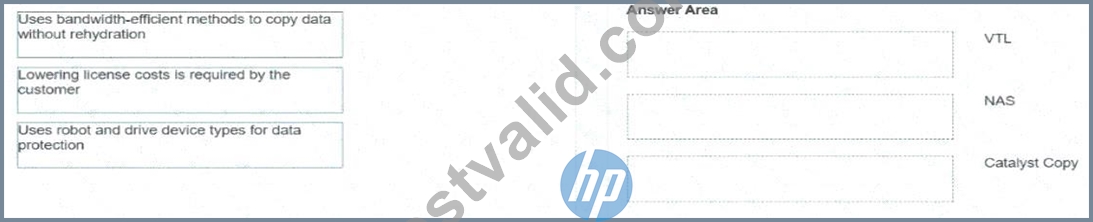
Answer:
Explanation: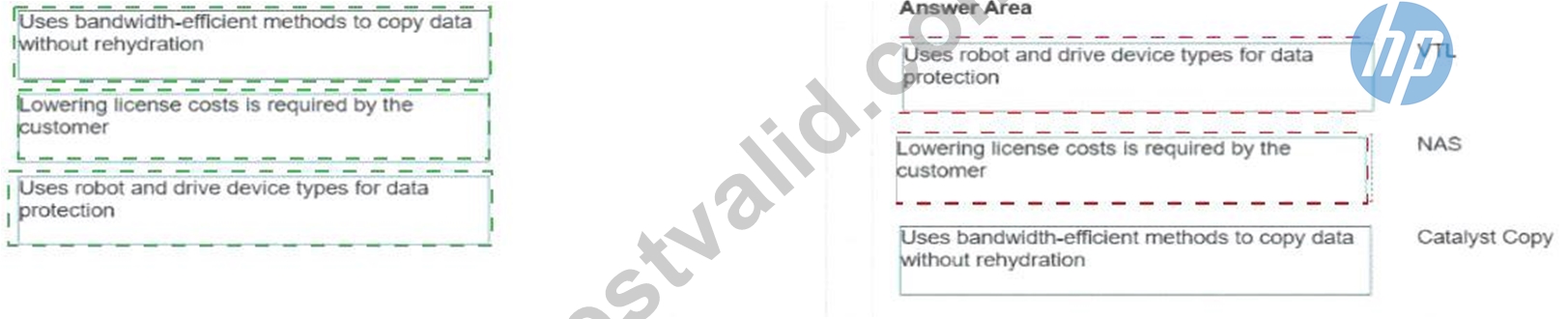
Explanation:
* Catalyst Copy: Uses bandwidth-efficient methods to copy data without rehydration
* NAS: Lowering license costs is required by the customer
* VTL: Uses robot and drive device types for data protection
The HPE StoreOnce portfolio provides multiple data protection interfaces to align with different legacy and modern workload requirements. Understanding the specific technical "DNA" of each interface is key to a successful Master ASE design.
HPE StoreOnce Catalyst Copy is the most advanced method for data movement. Unlike standard protocols that must "rehydrate" (decompress/deduplicate) data before sending it over the network, Catalyst Copy is
"deduplication-aware". It identifies unique data blocks at the source and only transmits those that do not already exist at the destination. This bandwidth-efficient method allows for high-speed replication over WAN links with minimal overhead.
The NAS (Network Attached Storage) interface is often chosen when lowering license costs is a primary driver. Because it utilizes industry-standard protocols like NFS or SMB/CIFS, it does not require the specialized (and often separately licensed) backup software agents or plug-ins associated with the high- performance Catalyst protocol. While it lacks some of the advanced deduplication-at-source benefits of Catalyst, it remains a cost-effective choice for general-purpose file-based backups.
The VTL (Virtual Tape Library) interface is designed for customers with existing investments in tape-based backup workflows. It emulates physical tape hardware, presenting the backup software with virtual "robot" (medium changer) and drive device types. This allows organizations to transition from physical tape to disk- based deduplication without changing their existing backup scripts or procedures, providing a seamless "drop- in" replacement for aging tape libraries.
NEW QUESTION # 33
What will occur when a new node is added to an existing HPE Alletra MP X10000 storage array?
- A. The expanded capacity is immediately available in the shared pool.
- B. An automatic rebalancing across JBOFs occurs as soon as a new drive or an additional JBOF is added.
- C. An automatic cluster upgrade is supported across all releases of the operating systems and models.
- D. Additional drives can be used to increase drive protection beyond the default limit of three drives.
Answer: B
Explanation:
The HPE Alletra MP X10000 is an object and file storage solution utilizing a Disaggregated Shared- Everything (DASE) architecture. A key differentiator of this disaggregated design is the stateless nature of the controller nodes and the centralized management of the data plane.
When a cluster expansion occurs-such as adding a new controller node or an additional JBOF (Just a Bunch of Flash) storage shelf-the system is designed to automatically optimize the workload distribution.
According to the HPE Alletra MP Architectural Guide, adding an additional JBOF or drives triggers an automatic rebalancing of the data stripes. Unlike older architectures where manual rebalancing services were required (such as in the 3PAR/B10000 block lineage), the X10000 uses a sophisticated hashing mechanism.
Specifically, data is distributed across DSPs (Data Storage Processors) which are virtualized management units. Upon the addition of hardware, these DSPs are rebalanced across the available compute and storage resources in a matter of seconds. Because the nodes are stateless and state is persisted only within the JBOFs, this rebalancing happens with minimal performance impact and no need for the massive "data movement" traditionally associated with expanding a RAID group. This ensures that as a customer scales from the minimum of 3 nodes up to 8 or more, the system always maintains an optimal load balance and utilizes all available flash bandwidth and compute cycles in parallel.
NEW QUESTION # 34
A company is going to upgrade a SAP HANA solution. The company is looking for competitive bids, and only SAP HANA hardware that is certified should be included in a bid. When building the bid, what must you first determine before you can right-size the solution with the appropriate HPE hardware?
- A. Number of HANA nodes
- B. Read cache size
- C. IOPS rate
- D. Replication features
Answer: C
Explanation:
Sizing a storage solution for SAP HANA is fundamentally different from sizing general-purpose virtualization workloads. SAP HANA is an in-memory database, but it has extremely strict requirements for the underlying persistent storage layer to ensure data integrity during savepoints and log writes. SAP enforces these requirements through the SAP HANA Tailored Data Center Integration (TDI) program.
To begin the sizing process and ensure the solution will pass the SAP Hardware Configuration Check Tool (HWCCT) or the newer SAP HANA System Check, a storage architect must first determine the required IOPS rate, specifically for the /hana/data and /hana/log volumes. SAP provides specific KPIs for latency and throughput that must be met. For instance, the log volume requires extremely low-latency writes to handle the sequential redo logs, while the data volume requires high-throughput (MB/s) and specific IOPS to handle asynchronous savepoints.
While the number of nodes (Option C) and replication features (Option D) are important for the overall architecture, they do not dictate the "right-sizing" of the storage performance tier in the same way the IOPS and throughput requirements do. If the storage cannot meet the SAP-certified IOPS and latency thresholds, the entire solution will be unsupported, regardless of how many nodes are present. By identifying the IOPS and throughput needs first, the architect can determine if the customer requires an All-Flash Alletra 9000 or if an Alletra MP configuration with specific drive counts is necessary to provide the required "parallelism" to hit SAP's performance targets.
NEW QUESTION # 35
A customer wants to implement HPE Cloud Bank Storage with the detach option LTU feature. Which statement is correct regarding the implementation of this feature?
- A. Support for reading and writing to the detached datastore is supported with the detach license installed.
- B. A detached Cloud Bank datastore can only be reconnected to the HPE StoreOnce system from which it was detached.
- C. HPE Cloud Bank Store must be connected using the connect (read-write) option.
- D. HPE Services is always required when reconnecting a detached datastore.
Answer: C
Explanation:
HPE Cloud Bank Storage is an extension of HPE StoreOnce Catalyst that enables the movement of deduplicated data to public, private, or hybrid cloud object storage. The Cloud Bank Detach feature is a critical lifecycle management capability designed for long-term retention and disaster recovery scenarios.
According to the HPE StoreOnce User Guide, the "Detach" operation is a specific administrative action that essentially "unplugs" the Catalyst store from the local StoreOnce appliance while leaving the data intact in the cloud bucket (e.g., AWS S3 or Azure Blob). For an administrator to initiate the detach process, the Cloud Bank store must currently be in a Read-Write (RW) state on the StoreOnce system. If a store is currently connected as Read-Only (often the case after a disaster recovery sync), it cannot be detached until it is promoted or was originally connected in a Read-Write capacity.
Once the detach operation is executed using the required Detach Capacity LTU (License to Use), the store enters a "Detached" state. In this state, the data in the cloud becomes immutable and the store is removed from the local StoreOnce system's active management. It is important to note that once detached, the store can only be reconnected to a StoreOnce system (either the original or a new one for DR) in a Read-Only state for recovery purposes. Statement D is incorrect because you cannot write to a detached store. Statement B is incorrect because one of the primary value propositions of Cloud Bank is portability-allowing you to connect a detached store to a completely different StoreOnce appliance in a different region for recovery.
Finally, while HPE Services are available for complex DR planning, they are not a technical requirement for the software-defined reconnection of a detached store.
NEW QUESTION # 36
An HPE customer has the following requirements:
* Enable self-service provisioning into any cloud
* Simplify Kubernetes clusters on-demand across bare metal, VMs, and cloud-native
* Normalize service management across clouds, giving consistent visibility into costs, dependencies, monitoring, and insights Which HPE solution meets these requirements?
- A. HPE OpsRamp
- B. HPE GreenLake
- C. HPE Morpheus Enterprise Software
- D. HPE OneView
Answer: C
Explanation:
HPE Morpheus Enterprise Software is a cloud-agnostic management and orchestration platform designed to enable a unified "cloud operating model" across hybrid and multi-cloud environments. It is specifically engineered to bridge the gap between traditional IT infrastructure and modern DevOps requirements.
The solution meets the customer's requirements as follows:
* Self-Service Provisioning: Morpheus provides a central catalog and a powerful self-service engine that allows users to provision VMs, containers, and application stacks into any private or public cloud (including AWS, Azure, GCP, VMware, and Nutanix) on-demand.
* Kubernetes Simplification: It offers a CNCF-certified Morpheus Kubernetes Service (MKS) and native integrations to deploy and manage Kubernetes clusters across bare metal, virtualized environments, and public clouds.
* Normalized Service Management & Visibility: Morpheus normalizes the management experience across different providers, offering built-in FinOps capabilities for cross-cloud cost tracking, invoice synchronization, and rightsizing recommendations. It provides unified governance with fine-grained role-based access control (RBAC) and consistent insights into workload dependencies and monitoring.
While HPE GreenLake (Option A) is the overarching brand for HPE's as-a-service offerings, Morpheus is the specific software engine that powers the self-service and orchestration layers within the GreenLake private cloud portfolio. HPE OpsRamp (Option B) focuses primarily on full-stack observability and AI-driven monitoring rather than orchestration/provisioning. HPE OneView (Option C) is an infrastructure management tool focused on the hardware lifecycle of servers, storage, and networking (primarily on- premises) rather than multi-cloud service orchestration.
NEW QUESTION # 37
A company bought an HPE StoreOnce solution as part of its data protection solution. The company has various Oracle installations that need to be backed up to StoreOnce. How should the company's administrator best implement the data protection strategy within the HPE StoreOnce user interface (UI)?
- A. From the System Dashboard, click Databases, click Create Library, then specify the Oracle RMAN option and the respective database servers.
- B. Under Data Services, create a Catalyst Store and install the Oracle RMAN plug-in on the Oracle database server.
- C. Under Data Services, create a Catalyst Store and select the Oracle RMAN option.
- D. From the System Dashboard, click Catalyst Store then specify the Oracle RMAN option and the respective database server.
Answer: B
Explanation:
To protect Oracle databases using HPE StoreOnce, the preferred architectural method is using HPE StoreOnce Catalyst for Oracle RMAN. This integration allows Oracle Database Administrators (DBAs) to manage backups directly from their native RMAN (Recovery Manager) tools while leveraging the deduplication and performance benefits of the StoreOnce appliance.
According to the HPE StoreOnce Catalyst for Oracle RMAN User Guide, the implementation involves two distinct stages: configuration on the StoreOnce appliance and configuration on the database server. First, the storage administrator must log into the StoreOnce UI and, under the Data Services section, navigate to Catalyst. Here, they must create a Catalyst Store. This store acts as the target repository for the backup data.
During creation, the administrator sets permissions (client access) to allow the Oracle server to communicate with this specific store.
The second, and crucial, part of the implementation (as noted in Option D) is the installation of the HPE StoreOnce Catalyst Plug-in for Oracle RMAN on the actual Oracle database server. This plug-in provides the "SBT" (System Backup to Tape) interface that RMAN requires to talk to a non-disk/non-tape target.
Without this plug-in installed on the host, RMAN has no way of translating its commands into the Catalyst protocol. Once the plug-in is installed and configured with the StoreOnce details, the DBA can allocate channels to the "SBT_TAPE" device and run backup jobs directly to the Catalyst Store created in the UI.
Options A, B, and C are incorrect because the StoreOnce UI does not have an "Oracle RMAN option" toggle or "Database Library" creator; the intelligence resides in the combination of the Catalyst Store and the host- side plug-in.
NEW QUESTION # 38
Which statement is correct regarding Fibre Channel over IP (FCIP)?
- A. It has no fixed distance limitation.
- B. A single controller pair should be used for all circuits for the FCIP connectivity.
- C. It has the same latency as CWDM or DWDM.
- D. It is reliant on fibre channel (FC) buffer credits.
Answer: A
Explanation:
Fibre Channel over IP (FCIP), as defined by IETF RFC 3821, is a tunneling protocol used to interconnect Fibre Channel (FC) storage area networks (SANs) over long distances using standard IP infrastructure. One of the primary architectural reasons for choosing FCIP over native Fibre Channel extension is its ability to overcome distance constraints.
Native Fibre Channel is governed by a flow-control mechanism called Buffer-to-Buffer (BB) Credits. In a native FC link, a frame cannot be sent until the sender has a "credit" from the receiver. As the distance between sites increases, the time it takes for an acknowledgment (and thus the return of a credit) to travel back significantly increases. This creates a "protocol drop-off" where performance collapses once the distance exceeds the available buffer memory. In contrast, FCIP encapsulates FC frames into TCP/IP segments.
TCP/IP uses a different flow-control mechanism called windowing.
By moving the transport to TCP/IP, the storage traffic is no longer strictly bound by the physical light- propagation constraints of the FC buffer-credit mechanism. While latency still increases with distance (governed by the speed of light in fiber), FCIP provides no fixed protocol distance limitation, making it possible to replicate data across continents or globally (asynchronous replication) as long as the IP network provides a path. Option D is incorrect because the "tunnel" handles the delivery, effectively shielding the FC fabric from the long-haul buffer requirement. Option A is incorrect because the encapsulation process in FCIP always adds more latency than "transparent" optical extensions like DWDM. Therefore, the architectural value of FCIP is its ability to provide "unlimited" distance connectivity using existing WAN infrastructure.
NEW QUESTION # 39
A company has a pair of Alletra 9000s, managed via the HPE GreenLake Data Services Cloud Console (DSCC). An administrator installed Kubernetes locally but requires persistent storage using the Alletra 9000s.
After installing the helm repo for the HPE CSI Driver for Kubernetes, what is the next step the administrator should perform to use the Alletra 9000s for persistent storage?
- A. Create a secret to allow the HPE CSI Driver to communicate with the Alletra 9000s.
- B. Add the Kubernetes conductor credentials to the Alletra 9000s in the HPE GreenLake DSCC.
- C. Create a storage class that references the Alletra 9000s on the Kubernetes conductor.
- D. Create a Kubernetes namespace for the HPE CSI Driver.
Answer: A
Explanation:
The deployment of the HPE CSI (Container Storage Interface) Driver involves several sequential steps to enable dynamic provisioning of storage on HPE Alletra 9000 arrays. Once the Helm repository has been added, the administrator must provide the driver with the necessary authentication and connectivity details for the storage backend.
According to the HPE Storage Container Orchestration Documentation (SCOD), the definitive next step to enable communication between the Kubernetes cluster and the Alletra 9000 is to create a Kubernetes Secret. This Secret contains critical parameters such as the storage array's IP address or FQDN, and the management credentials (username and password). Without this Secret, the CSI driver cannot authenticate against the Alletra 9000 REST API to perform volume creation, mounting, or snapshot operations.
While creating a StorageClass (Option C) is a required step, it follows the creation of the Secret. The StorageClass definition must specifically reference the name of the Secret to identify which storage backend should be used for a particular tier of service. Option A (creating a namespace) is often done as part of the helm install command itself (using the --create-namespace flag) and is a general administrative task rather than a storage-specific configuration step. Option D is incorrect as the Alletra 9000 does not pull credentials from the Kubernetes conductor; rather, the Kubernetes driver pushes requests to the array using the credentials stored in the Kubernetes Secret. Establishing this secure handshake via the Secret is the foundational step for all subsequent persistent volume (PV) and persistent volume claim (PVC) activities.
NEW QUESTION # 40
An administrator is setting up Zerto for data protection. The Zerto Virtual Manager <ZVM> has been installed and configured. The administrator is ready to deploy the Zerto Virtual Replication Appliances (VRAs) Use your cursor to place a + on the ZVM screen to deploy the VRAs.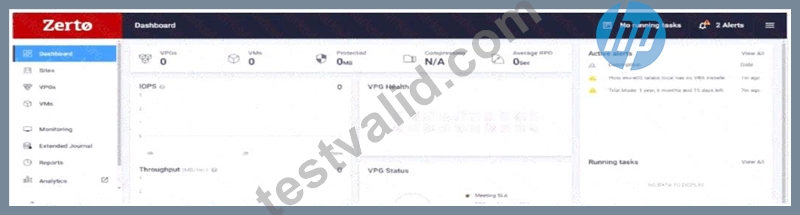
Answer:
Explanation: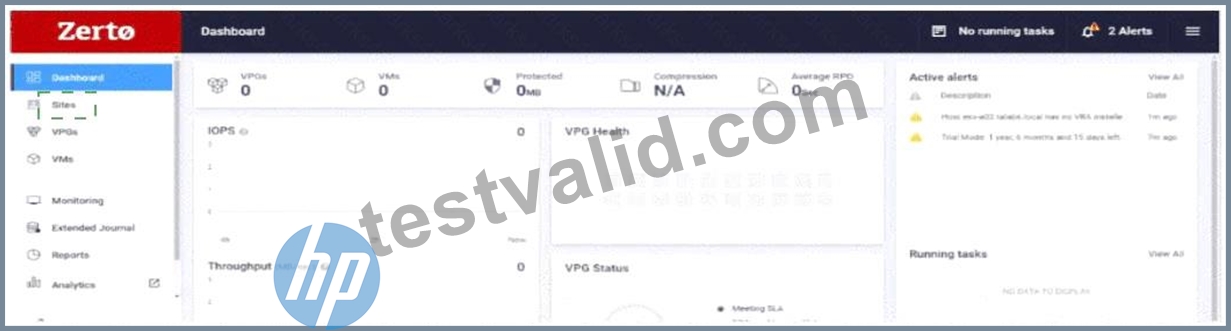
Explanation:
Sites
The Zerto Virtual Replication Appliance (VRA) is a critical architectural component of the Zerto solution.
It is a lightweight Linux-based virtual machine that must be installed on every hypervisor host (ESXi or Hyper-V) in both the production and recovery sites that will host protected virtual machines. The VRA is responsible for intercepting the I/O writes from the VMs and asynchronously replicating them to the recovery site.
In the Zerto Virtual Manager (ZVM) web interface shown in the exhibit (image_649973.png), the management of site-level infrastructure is centralized within the "Sites" tab. By clicking on this tab, the administrator accesses the view for both local and paired remote sites. Within the Local Site details, there is a sub-tab for "VRAs" or "Hosts" where the administrator can see a list of all hosts managed by the connected vCenter or SCVMM.
To deploy a VRA, the administrator selects the host(s) currently missing the appliance and clicks the "Install" button. The ZVM then automates the deployment, configuring the VRA with the necessary network settings and registering it with the hypervisor. Notably, the "Active alerts" window in the exhibit explicitly provides a hint: it shows an alert stating that "Host esx-e02.telabs.local has no VRA installed". Clicking on the "Sites" tab is the foundational step to resolve this alert and finalize the infrastructure setup required to begin creating Virtual Protection Groups (VPGs).
NEW QUESTION # 41
An administrator needs to create an FCIP trunk connection between two data centers to interconnect their Brocade fibre data fabrics. Refer to the exhibit.
Based on this configuration, which statement is correct?
- A. This is an invalid configuration. FOP trunks must be configured with an even number of circuits.
- B. This is a valid configuration. The trunk will have one active connection and two standby connections.
- C. This is a valid configuration. The trunk will have two active connections and one standby connection.
- D. This is an invalid configuration. FCIP trunks must be configured using fibre channel ports.
Answer: C
Explanation:
In a Brocade FCIP (Fibre Channel over IP) environment, an extension trunk (or tunnel) can be composed of multiple circuits to provide both increased bandwidth and high availability. The operational state of these circuits-whether they are active or standby-is determined by the Metric assigned to each individual circuit.
According to the Brocade Fabric OS Extension Configuration Guide, all circuits within a tunnel or trunk have a metric of either 0 or 1.
* Metric 0: This is the default value and indicates an active circuit. If multiple circuits are configured with Metric 0, they will operate in an active-active mode, and the load will be balanced across them.
* Metric 1: This indicates a standby (or passive) circuit. Standby circuits with Metric 1 are not used for data transmission unless all Metric 0 circuits within that tunnel/failover group fail.
In the provided exhibit, there is a single VE_Port (Virtual E_Port) trunking three individual IP circuits:
* ge0 is configured with Metric 0 (Active).
* ge1 is configured with Metric 0 (Active).
* ge2 is configured with Metric 1 (Standby).
Therefore, this is a valid configuration where the system will utilize the two Metric 0 circuits (ge0 and ge1) simultaneously for data traffic, providing an active-active load-balanced connection. The third circuit (ge2) will remain in a standby state, only becoming active to maintain the link if both primary circuits go offline.
Options A and B are incorrect because trunks do not require an even number of circuits, and FCIP trunks are specifically established over Ethernet (ge) ports, not native Fibre Channel ports.
NEW QUESTION # 42
A customer currently has a Dell EMC storage array and wants to migrate data to a newly purchased HPE Alletra MP B10000 storage array. Which solution should the administrator use to perform the migration?
- A. Online Import Utility (OIU) over fibre channel (FC)
- B. Peer persistence over fibre channel (FC)
- C. Remote copy over iSCSI
- D. Peer motion utility (PMU) over fibre channel (FC)
Answer: A
Explanation:
Migrating data from a non-HPE (third-party) array to an HPE storage platform requires a specialized toolset designed for interoperability. For the HPE Alletra MP B10000 (Block), the primary tool for migrating from competitive systems like Dell EMC, HDS, or IBM is the HPE Online Import Utility (OIU).
The Online Import Utility is designed to simplify and automate the migration process with minimal disruption to the host applications. Architecturally, OIU leverages the "Peer Motion" technology foundation but is specifically packaged to support "Import" workflows from non-HPE sources. When using OIU over Fibre Channel, the HPE Alletra MP array essentially acts as a "Pass-Through" or proxy. The administrator zones the Dell EMC array to the Alletra MP, and the Alletra MP presents itself as a host to the Dell system.
Once the connection is established, the data is pulled from the source array to the destination array. Because it is an Online utility, the host's I/O is redirected through the Alletra MP during the migration process. This allows the data to be moved in the background while the application remains online. Once the data copy is complete, a "cutover" is performed, and the Dell EMC array can be decommissioned. Option D (Peer Motion Utility) is technically the underlying engine, but "Online Import" is the specific utility name used for multi- vendor migrations. Options B and C are incorrect as Remote Copy and Peer Persistence are proprietary HPE- to-HPE technologies used for ongoing replication and high availability, not for one-time migrations from third-party hardware.
NEW QUESTION # 43
An HPE customer purchased an HPE B-Series SN7000B SAN fabric switch. QoS is currently not enabled.
Which two statements are correct regarding buffer-to-buffer (BB) credits and the operation of the switch?
(Choose two.)
- A. The default window size for fibre channel (FC) frame transmission is 1, but can be increased to 8 or 16, depending on the switch model.
- B. By default, all BB credits are reserved.
- C. Each user port reserves eight buffer credits when online or offline.
- D. BB credits are based on link speed and frame size.
- E. BB credits can be adjusted for specific applications or operating environments, but they must be agreed upon among all switches to allow the formation of the fabric.
Answer: C,D
NEW QUESTION # 44
An administrator has implemented automatic switchover (ASO) with Peer Persistence on a pair of HPE Alletra 6000 storage arrays. Which statement is correct regarding the ASO feature?
- A. When a downstream synchronously-replicated volume is unavailable, the upstream volume goes out of sync and host I/O is rejected.
- B. If the witness fails or is unreachable, ASO is still available.
- C. If any single controller in the HPE Alletra 6000 storage array fails, ASO occurs as normal.
- D. After a recovery and resynchronization from an ASO situation, a manual handover is required to restore the system back to the default.
Answer: D
Explanation:
HPE Peer Persistence for the Alletra 6000 (and Nimble) provides synchronous replication and automatic transparent failover (ATF) using the Automatic Switchover (ASO) feature. This process is governed by a Quorum Witness that monitors the health of both arrays in a group.
A fundamental design principle of HPE high-availability storage is to prevent "flapping"-a condition where a workload repeatedly bounces between two sites due to an unstable connection. Consequently, the ASO process is designed to be unidirectional and sticky. When a primary site failure occurs and the Quorum Witness authorizes an automatic switchover, the secondary array becomes the "Upstream" (active) array and begins serving I/O. Once the original primary site is restored and the replication link is re-established, the arrays will automatically begin a resynchronization to ensure data consistency. However, even after the data is fully synced, the system will not automatically move the workload back to the original array. The administrator must perform a manual handover to return the volume collection to its preferred primary site.
Regarding the other options:
* Option B: If the witness is unreachable, ASO is automatically disabled to prevent a "split-brain" scenario where both arrays might try to become active simultaneously.
* Option C: A single controller failure within an Alletra 6000 does not trigger an ASO. Instead, the array performs an internal controller failover (ALUA) which is transparent to the Peer Persistence relationship.
* Option D: In a synchronous relationship, if the target becomes unavailable, the source array typically transitions to an "Out of Sync" state but continues to serve host I/O in order to maintain application availability, rather than rejecting it.
NEW QUESTION # 45
A customer has a diverse NoSQL big data and data analytics workload implementation. This workload runs on bare-metal servers to achieve the most efficient performance. The customer requires a new storage solution to meet their growing data needs. Which solution will be best for the customer?
- A. HPE SimpliVity
- B. HPE GreenLake for Private Business Cloud Edition (PBCE)
- C. HPE Alletra Storage Server 4110
- D. HPE Alletra dHCI
Answer: C
Explanation:
For workloads like NoSQL databases (e.g., MongoDB, Cassandra), Big Data analytics (e.g., Hadoop, Spark), and high-throughput data lakes, the primary performance bottleneck is often the latency and bandwidth between the compute and the storage media. When a customer specifies they are running on bare- metal servers to achieve "most efficient performance," they are looking for a solution that minimizes the overhead of hypervisors and provides direct, high-speed access to storage.
The HPE Alletra Storage Server 4000 series, and specifically the Alletra 4110, is purposefully engineered for this "Data-First" server-based storage market. The Alletra 4110 is a 1U, all-NVMe ultra-dense storage server that supports dual 4th or 5th Gen Intel Xeon Scalable processors and PCIe Gen5 throughput. Unlike traditional storage arrays that connect via a SAN, the Alletra 4110 functions as high-performance Software- Defined Storage (SDS) infrastructure. It is designed to run the application and the data storage on the same high-density nodes, or to act as a high-speed storage tier for bare-metal clusters.
Other options are less suitable for this specific "bare-metal NoSQL" requirement:
* HPE SimpliVity (B) is a Hyperconverged Infrastructure (HCI) solution that is inherently tied to a hypervisor (VMware or Hyper-V), which contradicts the customer's bare-metal requirement.
* HPE Alletra dHCI (C) is a disaggregated HCI solution that automates a SAN environment but is also centered around VMware virtualization.
* HPE GreenLake for Private Cloud Business Edition (A) is a service-oriented offering primarily for managing virtualized private clouds.
The Alletra 4110 provides the massive I/O throughput (up to 315 GB/s of PCIe Gen5 bandwidth to SSDs) and the low-latency NVMe performance that NoSQL and analytics workloads demand, making it the superior architectural choice for bare-metal, data-intensive environments.
NEW QUESTION # 46
An HPE Partner is using HPE CloudPhysics to size a new storage solution for a customer that currently has a non-HPE storage array. When looking at the graphs and statistics in CloudPhysics, what is the only summary statistic that has time-correlated values?
- A. Hardware Performance
- B. Deduplication Performance
- C. Storage Metrics
- D. Peak Details
Answer: D
Explanation:
HPE CloudPhysics is a SaaS-based analytics platform that collects high-resolution metadata (at 20-second intervals) from a customer's virtualized infrastructure to drive data-led procurement and optimization decisions. In the context of performance analysis and sizing, it is critical to understand not just the average utilization, but how different resource demands interact over time.
The Peak Details statistic is unique within the CloudPhysics analytics framework because it provides time- correlated values across different resource dimensions (CPU, RAM, and Disk I/O). While standard "Storage Metrics" or "Hardware Performance" summaries often present aggregated averages or 95th percentile figures that lose their temporal context, Peak Details allows an architect to see exactly when a spike occurred.
This correlation is essential for determining if a storage bottleneck is being driven by a simultaneous compute peak or if a specific "noisy neighbor" VM is impacting the entire datastore during a backup or batch processing window. By aligning disk latency peaks with IOPS and throughput peaks on the same timeline, CloudPhysics enables the architect to validate if the existing third-party array is truly under-provisioned or simply misconfigured. This time-correlated insight ensures that the new HPE storage solution is sized not just for total capacity, but for the actual performance "burstiness" observed in the customer's production cycle.
Other metrics, while useful for high-level summaries, do not provide the granular, synchronized timeline required to perform a deep-dive root cause analysis or precision sizing for mission-critical workloads.
NEW QUESTION # 47
Which statement is correct concerning the hardware configuration of the HPE Alletra 5000 storage arrays?
- A. The head shelf must have the maximum number of SSD drives installed.
- B. Dual Flash Carriers support both SAS and NVMe SSD drives.
- C. A maximum of six SSD drives are supported across the entire system.
- D. The SSD drives are installed in slots 22-24.
Answer: D
Explanation:
The HPE Alletra 5000 is a hybrid storage array family built on the legacy of the HPE Nimble Storage Adaptive Flash architecture. Its hardware design is optimized for a mixture of high-capacity Hard Disk Drives (HDDs) and high-performance Solid State Drives (SSDs) used for caching (CASL architecture).
The chassis is a 4U enclosure featuring 24 drive slots. To maintain consistent performance and thermal profiles, the architecture designates specific slots for different media types. According to the HPE Alletra
5000 Installation and Service Guide, the SSDs used for cache are housed in Dual Flash Carriers (DFC).
Each DFC can hold either one or two SSDs, allowing for a total of 3 or 6 cache drives per shelf. These DFCs are specifically required to be installed in the last three slots of the array, which are slots 22, 23, and 24.
The remaining 21 slots (slots 1 through 21) are populated with Large Form Factor (LFF) HDDs for the primary capacity tier.
Option B is incorrect because the system is flexible; it can be configured with a minimum of 3 SSDs (one in each DFC) and does not require the maximum of 6. Option C is incorrect because expansion shelves (like the HPE Alletra 2120) also support their own cache SSDs, meaning the "entire system" capacity for SSDs scales as shelves are added. Option D is incorrect because the Alletra 5000 is a SAS/SATA-based hybrid platform; it does not support NVMe SSDs in its drive slots. NVMe support is reserved for the all-flash Alletra 6000 and
9000 models. Understanding this physical slotting is crucial for site planning and field service operations to ensure the array initializes correctly.
NEW QUESTION # 48
......
Valid HPE7-J01 Exam Dumps Ensure you a HIGH SCORE: https://lead2pass.testvalid.com/HPE7-J01-valid-exam-test.html