

Latest [Nov 03, 2025] Realistic Verified PMP Dumps
Pass PMI PMP Exam Updated 1975 Questions
The PMP certification is an essential certification for project managers looking to advance their careers. It is a globally recognized certification that demonstrates a project manager’s knowledge, experience, and understanding of project management principles, processes, and methodologies. By passing the PMP certification exam, project managers can improve their job prospects, increase their earning potential, and demonstrate their commitment to the project management profession.
PMI PMP certification exam is updated periodically to reflect changes in the field of project management. The latest version of the exam, the PMI PMP (Project Management Professional (2023 Version)) certification exam, is scheduled to be released in January 2023. The new exam is expected to reflect the latest trends and best practices in project management and will be aligned with the PMI Talent Triangle, which includes technical project management skills, leadership skills, and strategic and business management skills.
To earn the PMP certification, candidates must meet certain eligibility criteria, including a combination of education and experience in project management. They must also pass the PMP certification exam, which consists of 180 multiple-choice questions and takes four hours to complete. PMP exam is computer-based and can be taken at a testing center or online. Candidates who pass the exam are awarded the PMP certification, which is valid for three years and requires ongoing professional development to maintain.
NEW QUESTION # 1101
During a project's execution phase, team members disagree about how to proceed with upcoming tasks due to intellectual property conflicts and non-disclosure agreements with external resources. What should the project manager do?
- A. Ask the team to agree to compromise and move on
- B. Document it in the issue log
- C. Escalate it to senior management
- D. Work with the team to incorporate multiple viewpoints
Answer: C
Explanation:
Section: Executing
NEW QUESTION # 1102
A project manager complains that the vendor obtained through the procurement process did not meet the project's requirements The procurement department argues that the project manager did not provide adequate information when submitting the procurement documents What should the project manager do?
- A. Negotiate with the vendor on how the requirements can be met
- B. Escalate the problem to both the project sponsor and the procurement department director.
- C. Determine if there is sufficient time and funds to terminate the contract and then conduct a new procurement process
- D. Compare the submitted procurement documents to the quality management plan requirements.
Answer: A
NEW QUESTION # 1103
A verbal announcement is made that the new team member joining the Scrum team has limited mobility The scrum master is aware that some team members are unsure how the dynamics of the team will change What should the scrum master do?
- A. Update the team charter accordingly.
- B. Design a communications management plan
- C. Create a stakeholder engagement plan
- D. Set up a meeting to discuss accommodations the team will have to make
Answer: D
Explanation:
* A scrum master is a facilitator and coach for a scrum team, who ensures that the team follows the scrum process and removes any obstacles that may impede progress12. A scrum master is not a manager or decision-maker, but instead serves the team by helping them to be more effective34.
* When a new team member joins the scrum team, especially one with limited mobility, the scrum master should set up a meeting to discuss the accommodations the team will have to make to ensure a smooth and inclusive collaboration. This meeting should involve the new team member, the existing team members, and any other relevant stakeholders, such as the product owner or the sponsor5 .
* The purpose of this meeting is to welcome the new team member, understand their needs and preferences, address any concerns or questions, and agree on the best ways to work together. The scrum master should facilitate open discussion and conflict resolution, and ensure that everyone is respectful and supportive of each other .
* The meeting should also cover the practical aspects of working as a scrum team, such as the tools, techniques, and processes that the team uses, the roles and responsibilities of each team member, the communication channels and frequency, the sprint goals and deliverables, and the feedback and improvement mechanisms. The scrum master should help the team to adapt and adjust their workflows and practices to accommodate the new team member's limited mobility, and ensure that they have the necessary resources and support .
* By setting up a meeting to discuss accommodations the team will have to make, the scrum master can foster a positive and productive team culture, where everyone feels valued, engaged, and empowered.
This can also help to prevent or mitigate any potential issues or risks that may arise from the change in team dynamics, such as misunderstandings, conflicts, delays, or quality problems .
References:
1: What is a Scrum Master? [Roles & Responsibilities] - Atlassian 2: Scrum Master Guide: Everything You Need to Know to Get Started 3: What Is a Scrum Master (and How Do I Become One)? - Coursera 4: What is a Scrum Master? - Codecademy 5: [How to Integrate New Team Members in Agile Teams] : [How to Onboard New Team Members in Scrum] : [How to Build Trust in a Scrum Team] : [How to Manage Conflict in Agile Teams] : [How to Adapt Scrum Practices for Remote Teams] : [How to Support Team Members with Disabilities in Agile Projects] : [How to Manage Change in Agile Projects] : [How to Measure Team Performance in Agile Projects]
NEW QUESTION # 1104
The following chart contains information about the tasks in a project.
Based on the chart, what is the schedulevariance (SV) for Task 8?
- A. 1,000
- B. 2,000
- C. -2,000
- D. -1,000
Answer: D
NEW QUESTION # 1105
A project manager is managing a few innovation projects with a high level of uncertainty. The project manager is experiencing challenges with the large number of change requests issued due to the nature of the project.
What should the project manager do?
- A. Initiate the number of iterations to reduce the number of change requests.
- B. Reduce the number of approvers required to implement a change request.
- C. Request sponsor approval for all change requests to reduce the number of changes.
- D. Add a fixed number of change requests allowed by the client on the project baseline.
Answer: A
NEW QUESTION # 1106
You have been assigned to a project in which the objectives are to expand three miles of the north-to-south highway through your city by two lanes in each direction. You are interested in implementing a new project process called Design-Build in order to speed up the project schedule. The idea is that the construction team will work on the first mile of the highway reconstruction at the same time the design team is coming up with plans for the third mile of the reconstruction rather than completing all design before any construction begins. This is an example of
- A. progressive elaboration
- B. managing the projects as a program
- C. fast tracking
- D. co-location
Answer: C
Explanation:
Fast tracking is starting a new phase before the phase you're working on is completed. This compresses the project schedule, and as a result, the project is completed sooner.
NEW QUESTION # 1107
A project sponsor indicates that the time frame for a project needs to be shortened. The project network diagram cannot be modified, but there are extra resources available in the company.
What action should the project manager take?
- A. Crash the project schedule.
- B. Perform Monte Carlo analysis.
- C. Fast track the project.
- D. Conduct earned value management (EVM) analysis.
Answer: A
NEW QUESTION # 1108
Project Risk _____ .
- A. is the probability of each risk event minus the sum of the consequences of potential risk events.
- B. cannot be quantified for first time projects.
- C. is the cumulative effect of uncertain occurrences which will adversely affect project objectives.
- D. 1) is the probability of each risk event minus the sum of the consequences of potential risk events. or 2) cannot be quantified for first time projects.
- E. should not be calculated for small projects.
Answer: C
NEW QUESTION # 1109
A project manager is working on a critical multinational project. The project is very complex and is planned to be completed in three years. The project manager is working with several contractors from countries with unstable economies, and the contractors are afraid that they will not be able to guarantee a fixed price for their services for the life of the project.
Which precautions should the project manager take into consideration?
- A. Set a maximum price that cannot be exceeded for the extent of the project.
- B. Register the risk and establish a procedure in the change management plan to handle these changes.
- C. Notify the sponsor about this and ask for a larger budget for any contingency.
- D. Inform the procurement manager and ask procurement to handle this with these vendors directly.
Answer: B
Explanation:
Section: Initiation
NEW QUESTION # 1110
A project has issues arising where the data integration team and the data migration team have areas that overlap It is not clear who would be responsible for delivery on these areas What should the project manager do next?
- A. Review the project scope to align the project teams
- B. Review the resource management plan to align the project teams
- C. Review the project integration plan to align the project teams
- D. Review the work breakdown structure (WBS) to align the project teams
Answer: B
NEW QUESTION # 1111
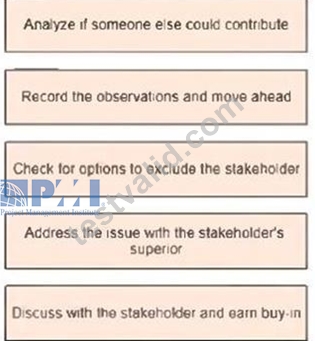
A project manager is worried that a key stakeholder is not participating in the project and has concluded that the final product is not as good as it could have been if the stakeholder had been more involved Drag the scenario on the left to the correct risk response strategy on the right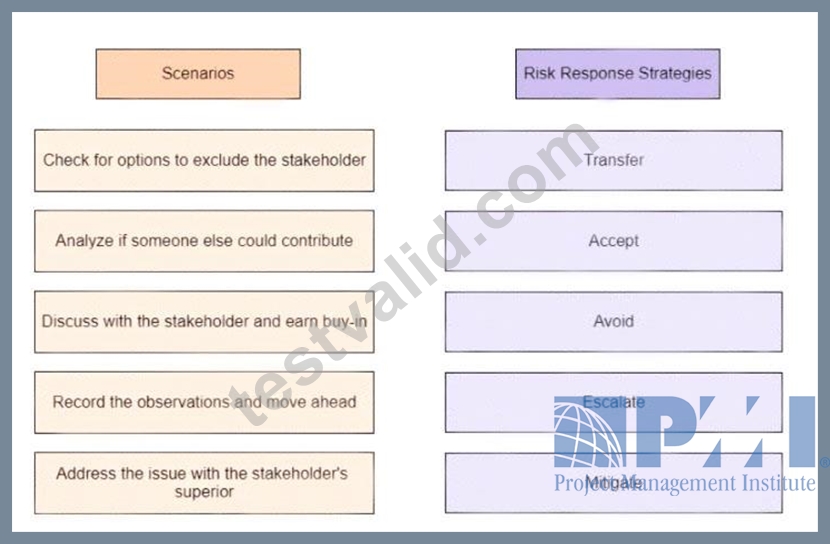
Answer:
Explanation: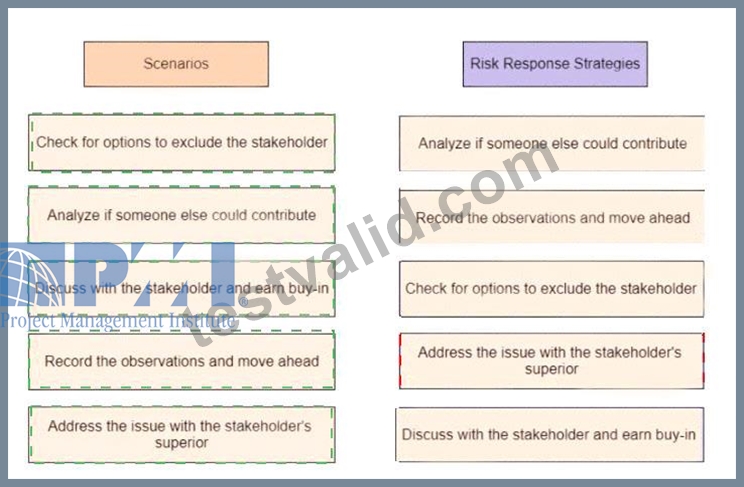
NEW QUESTION # 1112
A key customer stakeholder asks the project team to include new tasks in the backlog and begin analyzing new requests. The customer expects results as soon as possible and pressures the team to attend noncritical meetings. The team is frustrated by this situation.
How should the project manager approach this situation?
- A. Understand the customer's perspective and provide mentoring on agile mindsets.
- B. Ask the customer to work with the product owner to prioritize all requests.
- C. Call for an internal team retrospective and create an improvement action plan.
- D. Work with the team to receive customer directions and improve the process.
Answer: B
NEW QUESTION # 1113
A project manager is leading an in-house company project in its very early stages This current project is similar to another project that ended a year ago What should the project manager do to analyze the involved stakeholders?
- A. Lower the priority of stakeholder engagement as the stakeholders already have knowledge of this kind of project
- B. Refer to the stakeholder register from the previous project as it was similar to the current project
- C. Document in the risk register that the current project may have different
- D. Use lessons learned from the previous project as a guide for the current project's stakeholder register
Answer: D
Explanation:
stakeholders than the previous project
NEW QUESTION # 1114
During a regular review, the project manager of an agile project realizes that a key stakeholder is missing critical information about some features being developed. In order to improve communications and reduce the risk of deploying the wrong features, what should the project manager do?
- A. Conduct stakeholder remapping, evaluate stakeholders by their level of influence and interest on the project, and communicate accordingly.
- B. Invite the stakeholder to the regular "show and tell" sessions so the stakeholder is aware of project progress and feedback can be gathered.
- C. Include the stakeholder on regular project communications so that decisions can be followed up closely.
- D. Assess the stakeholder's needs and communication style and propose a tailored approach with regular status reports and progress meetings.
Answer: B
NEW QUESTION # 1115
In a daily standup meeting, a developer indicates that a backlog item will not be delivered because they need to take an unexpected leave for the next couple of days. The backlog item is a prerequisite for a feature expected by users in the next sprint review.
What should the project lead do?
- A. Ask the developer to postpone the leave until the backlog item is delivered.
- B. Work with the product owner to change the priorities in the sprint backlog.
- C. Ask the development manager to provide a replacement for a couple of days.
- D. Work with the product owner to inform the users that the feature is delayed.
Answer: B
NEW QUESTION # 1116
When managing projects, one important technique is capturing lessons learned from previous projects to improve the organization's project management process. Therefore, in planning the project, it is important to plan the closing procedures, particularly to review the______________
- A. WBS and scope documents
- B. Checklists for risk identification
- C. Team members' performance feedback
- D. Risk responses that were used
Answer: B
Explanation:
Explanation/Reference:
Explanation:
Checklists are a tool and technique of the identify risks process and include risks encountered on similar, previous projects identified through the lessons learned process. The project team will review the checklist as part of the identify risks process as well as during closeout. To help others in the future, the team will add to the list as necessary based on its experience.
NEW QUESTION # 1117
A project manager is leading a project with a predictive approach for a governmental body with strictly defined requirements. In the middle of the project, the sponsor requires a significant new feature to be included. This feature was not in the original plan, nor was it part of the planning process, What should the project manager do?
- A. Inform the senior manager that they will need a new project management plan for this feature,
- B. Complete the most current feature and release the resources for the new feature.
- C. Descope low-priority features that were not explicitly requested and add this feature as a high priority.
- D. Analyze the impact of this change and present the options to the senior manager.
Answer: D
Explanation:
According to the Project Management Body of Knowledge (PMBOK) guide, when a significant change is requested that was not part of the original plan, the project manager should first analyze the impact of this change on the project's scope, schedule, cost, and resources. This analysis should then be presented to the senior manager or project sponsor, who can make an informed decision about whether to proceed with the change.
This approach ensures that the implications of the change are fully understood before any action is taken, and it allows the project's stakeholders to make decisions based on the most accurate and up-to-date information.
This is a key aspect of effective change management in project management. References: PMBOK Guide, 6th Edition, Section 4.5: Perform Integrated Change Control.
NEW QUESTION # 1118
A project manager was assigned to lead a global project with a virtual team that is globally dispersed. The project manager has difficulties communicating with the team members and there seems to be frequent misunderstandings and conflicts.
What should the project manager do?
- A. Listen to team members actively and change the communication practices accordingly.
- B. Ask the team members to refamiliarize themselves with the communications management plan.
- C. Model servant leadership by adapting to team requirements.
- D. Organize effective communication training for team members.
Answer: A
NEW QUESTION # 1119
During a software development project, one team member fails to complete assigned tasks, which prevents integration with other components and causes a milestone to be missed The team member did not inform the project manager about any problems with their tasks.
What should the project manager do first to communicate this to the sponsor?
- A. Escalate the delay to the sponsor informing them that the team member failed to complete assigned tasks.
- B. Schedule a meeting with the sponsor to inform them of the issue and present a recovery plan.
- C. Include an updated project schedule in the weekly status report.
- D. Add it to the risk register as a materialized risk and send the updated risk register to the sponsor.
Answer: D
NEW QUESTION # 1120
A project manager is in the process of closing out a project and has been asked by the project management office (PMO) to confirm that the transfer of knowledge to the operations team for support operations has been successfully completed. Which technique should the project manager apply to verify the knowledge transfer?
- A. Regression analysis
- B. Meetings
- C. Brainstorming
- D. Expert judgment
Answer: D
Explanation:
Expert judgment is a technique often used in project management to assess situations, make decisions, and resolve issues based on the knowledge and experience of experts. In the context of verifying knowledge transfer, expert judgment can be applied by consulting with individuals who have expertise in the subject matter of the knowledge transferred and the process of knowledge transfer itself. These experts can evaluate whether the knowledge has been comprehensively communicated and understood by the operations team. This approach aligns with the PMBOKGuide's principles, which recognize expert judgment as a valuable tool for project managers in various project management processes1.
References: The answer is supported by the principles found in the PMBOKGuide and the Professional in Business Analysis Reference Materials provided by PMI21.
NEW QUESTION # 1121
A project manager has just been assigned to a team that is developing a new design product. The work breakdown structure (VW/BS) has been created and the activities have been assigned to the team members.
The project manager finds that there are activities that could be completed sooner by other team members. If the current assignments are left as is, the project could be delayed 2 weeks.
What should the project manager do in this situation?
- A. Keep the task assignments unchanged since the project management plan has been approved.
- B. Maintain the task assignments as planned and compress the other tasks to keep the project on schedule.
- C. Ask the team members to work overtime to finish the tasks on time according to the schedule.
- D. Review the work allocation and reassign some tasks to shorten the critical path.
Answer: D
Explanation:
The project manager should always monitor and control the project schedule and make adjustments as needed to ensure timely completion of the project. If the project manager identifies that some activities can be done faster by other resources, they should review the work allocation and reassign some tasks to shorten the critical path. The critical path is the longest sequence of activities that determines the project duration. By reducing the duration of the critical path activities, the project manager can avoid delays and meet the project deadline.
This is also consistent with the principle of optimizing resources and minimizing waste, which is part of the PMI Talent Triangle. References:
* PMBOK Guide 7th Edition, page 131
* Agile Practice Guide, page 50
* PMI Talent Triangle 1
NEW QUESTION # 1122
Plan Communications Management develops an approach and plan for project communications based on stakeholders' needs and requirements and:
- A. Enterprise environmental factors
- B. Project staff assignments
- C. Available organizational assets
- D. Interpersonal skills
Answer: C
Explanation:
Section: Initiation
NEW QUESTION # 1123
......
Get 2025 Updated Free PMI PMP Exam Questions and Answer: https://lead2pass.testvalid.com/PMP-valid-exam-test.html