

New 2026 Guaranteed Success with TestValid 2V0-32.24 Dumps VMware PDF Questions
Exceptional Practice To VMware Cloud Operations 8.x Professional V2 Pass the First Time
VMware 2V0-32.24 Exam Syllabus Topics:
| Topic | Details |
|---|---|
| Topic 1 |
|
| Topic 2 |
|
| Topic 3 |
|
| Topic 4 |
|
| Topic 5 |
|
NEW QUESTION # 23
An administrator needs to change the password for the admin user account on vRealize Operations.
Which two methods can the administrator use to complete this task? (Choose two.)
- A. Log in to the Primary node via SSH and use the appropriate command to reset the admin user account password
- B. Log in to each node via SSH and use the appropriate script to reset the admin user account password
- C. Log in to the vRealize Operations admin UI as the admin user and use the change password functionality
- D. Log in to vRealize Suite Lifecycle Manager and use the rotate password functionality
- E. Log in to the vRealize Operations admin UI as the admin user, take the cluster offline and use the change password functionality
Answer: A,B
Explanation:
To change the password for the admin user account in vRealize Operations, these methods can be used:
Log in to the Primary node via SSH and use the appropriate command to reset the admin user account password: This method allows the administrator to directly reset the admin password on the primary node via SSH using command-line utilities specific to vRealize Operations.
Log in to each node via SSH and use the appropriate script to reset the admin user account password: In a multi-node environment, the password reset might need to be performed on each node using a script to ensure that the new password is applied across all nodes in the cluster.
NEW QUESTION # 24
An administrator has been tasked to configure vRealize Operations to securely forward vRealize Operations logs to a centralized syslog server. The logs should be forwarded in their original format.
What would be the resulting Protocol and Port configuration?
- A. Port: 514 - Protocol: syslog
- B. Port: 9543 - Protocol: cfapi
- C. Port: 6514 - Protocol: syslog
- D. Port: 9000 - Protocol: cfapi
Answer: C
Explanation:
To securely forward vRealize Operations logs to a centralized syslog server, the syslog protocol over port
6514 is used. Port 6514 is the default port for secure syslog (Syslog over TLS), ensuring that logs are transmitted in their original format while being encrypted for security.
NEW QUESTION # 25
Which vRealize Log Insight deployment architecture is valid?
- A. A four node cluster deployed with two nodes in each of two datacenters
- B. A three node cluster forwarding all messages to a three node cluster in another datacenter
- C. A three node cluster with a large central node and two smaller remote nodes
- D. A six node cluster deployed with three nodes in each of two datacenters
Answer: D
Explanation:
vRealize Log Insight supports the deployment of multi-node clusters across multiple data centers for high availability and scalability. The architecture with three nodes in each of two separate data centers ensures fault tolerance and load balancing. The six-node cluster can operate across the two datacenters and provides a resilient and distributed logging solution.
NEW QUESTION # 26
vRealize Operations can be integrated with which two other VMware solutions? (Choose two.)
- A. vRealize Log Insight
- B. vRealize Network Insight Cloud
- C. vRealize Automation Cloud
- D. vRealize Log Insight Cloud
- E. vRealize Automation
Answer: A,E
Explanation:
vRealize Log Insight: vRealize Operations can be integrated with vRealize Log Insight to provide enhanced log management and visualization for troubleshooting and performance analysis across the environment.
vRealize Automation: vRealize Operations can also be integrated with vRealize Automation, allowing for better management and optimization of resources by correlating performance data with automation workflows.
NEW QUESTION # 27
An administrator has been tasked with analyzing the impact of deploying a new application. The current infrastructure is using an external storage array.
What vRealize Operations What-If Analysis should the administrator perform to get this information?
- A. Infrastructure Planning: Hyperconverged
- B. Workload Planning: Traditional
- C. Workload Planning: Hyperconverged
- D. Infrastructure Planning: Traditional
Answer: B
Explanation:
To analyze the impact of deploying a new application in an environment using an external storage array, the administrator should perform a Workload Planning: Traditional analysis in vRealize Operations. This type of analysis focuses on traditional infrastructure, which includes external storage arrays and other non- hyperconverged components. It allows for evaluating how the new application might affect resources such as CPU, memory, and storage, while considering the traditional setup of the infrastructure.
NEW QUESTION # 28
In vRealize Operations, a user applies a CPU License to a custom group which has existing hosts.
How will the Virtual Machines (VMs) on the existing hosts be affected?
- A. The VMs running on the hosts show a 'License is Invalid' watermark.
- B. vRealize Operations prompts the user to apply a VM license key to the VMs running.
- C. The VMs running on the hosts are not affected.
- D. The CPU license gets converted to a CPU and VM license.
Answer: C
Explanation:
When a CPU license is applied to a custom group in vRealize Operations, it impacts the hosts but does not directly affect the Virtual Machines (VMs) running on those hosts. The license is applied at the host level, and the VMs are not impacted by this change. The VMs will continue to run as they were, and no additional VM licenses are required.
NEW QUESTION # 29
Refer to the exhibit.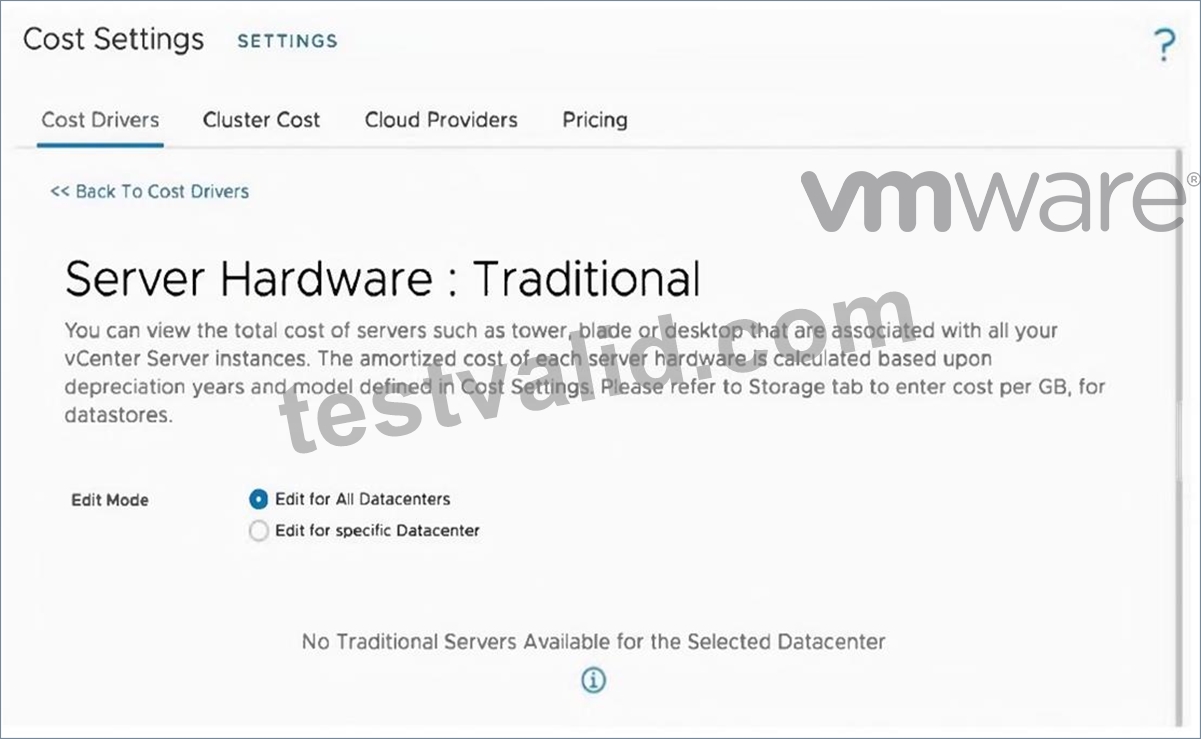
An administrator is tasked to manually upload the cost drivers of all the hosts, to obtain cost calculations accurate for their datacenter. However, when the administrator tries to update the cost drivers, the message displayed on the exhibit is shown.
What is the cause of this message?
- A. Reference database is being used.
- B. All hosts are in vSAN enabled clusters.
- C. Cost drivers must be established on a per Datacenter basis.
- D. Cost calculation process is running at this moment.
Answer: C
Explanation:
The message in the exhibit indicates that no "Traditional Servers" are available for the selected datacenter, which means the cost drivers have not been configured for that specific datacenter. In vRealize Suite, cost drivers must be set up on a per-datacenter basis, and the administrator needs to select the appropriate datacenter to configure and upload the cost drivers accordingly.
NEW QUESTION # 30
A user reports that when browsing to the vRealize Operations (vROps) user interface a 503 error is displayed.
An administrator determines that the vROps cluster is offline.
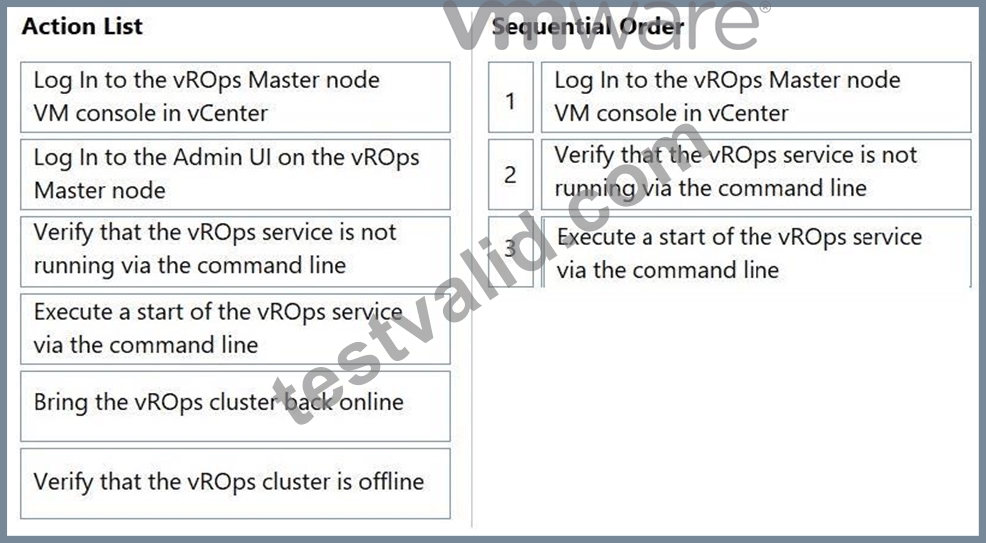
Drag and drop the three correct actions the administrator must complete to troubleshoot the issue from the action list on the left and place the action into the correct sequence on the right. (Choose three.)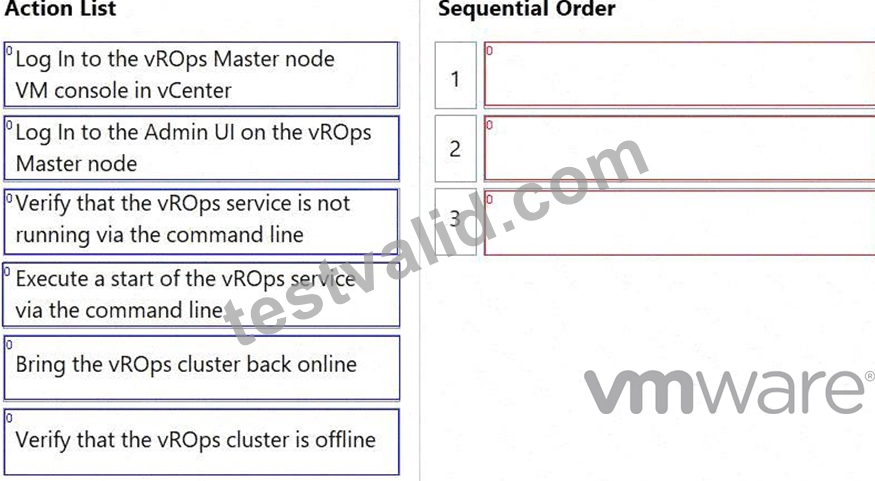
Answer:
Explanation: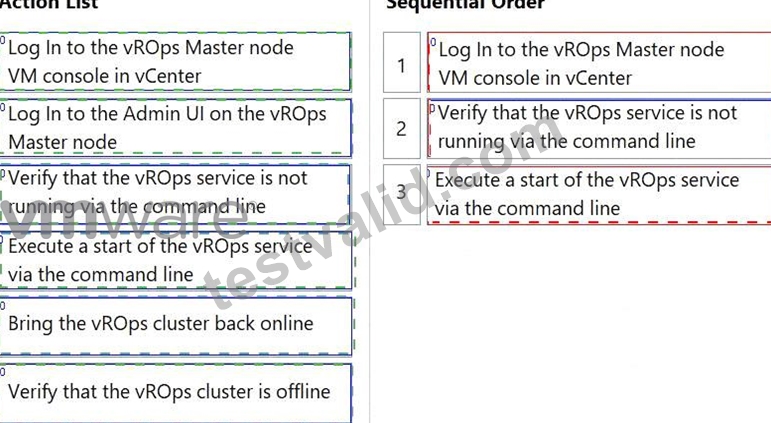
NEW QUESTION # 31
An administrator has configured vRealize Lifecycle Manager to manage content between two vRealize Operations instances. The administrator is encountering an issue when releasing content to the second vRealize Operations instance.
What are the two possible causes of the issue? (Choose two.)
- A. Configuring a vRealize Operations endpoint with an SSH user other than root is not supported.
- B. Content release from different versions of vRealize Operations Manager may fail.
- C. The policy "Enable code review" must be added to the second vRealize Operations endpoint.
- D. A vRealize Operations endpoint can only be configured with FQDN.
- E. Only the policy "Allow content to be captured from this endpoint" has been configured for both vRealize Operations endpoints.
Answer: A,B
Explanation:
Configuring a vRealize Operations endpoint with an SSH user other than root is not supported: vRealize Lifecycle Manager (vRSLCM) requires the use of the root user for SSH access to vRealize Operations endpoints. Using any other user for SSH access is not supported and may lead to issues when attempting to release content.
Content release from different versions of vRealize Operations Manager may fail: If the two vRealize Operations instances are running different versions, content release might fail due to version incompatibility.
It's recommended to ensure both instances are running compatible versions of vRealize Operations to ensure seamless content management and release.
NEW QUESTION # 32
When setting up the vRealize Log Insight integration within vRealize Operations what do administrators configure within vRealize Operations?
- A. The vRealize Log Insight management pack
- B. The vRealize Log Insight troubleshootingdashboard
- C. The vRealize Log Insight collector group instance
- D. The vRealize Log Insight content pack
Answer: A
Explanation:
When setting up vRealize Log Insight integration within vRealize Operations, administrators configure the vRealize Log Insight management pack in vRealize Operations. This management pack allows vRealize Operations to integrate with vRealize Log Insight, enabling the collection and analysis of log data from vRealize Log Insight within the vRealize Operations platform. It provides enhanced visibility and monitoring for logs, allowing users to correlate performance data with log data.
NEW QUESTION # 33
Which statement is correct about the deployment process for vRealize Log Insight using vRealize Suite Lifecycle Manager?
- A. Federal Information Processing Standard (FIPS) is enabled by default.
- B. A cluster Virtual IP (VIP) address is a mandatory requirement.
- C. VMware Identity Manager (VIDM) is not a mandatory requirement.
- D. A DHCP address can be used for vRealize Log Insight worker nodes.
Answer: D
Explanation:
In the deployment process for vRealize Log Insight using vRealize Suite Lifecycle Manager, DHCP addresses can be used for vRealize Log Insight worker nodes. This allows the flexibility to use dynamic IP addresses for worker nodes, simplifying network configuration in some environments.
NEW QUESTION # 34
Which three factors determine the size of vRealize Log Insight (vRLI) deployment? (Choose three.)
- A. Log ingestion per day
- B. Type of vRLI Agents
- C. Number of endpoints
- D. Sysloq connections
- E. Events per second
- F. Log message format
Answer: A,C,E
Explanation:
The size of a vRealize Log Insight (vRLI) deployment is determined by the following factors:
Number of endpoints: The more endpoints (e.g., ESXi hosts, virtual machines, network devices) that generate logs, the larger the vRLI deployment needs to be to handle the log data.
Log ingestion per day: The volume of log data ingested on a daily basis affects the size of the deployment, as more storage and processing power are required to handle higher data volumes.
Events per second: The rate at which events are generated (events per second) directly impacts the capacity required for log processing and storage in vRLI.
NEW QUESTION # 35
An administrator has been tasked with creating an identically configured deployment of the production vRealize Operations cluster that is currently managed by vRealize Suite Lifecycle Manager (vRSLCM).
Which four steps should the administrator complete to meet this objective? (Choose four.)
- A. Update the JSON file to replace any configuration details
- B. Create a new vRSLCM Environment using the JSON Configuration file
- C. Create new locker SSL certificates and passwords for the new deployment
- D. Create a new vRSLCM Environment using the YAML Configuration file
- E. Create new locker SSL certificates for the new deployment
- F. Update the YAML file to replace any configuration details
- G. Export the configuration for the Production vRSLCM Environment
Answer: A,B,F,G
Explanation:
Update the YAML file to replace any configuration details: The configuration details for the production vRealize Operations cluster will need to be reflected in the YAML file, which contains setup details for replication.
Create a new vRSLCM Environment using the JSON Configuration file: The environment configuration for the new deployment can be created using the exported JSON configuration file.
Update the JSON file to replace any configuration details: The exported JSON configuration file needs to be modified to ensure that it points to the new environment setup (e.g., IP addresses, FQDNs).
Export the configuration for the Production vRSLCM Environment: Exporting the existing production configuration is the first step in creating a new, identically configured deployment of vRealize Operations.
NEW QUESTION # 36
Which three features are available in vRealize Log Insight? (Choose three.)
- A. Use of Remote Collectors
- B. Application Discovery Dashboard
- C. Interactive Analytics
- D. Machine Learning Analytics
- E. Event Forwarding
- F. Management Pack Marketplace
Answer: A,C,E
Explanation:
Interactive Analytics: vRealize Log Insight provides an interactive analytics interface that allows users to search, query, and visualize log data in real time.
Use of Remote Collectors: Remote Collectors in vRealize Log Insight allow logs to be collected from remote locations and forwarded to the central vRLI instance for processing.
Event Forwarding: vRealize Log Insight supports event forwarding, enabling the forwarding of log data to other systems or central servers, which helps with centralized log management.
NEW QUESTION # 37
An administrator needs to deploy a 3-node High Availability cluster of vRealize Operations using custom CA- signed certificates. An existing vRealize Operations development environment has previously been deployed using vRealize Suite Lifecycle Manager.
Which method should the Administrator use to complete this objective?
- A. Deploy vRealize Operations analytics cluster using Command Line Interface.
- B. Deploy a single node cluster at the begining to further expand it to 3 nodes in the next step.
- C. Deploy vRealize Operations analytics cluster using vRealize Suite Lifecycle Manager.
- D. Deploy 3 nodes independently, replace certificates and then form the 3-node cluster.
Answer: C
Explanation:
To deploy a 3-node High Availability cluster of vRealize Operationswith custom CA-signed certificates, the best approach is to use vRealize Suite Lifecycle Manager (vRSLCM). Since vRSLCM has already been used in the existing vRealize Operations development environment, it simplifies the deployment process for a 3- node cluster, allowing for easy management of certificates and cluster configuration.
Using vRSLCM allows for the configuration of custom CA-signed certificates during the deployment, and it supports the creation of the necessary cluster nodes in a seamless manner. This ensures that the HA configuration is maintained and the custom certificates are applied properly across all nodes.
NEW QUESTION # 38
An administrator looking to add a new FQDN of vRealize Suite Lifecycle Manager in the VMware Identity Manager catalogue.
Which action does the administrator need to take?
- A. Delete vRealize Suite Lifecycle Manager and redeploy it
- B. Update authentication provider and re-sync FQDN
- C. Recreate authentication provider and sync VMware Identity Manager
- D. Sync FQDN and re-register with VMware Identity Manager
Answer: B
Explanation:
To add a new Fully Qualified Domain Name (FQDN) of vRealize Suite Lifecycle Manager (vRSLCM) in the VMware Identity Manager catalog, the administrator needs to update the authentication provider in VMware Identity Manager and then re-sync the FQDN. This ensures the new FQDN is properly reflected in the VMware Identity Manager for seamless integration.
NEW QUESTION # 39
An administrator has been tasked with implementing a solution to meet the following requirements:
Provide monitoring and predictive analytics across enterprise database solutions Provide monitoring and predictive analytics across enterprise networking solutions Provide performance data for common enterprise application solutions Provide performance data for VMware Tanzu Application Service Present all collected data to administrators within a single portal Provide vendor support for the deployed solution Which solution could help the administrator complete this task?
- A. vRealize Log Insight and vRealize Suite Lifecycle Manager
- B. vRealize Operations using a community created management pack
- C. vRealize Operations and vRealize True Visibility Suite
- D. vRealize Operations using the Endpoint Operations Agent
Answer: C
Explanation:
vRealize Operations, combined with thevRealize True Visibility Suite, provides comprehensive monitoring and predictive analytics across various enterprise solutions such as databases, networking, applications, and VMware Tanzu Application Service. TheTrue Visibility Suiteincludes a wide range of management packs for different technologies, which allows the collection and visualization ofperformance data for these enterprise solutions in a single portal. Additionally, the suite offers vendor support, ensuring reliable integration and support for the deployed solution.
NEW QUESTION # 40
When creating a vRealize Operations content endpoint in vRealize Suite Lifecycle Manager what should an administrator configure on the vRealize Operations appliance?
- A. A new file system partition that is shared for storing content exports
- B. A configuration file with the vRealize Suite Lifecycle Manager server details
- C. A local user account with the relevant permissions to allow ssh access
- D. A content management agent for capturing the supported types of content
Answer: B
Explanation:
When creating a vRealize Operations content endpoint in vRealize Suite Lifecycle Manager (vRSLCM), an administrator must configure a configuration file that includes the vRealize Suite Lifecycle Manager server details. This allows vRealize Operations to communicate with vRSLCM and facilitates the management of content within vRealize Operations using the Lifecycle Manager.
NEW QUESTION # 41
What three types of authentication sources are valid in vRealize Operations? (Choose three.)
- A. VMware Identity Manager
- B. RADIUS
- C. OpenLDAP
- D. Active Directory
- E. LocalOS
- F. QAuth2
Answer: A,C,D
Explanation:
In vRealize Operations, the following authentication sources are valid:
Active Directory: vRealize Operations can integrate with Active Directory for user authentication.
OpenLDAP: vRealize Operations supports integration with OpenLDAP as an authentication source.
VMware Identity Manager: vRealize Operations can also integrate with VMware Identity Manager to manage user authentication and access.
NEW QUESTION # 42
A vRealize Log Insight (vRLI) administrator wants to search archived logs for certain events.
What are the required steps to provide the administrator the ability to search the log messages?
- A. SSH into the vRLI appliance, mount the archiving NFS share then import the archive using CLI.
- B. SSH into the NFS server, mount the archiving partition, then import the archive using CLI to vRLI appliance.
- C. SSH into the vRLI appliance, install vRLI tools, then import the archive using CLI from NFS share to the vRLI appliance.
- D. SSH into the NFS server, install vRLI tools, then import the archive using CLI from NFS share to the vRLI appliance.
Answer: A
Explanation:
To allow the administrator to search archived logs in vRealize Log Insight (vRLI), the logs stored in an NFS share must be imported into the vRLI appliance. The correct steps involve SSHing into the vRLI appliance, mounting the NFS share where the archived logs are stored, and then using the CLI to import the archived logs into the vRLI appliance for searching. This is the standard method for handling archived log files in vRLI.
NEW QUESTION # 43
......
2V0-32.24 EXAM DUMPS WITH GUARANTEED SUCCESS: https://lead2pass.testvalid.com/2V0-32.24-valid-exam-test.html