

Palo Alto Networks PCCET Real Exam Questions Test Engine Dumps Training With 145 Questions
PCCET Actual Questions Answers PDF 100% Cover Real Exam Questions
How to get ready for the Palo Alto Networks PCCET Certification Exam
The best preparation guide for the Palo Alto Networks PCCET Certification Exam
If you want to get PCCET Certification in a single try, keep reading
PCCET is an entry-level cybersecurity certification consisting of questions based on network, cloud, endpoint and mobile security, and social engineering. Candidates will be asked to demonstrate knowledge on how to protect devices from malware and hacking attempts while being cognizant of network security concerns, vulnerabilities, and the latest threats impacting the industry. Candidates will be required to answer questions regarding cyber-attacks in order to demonstrate their competency in each of the exam objectives. PCCET Dumps are the most trusted tool for your success in the PCCET certification exam.
In this article, we will discuss the exam topics, learning objectives, and exam format in greater detail. We will also take a deeper dive into the sources available for the prep of the PCCET Exam, including exam dumps. Moreover, we outline the certification process, as well as provide information about the vendor testing locations and date for the examination. Let's start learning!
NEW QUESTION # 43
Which NGFW feature is used to provide continuous identification, categorization, and control of known and previously unknown SaaS applications?
- A. Device-ID
- B. Content-ID
- C. User-ID
- D. App-ID
Answer: D
Explanation:
App-ID technology leverages the power of the broad global community to provide continuous identification, categorization, and granular risk-based control of known and previously unknown SaaS applications, ensuring new applications are discovered automatically as they become popular.
NEW QUESTION # 44
What does "forensics" refer to in a Security Operations process?
- A. Reviewing information about a broad range of activities
- B. Analyzing new IDS/IPS platforms for an enterprise
- C. Collecting raw data needed to complete the detailed analysis of an investigation
- D. Validating cyber analysts' backgrounds before hiring
Answer: C
NEW QUESTION # 45
Match the description with the VPN technology.
Answer:
Explanation:
NEW QUESTION # 46
What are three benefits of the cloud native security platform? (Choose three.)
- A. Flexibility
- B. Exclusivity
- C. Digital transformation
- D. Increased throughput
- E. Agility
Answer: A,C,D
NEW QUESTION # 47
Which pillar of Prisma Cloud application security does vulnerability management fall under?
- A. compute security
- B. identity security
- C. network protection
- D. dynamic computing
Answer: A
Explanation:
Prisma Cloud comprises four pillars:
* Visibility, governance, and compliance. Gain deep visibility into the security posture of multicloud environments. Track everything that gets deployed with an automated asset inventory, and maintain compliance with out-of-the-box governance policies that enforce good behavior across your environments.
* Compute security. Secure hosts, containers, and serverless workloads throughout the application lifecycle. Detect and prevent risks by integrating vulnerability intelligence into your integrated development environment (IDE), software configuration management (SCM), and CI/CD workflows. Enforce machine learning-based runtime protection to protect applications and workloads in real time.
* Network protection. Continuously monitor network activity for anomalous behavior, enforce microservice-aware micro-segmentation, and implement industry-leading firewall protection. Protect the network perimeter and the connectivity between containers and hosts.
* Identity security. Monitor and leverage user and entity behavior analytics (UEBA) across your environments to detect and block malicious actions. Gain visibility into and enforce governance p
NEW QUESTION # 48
Why have software developers widely embraced the use of containers?
- A. Containers require separate development and production environments to promote authentic code.
- B. Containers simplify the building and deploying of cloud native applications.
- C. Containers are host specific and are not portable across different virtual machine hosts.
- D. Containers share application dependencies with other containers and with their host computer.
Answer: B
NEW QUESTION # 49
Which type of malware takes advantage of a vulnerability on an endpoint or server?
- A. technique
- B. patch
- C. vulnerability
- D. exploit
Answer: A
NEW QUESTION # 50
What is used to orchestrate, coordinate, and control clusters of containers?
- A. Prisma Saas
- B. CN-Series
- C. Docker
- D. Kubernetes
Answer: D
Explanation:
Explanation
As containers grew in popularity and used diversified orchestrators such as Kubernetes (and its derivatives, such as OpenShift), Mesos, and Docker Swarm, it became increasingly important to deploy and operate containers at scale.
https://www.dynatrace.com/news/blog/kubernetes-vs-docker/
NEW QUESTION # 51
A user is provided access over the internet to an application running on a cloud infrastructure. The servers, databases, and code of that application are hosted and maintained by the vendor.
Which NIST cloud service model is this?
- A. PaaS
- B. IaaS
- C. CaaS
- D. SaaS
Answer: D
Explanation:
Explanation
SaaS - User responsible for only the data, vendor responsible for rest
NEW QUESTION # 52
Which characteristic of serverless computing enables developers to quickly deploy application code?
- A. Using Container as a Service (CaaS) to deploy application containers to run their code.
- B. Using cloud service spot pricing to reduce the cost of using virtual machines to run their application code
- C. Uploading cloud service autoscaling services to deploy more virtual machines to run their application code based on user demand
- D. Uploading the application code itself, without having to provision a full container image or any OS virtual machine components
Answer: D
Explanation:
Explanation
"In serverless apps, the developer uploads only the app package itself, without a full container image or any OS components. The platform dynamically packages it into an image, runs the image in a container, and (if needed) instantiates the underlying host OS and VM and the hardware required to run them."
NEW QUESTION # 53
What is the primary security focus after consolidating data center hypervisor hosts within trust levels?
- A. control and protect inter-host traffic by using IPv4 addressing
- B. control and protect inter-host traffic using routers configured to use the Border Gateway Protocol (BGP) dynamic routing protocol
- C. control and protect inter-host traffic using physical network security appliances
- D. control and protect inter-host traffic by exporting all your traffic logs to a sysvol log server using the User Datagram Protocol (UDP)
Answer: C
Explanation:
Explanation
page 211 "Consolidating servers within trust levels: Organizations often consolidate servers within the same trust level into a single virtual computing environment: ... ... ... This virtual systems capability enables a single physical device to be used to simultaneously meet the unique requirements of multiple VMs or groups of VMs. Control and protection of inter-host traffic with physical network security appliances that are properly positioned and configured is the primary security focus."
NEW QUESTION # 54
Which TCP/IP sub-protocol operates at the Layer7 of the OSI model?
- A. NFS
- B. UDP
- C. SNMP
- D. MAC
Answer: C
Explanation:
* Application (Layer 7 or L7): This layer identifies and establishes availability of communication partners, determines resource availability, and synchronizes communication.
* Presentation (Layer 6 or L6): This layer provides coding and conversion functions (such as data representation, character conversion, data compression, and data encryption) to ensure that data sent from the Application layer of one system is compatible with the Application layer of the receiving system.
* Session (Layer 5 or L5): This layer manages communication sessions (service requests and service responses) between networked systems, including connection establishment, data transfer, and connection release.
* Transport (Layer 4 or L4): This layer provides transparent, reliable data transport and end-to-end transmission control.
NEW QUESTION # 55
Which option is a Prisma Access security service?
- A. Firewall as a Service (FWaaS)
- B. Virtual Private Networks (VPNs)
- C. Compute Security
- D. Software-defined wide-area networks (SD-WANs)
Answer: A
Explanation:
Explanation
Prisma Access provides firewall as a service (FWaaS) that protects branch offices from threats while also providing the security services expected from a next-generation firewall. The full spectrum of FWaaS includes threat prevention, URL filtering, sandboxing, and more.
NEW QUESTION # 56
Which two network resources does a directory service database contain? (Choose two.)
- A. /etc/shadow files
- B. Users
- C. Terminal shell types on endpoints
- D. Services
Answer: B,D
Explanation:
A directory service is a database that contains information about users, resources, and services in a network.
NEW QUESTION # 57
Which IPsec feature allows device traffic to go directly to the Internet?
- A. Diffie-Hellman groups
- B. d.Authentication Header (AH)
- C. IKE Security Association
- D. Split tunneling
Answer: D
Explanation:
"Or split tunneling can be configured to allow internet traffic from the device to go directly to the internet, while other specific types of traffic route through the IPsec tunnel, for acceptable protection with much less performance degradation."
NEW QUESTION # 58
Which Palo Alto Networks subscription service complements App-ID by enabling you to configure the next- generation firewall to identify and control access to websites and to protect your organization from websites hosting malware and phishing pages?
- A. WildFire
- B. Threat Prevention
- C. DNS Security
- D. URL Filtering
Answer: D
NEW QUESTION # 59
Which aspect of a SaaS application requires compliance with local organizational security policies?
- A. Vulnerability scanning and management
- B. Types of physical storage media used
- C. Acceptable use of the SaaS application
- D. Data-at-rest encryption standards
Answer: C
NEW QUESTION # 60
Which three layers of the OSI model correspond to the Application Layer (L4) of the TCP/IP model?
- A. Data Link, Session, Transport
- B. Physical, Data Link, Network
- C. Session, Transport, Network
- D. Application, Presentation, and Session
Answer: D
Explanation:
Explanation
Application (Layer 4 or L4): This layer loosely corresponds to Layers 5 through 7 of the OSI model.
Transport (Layer 3 or L3): This layer corresponds to Layer 4 of the OSI model.
Internet (Layer 2 or L2): This layer corresponds to Layer 3 of the OSI model.
Network Access (Layer 1 or L1): This layer corresponds to Layers 1 and 2 of the OSI model
NEW QUESTION # 61
Match the Identity and Access Management (IAM) security control with the appropriate definition.
Answer:
Explanation: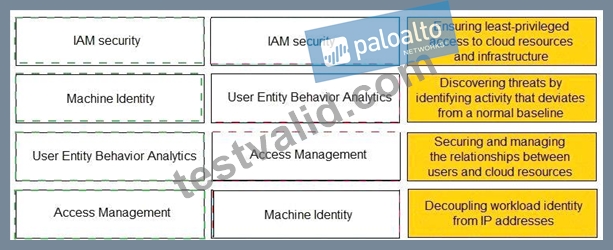
NEW QUESTION # 62
Which SOAR feature coordinates across technologies, security teams, and external users for centralized data visibility and action?
- A. Playbooks
- B. Integrations
- C. Case management
- D. Ticketing system
Answer: A
NEW QUESTION # 63
Which core component is used to implement a Zero Trust architecture?
- A. VPN Concentrator
- B. Web Application Zone
- C. Segmentation Platform
- D. Content Identification
Answer: C
Explanation:
"Remember that a trust zone is not intended to be a "pocket of trust" where systems (and therefore threats) within the zone can communicate freely and directly with each other. For a full Zero Trust implementation, the network would be configured to ensure that all communications traffic, including traffic between devices in the same zone, is intermediated by the corresponding Zero Trust Segmentation Platform."
NEW QUESTION # 64
......
TestValid PCCET Exam Practice Test Questions: https://lead2pass.testvalid.com/PCCET-valid-exam-test.html