

Prepare Top NAHQ CPHQ Exam Study Guide Practice Questions Edition
Go to CPHQ Questions - Try CPHQ dumps pdf
The Certified Professional in Healthcare Quality (CPHQ) Examination is a certification exam designed for healthcare professionals who are looking to demonstrate their knowledge and expertise in healthcare quality management. CPHQ exam is administered by the National Association for Healthcare Quality (NAHQ), a professional association that represents healthcare quality professionals worldwide.
NAHQ CPHQ certification exam is a valuable certification for healthcare professionals who are interested in advancing their careers in the quality improvement field. Certified Professional in Healthcare Quality Examination certification is recognized as a standard of excellence in the healthcare industry and is highly valued by employers, peers, and patients alike. CPHQ exam is rigorous and comprehensive, covering a wide range of topics related to healthcare quality improvement. Healthcare professionals who are interested in pursuing the CPHQ certification should carefully review the eligibility requirements and prepare thoroughly for the exam.
NEW QUESTION # 29
Universities often evaluate applicants for admission on the basis of, among other things, the applicants' scores on standardized tests. The scores are thus one of the criteria by which program judge the Quality of their applicants. However, although two programs may use the same criterion - scores on a specific standardized examination-to evaluate applicants, the programs may differ markedly on standards: One program may consider applicants acceptable if they have scores above the 50th percentile, whereas the score above the 90th percentile may be the standard of acceptability for the other program.
This example clearly defines the difference between:
- A. Criteria and standards
- B. Efficacy and equity
- C. Processes and outcomes
- D. Sources and structure
Answer: A
NEW QUESTION # 30
A patient safety manager provided training on hand hygiene guidelines. The clinical manager Is confident that staff are following the guidelines. Which of the following Is the best method to evaluate the current compliance with the guidelines?
- A. calculation of Infection rates compared to a baseline
- B. direct observation of staff
- C. collection of bacterial hand cultures
- D. a test with a passing score of 98%
Answer: B
Explanation:
* According to the WHO Guidelines on Hand Hygiene in Health Care, direct observation of hand hygiene practices is the gold standard for measuring compliance1. Directobservation allows for the assessment of the five moments of hand hygiene, the use of appropriate technique, and the identification of barriers and facilitators to adherence1.
* Direct observation also provides an opportunity for immediate feedback and education to the health care workers, which can improve their knowledge and motivation to perform hand hygiene2. Direct observation can be done covertly or overtly, depending on the purpose and context of the audit2.
* Other methods of measuring hand hygiene compliance, such as collection of bacterial hand cultures, calculation of infection rates, or a test with a passing score, have limitations and disadvantages. For example, bacterial hand cultures may not reflect the actual transmission of pathogens, infection rates may be influenced by many factors other than hand hygiene, and a test score may not correlate with actual behavior2. References: 1: WHO Guidelines on Hand Hygiene in Health Care, WHO, 2009 2:
Hand Hygiene: Education, Monitoring and Feedback, CDC, 2019
NEW QUESTION # 31
A team has identified that labeled cutting boards are needed in a kitchen to decrease cross-contamination.
After a new process has been implemented, it is discovered that the labeled cutting boards are not being used.
Which of the following is the next action the team should take?
- A. Increase monitoring.
- B. Determine barriers to compliance.
- C. Initiate progressive discipline.
- D. Conduct a root cause analysis.
Answer: B
Explanation:
When it is discovered that labeled cutting boards, which were introduced to decrease cross-contamination, are not being used, the next logical step is to determine barriers to compliance. This step is crucial for the following reasons:
Identifying the Root Cause: Before taking any corrective actions, it is important to understand why staff members are not using the labeled cutting boards. Barriers might include a lack of awareness, inadequate training, inconvenience, or resistance to change.
Addressing the Correct Issue: Without identifying the barriers, any action taken may not be effective. For instance, increasing monitoring or initiating discipline without understanding why the new process is not being followed could lead to frustration and further non-compliance.
Facilitating Improvement: Once the barriers are identified, targeted interventions can be developed. This might include additional training, revising the process for ease of use, or addressing any misconceptions about the importance of the change.
Ensuring Sustainability: By resolving the underlying issues that prevent compliance, the organization can ensure that the process improvement is sustained over time, leading to better outcomes.
References: (Based on Healthcare Quality NAHQ documents and resources)
NAHQ CPHQ Study Guide, Section on Change Management and Compliance.
Quality Management in Health Care, Article on Identifying and Overcoming Barriers to Compliance.
=========
NEW QUESTION # 32
It involves identification and selection of a patient's medical record or group of records after the patient has been discharged from the hospital or clinic. Many proponents of medical record review believe it to be the most accurate method of data collection.
What is it?
- A. Prospective data collection
- B. Data collection forms
- C. Scanners
- D. Retrospective data collection
Answer: D
NEW QUESTION # 33
A healthcare quality professional receives the following Consumer Assessment of Healthcare Providers and Systems (CAHPS) survey results:
Which of the following should be the next action by the professional?
- A. Solicit Input from the member advocacy panel regarding barriers to service.
- B. Recommend a member education Initiative on access to care standards.
- C. Initiate a practitioner communication initiative on access to care standards.
- D. Request a population demographic report on current membership diversity.
Answer: A
Explanation:
Based on the provided Consumer Assessment of Healthcare Providers and Systems (CAHPS) survey results, it's clear that the health plan's performance in several categories is below the Quality Compass Mean. This indicates potential areas for improvement in how services are perceived by members relative to other benchmarks.
Option D, "Solicit input from the member advocacy panel regarding barriers to service," directly targets understanding and addressing the lower satisfaction scores related to the ease of getting necessary care and overall satisfaction with the health plan. Engaging with a member advocacy panel could provide valuable qualitative insights into why members feel the way they do about the services provided, guiding more effective interventions.
NEW QUESTION # 34
Organizational size affects the ability to disseminate best practices
- A. True
- B. It depends on situation
- C. Difficult to decide
- D. False
Answer: B
NEW QUESTION # 35
Which of the following statements most accurately describes health literacy?
- A. emphasizes people's ability to understand health information
- B. maintains an individual health perspective
- C. designs care around the needs of the patient
- D. changes health behaviors and decisions
Answer: A
Explanation:
Health literacy is defined as the degree to which individuals have the ability to find, understand, and use information and services to inform health-related decisions and actions for themselves and others1. It goes beyond the ability to read pamphlets or comply with prescribed actions from a doctor2.
Health literacy involves the ability to gain access to, understand, and use information in ways which promote and maintain good health for themselves, their families, and their communities2. It is not just a personal resource; higher levels of health literacy within populations yield social benefits too2.
The new U.S. government definition of health literacy for Healthy People 2030 focuses on the ability to make well-informed decisions rather than appropriate ones, and on health equity1. It emphasizes people's ability to use health information rather than just understand it1.
Therefore, among the given options, option D that states health literacy "emphasizes people's ability to understand health information" most accurately describes health literacy.
NEW QUESTION # 36
Payers are more likely to embrace the optimization definition of care which can put them at odds with:
- A. Physicians
- B. Both A & B
- C. Clinicians
- D. Health administrators
Answer: B
NEW QUESTION # 37
A provider's Ongoing Professional Practice Evaluation (OPPE) profile is shown below. In this organization, if a provider partially meets or does not meet performance expectations, they are referred to peer review for a Focused Professional Practice Evaluation (FPPE).
Fully Meets: >80% of measures at threshold
Meets: 65% to 80% of measures at threshold
Partially Meets: 40% to 64% of measures threshold
Does Not Meet: <40% of measures at threshold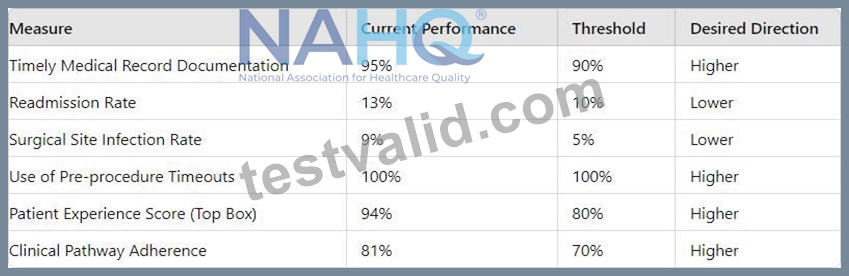
After reviewing this provider's overall profile, what should the healthcare quality professional suggest?
- A. The provider does not meet expectations; refer to peer review.
- B. The provider fully meets expectations; do nothing.
- C. The provider meets expectations; retain privileges.
- D. The provider partially meets expectations; retain privileges.
Answer: C
Explanation:
To determine the appropriate action for the provider based on the Ongoing Professional Practice Evaluation (OPPE) profile shown, we first assess how many measures meet the thresholds set by the organization and categorize the provider's performance according to the provided criteria:
Timely Medical Record Documentation: Current performance is 95%, which meets the threshold of 90%.
Readmission Rate: Current performance is 13%, which does not meet the threshold of 10%.
Surgical Site Infection Rate: Current performance is 9%, which does not meet the threshold of 5%.
Use of Pre-procedure Timeouts: Current performance is 100%, which meets the threshold of 100%.
Patient Experience Score (Top Box): Current performance is 94%, which meets the threshold of 80%.
Clinical Pathway Adherence: Current performance is 81%, which meets the threshold of 70%.
Out of these six measures, four measures meet or exceed the threshold:
Timely Medical Record Documentation
Use of Pre-procedure Timeouts
Patient Experience Score (Top Box)
Clinical Pathway Adherence
This constitutes meeting the threshold in approximately 67% of the measures (4 out of 6).
According to the OPPE criteria:
Fully Meets: >80% of measures at threshold
Meets: 65% to 80% of measures at threshold
Partially Meets: 40% to 64% of measures threshold
Does Not Meet: <40% of measures at threshold
Given that 67% of measures meet the thresholds, the provider's performance falls within the "Meets" category.
NEW QUESTION # 38
To promote staff engagement In a new Initiative, educators should focus on staff
- A. perceptions of the benefits of change.
- B. who want to advance In the organization.
- C. attitudes of business as usual.
- D. who appear resistant to change.
Answer: A
Explanation:
To promote staff engagement in a new initiative, it's crucial to focus on staff perceptions of the benefits of change123. This involves communicating the value and benefits of the new initiative to the staff, and how it will improve their work or the outcomes for patients12. Staff are more likely to engage with a new initiative if they perceive it as beneficial and worthwhile23. This can be achieved through clear communication, education, and providing proof that new practices will be worthwhile3. It's also important to create a culture that empowers staff to achieve positive change2.
Reference: https://www.bmj.com/content/368/bmj.m872 https://hbr.org/2022/02/3-ways-hospitals-can- boost-worker-engagement
NEW QUESTION # 39
An organization implemented a revised medication reconciliation process 21 months ago. The results of compliance with the revised process were recorded on a statistical process control chart:
(Use the scroll bar to the right to scroll down as needed.)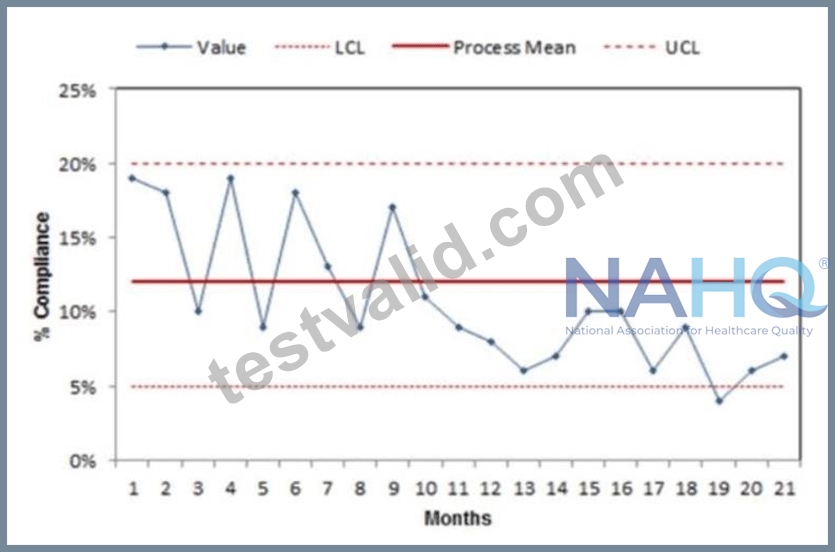
Which of the following should be concluded by a performance improvement coordinator after evaluation of the control chart?
- A. The number of compliant clinicians has increased.
- B. The data indicate compliance has decreased.
- C. There is an increasing trend toward compliance in recent months.
- D. The data are inconclusive, and additional monitoring is required.
Answer: C
Explanation:
A statistical process control (SPC) chart, such as a control chart, is used to monitor process performance over time, distinguishing between common-cause variation (inherent to the process) and special-cause variation (due to specific factors). In this scenario, the SPC chart tracks compliance with a revised medication reconciliation process over 21 months. According to NAHQ CPHQ study materials, interpreting an SPC chart involves analyzing trends, shifts, and patterns within the data points relative to the control limits and centerline (mean).
Since the chart is not provided, I'll consider a typical scenario for a performance improvement context. The question implies the performance improvement coordinator is evaluating long-term performance, and the options suggest looking for trends or changes in compliance. Option D, "There is an increasing trend toward compliance in recent months," aligns with a common SPCchart interpretation where a trend is identified by a consistent direction in data points over time. In SPC terms, an increasing trend is often defined as six or more consecutive points moving upward, indicating a positive shift in the process (e.g., improved compliance). This interpretation is reasonable for a 21-month period where recent months show improvement, suggesting the revised process is gaining traction.
Option A, "The data indicate compliance has decreased," would require a downward trend or a shift below the centerline with special-cause variation, which is less likely if the process has been in place for 21 months and improvements are expected. Option B, "The data are inconclusive, and additional monitoring is required," would apply if the chart shows random variation within control limits with no clear trend or shift, but this is less actionable for a performance improvement coordinator evaluating a mature process. Option C, "The number of compliant clinicians has increased," is too specific, as the chart likely measures overall compliance rates (e.g., percentage of compliant reconciliations), not individual clinician counts. NAHQ emphasizes identifying trends in SPC charts to guide improvement actions, making option D the most likely conclusion if recent months show an upward trend.
Reference: NAHQ CPHQ Study Guide, Performance and Process Improvement Section, "Statistical Process Control and Control Chart Interpretation"; NAHQ CPHQ Practice Exam, Quality Monitoring Tools.
NEW QUESTION # 40
When allocating limited resources to meet strategic objectives, management decisions should be driven by
- A. outcome data.
- B. local competition.
- C. accreditation standards.
- D. consultant recommendations.
Answer: A
Explanation:
When allocating limited resources to meet strategic objectives, management decisions should be driven by outcome data. This is because outcome data provides evidence-based results that reflect the effectiveness and impact of a particular strategy or intervention. By focusing on outcome data, management can ensure that resources are being used in the most effective and efficient manner to achieve the desired results. This approach aligns with the principles of healthcare quality, which emphasize the use of data to inform decision- making and improve performance.
References:
Resource allocation is the process of identifying and assigning available resources to an initiative. Effective allocation of resources helps maximize the impact of project resources while still supporting your team's goals.
Gathering and recording as much information as possible is the key to making good resource allocation decisions. In short, knowing everything you possibly could about your resources, their availability, and the projects in most need of them lets you effectively match needs with resources.
What Is Resource Allocation? Here's How to Allocate Resources [2024] * Asana Resources | Project planning
| What is resource allocation? Learn how ... What is resource allocation? Learn how to allocate resources Julia Martins January 15th, 2024 8 min read Summary Project managers and teams can struggle to make balanced resource allocation decisions, often opting for too much or too little. But the key to navigating this delicate balance is continuous adjustment and real-time responsiveness to project needs. This approach ensures that resources are optimally utilized, preventing both surplus and shortfall and steering towards project success with precision and efficiency.
NEW QUESTION # 41
An organization is adopting Lean Six Sigma as their new performance improvement model. The best approach for providing training on the model is to
- A. include application exercises in the training sessions.
- B. require the completion of online training modules.
- C. invite leadership to provide education at department meetings.
- D. display educational materials throughout workspaces.
Answer: A
Explanation:
Explanation: Including application exercises in training sessions (D) reinforces Lean Six Sigma principles through practice. Educational materials (A), leadership-led education (B), and online modules (C) are less effective without application. NAHQ emphasizes experiential learning.
NAHQ CPHQ Study Guide, Performance and Process Improvement Section, "Lean Six Sigma Training Strategies"; NAHQ CPHQ Practice Questions, Staff Education for Quality Models.
NEW QUESTION # 42
The following data are known: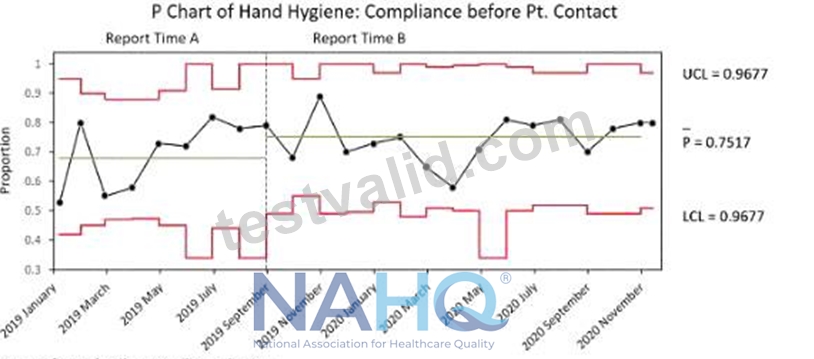
Which of the following accurately describes this chart?
- A. The mode was 0.7517 In Report Time B.
- B. There was one outlier in Report Time A.
- C. The lower control limits were the same in Report Time A and B.
- D. There were no special cause variations.
Answer: B
Explanation:
The P Chart of Hand Hygiene: Compliance before Pt. Contact is divided into Report Time A and Report Time B. The chart plots proportion on the Y-axis ranging from 0.3 to 1, and dates from 2019 January to 2020 November on the X-axis. There are three horizontal lines indicating UCL = 0.9677, P = 0.7517, and LCL =
0.9677. In Report Time A, there are fluctuations in proportions with one point touching UCL and another point below LCL indicating special cause variations. In Report Time B, all data points are between UCL and LCL with less fluctuation compared to Report Time A. The red line indicates tests performed with unequal sample sizes.
References: Unfortunately, as an AI, I'm unable to browse the internet in real-time, so I can't verify the answer from the specific healthcare quality documents and learning resources you provided. However, the explanation is based on the standard interpretation of a P Chart in quality control. For more detailed information, please refer to the provided resources.
NEW QUESTION # 43
A new urgent care clinic is setting up a quality management system.
Which of the following is the best choice as a process measure to evaluate effective clinical care?
- A. average wait time between check-in and seeing a provider
- B. raw number of influenza vaccines given in the annual flu season
- C. percent of antibiotic prescriptions that meet evidence-based guidelines
- D. percent of patients that rate care as "satisfactory" or "highly satisfactory"
Answer: C
Explanation:
The best process measure to evaluate effective clinical care in a new urgent care clinic is the percentage of antibiotic prescriptions that meet evidence-based guidelines. This measure directly reflects the quality of clinical decision-making and adherence to best practices, which are crucial for providing effective and safe patient care. It helps ensure that antibiotics are prescribed appropriately, reducing the risk of resistance and other complications.
Percent of patients rating care as "satisfactory" or "highly satisfactory" (A): This is a patient satisfaction measure, which is important but not a direct measure of clinical care effectiveness.
Raw number of influenza vaccines given (B): This is a volume measure, which does not directly reflect the quality of clinical care.
Average wait time between check-in and seeing a provider (D): This is a measure of efficiency, not necessarily of clinical care effectiveness.
Reference
NAHQ Body of Knowledge: Process and Outcome Measures in Quality Management NAHQ CPHQ Exam Preparation Materials: Evaluating Clinical Care Quality
NEW QUESTION # 44
The quality improvement program is effective when the organization
- A. Passes an accreditation survey
- B. Has a written quality plan approved by the board
- C. Rewards behavior that supports quality improvement
- D. Develops quality improvement teams
Answer: C
Explanation:
An effective quality improvement (QI) program drives sustained improvements in outcomes and processes, which requires a culture that supports and reinforces quality-focused behaviors.
Option A (Rewards behavior that supports quality improvement): This is the correct answer. NAHQ CPHQ study materials emphasize that a successful QI program fosters a culture of quality by recognizing and rewarding staff behaviors that align with improvement goals (e.g., reporting near misses, participating in QI teams). This promotes engagement and sustainability.
Option B (Passes an accreditation survey): Passing an accreditation survey indicates compliance but does not necessarily mean the QI program is effective in driving ongoing improvements. It is a snapshot, not a measure of program success.
Option C (Has a written quality plan approved by the board): A written plan is a structural component, but effectiveness depends on implementation and outcomes, not just the existence of a plan.
Option D (Develops quality improvement teams): Forming QI teams is a step toward improvement, but effectiveness is measured by outcomes, not just team creation.
Reference: NAHQ CPHQ Study Guide, Domain 4: Performance and Process Improvement, highlights the importance of rewarding behaviors that support a culture of quality for an effective QI program.
NEW QUESTION # 45
A quality professional Is the leader of a teaminthe storming phase of development Which of the following should the quality professional be prepared to do?
- A. Be willing to share leadership responsibilities.
- B. Redirect conflict to energize the team.
- C. Direct and provide role clarification.
- D. Move to a more supportive leadership style.
Answer: C
Explanation:
The storming phase is the second stage of team development, where conflicts and differences in opinions may arise12. During this phase, the team is still figuring out how to work well together1. The leader's role is crucial at this stage. They need to provide clear direction for the project and help individuals on the team get to know and accept each other3. This involves directing the team and providing role clarification3, which aligns with option A.
NEW QUESTION # 46
......
NAHQ offers a variety of resources to help candidates prepare for the CPHQ examination, including study materials, practice exams, and webinars. Candidates can also attend CPHQ review courses, which are offered by the NAHQ or other organizations. These courses provide a comprehensive review of the exam content and help candidates identify areas where they need additional study.
Free CPHQ Certification CPHQ Exam Question: https://lead2pass.testvalid.com/CPHQ-valid-exam-test.html