

Dumps for Free Splunk SPLK-1002 Practice Exam Questions [Oct 01, 2025]
SPLK-1002 Dumps PDF And Certification Training
The SPLK-1002 exam is part of the Splunk certification program, which consists of multiple levels. The Splunk Core Certified Power User certification is the second level in this program, following the Splunk Fundamentals 1 certification. Splunk Core Certified Power User Exam certification is designed for professionals who are familiar with Splunk and want to demonstrate their expertise in using the platform to solve complex data analysis problems.
NEW QUESTION # 116
Which of the following Statements about macros is true? (select all that apply)
- A. Argument values are used to resolve the search string when the macro is created.
- B. Argument values are used to resolve the search string at execution time.
- C. Arguments are defined when the macro is created.
- D. Arguments are defined at execution time.
Answer: B,C
Explanation:
Explanation
A macro is a way to save a commonly used search string as a variable that you can reuse in other searches1. When you create a macro, you can define arguments that are placeholders for values that you specify at execution time1. The argument values are used to resolve the search string when the macro is invoked, not when it is created1. Therefore, statements B and C are true, while statements A and D are false.
NEW QUESTION # 117
When should transaction be used?
- A. When grouping events results in over 1000 events in each group.
- B. When event grouping is based on start/end values.
- C. When calculating results from one or more fields.
- D. Only in a large distributed Splunk environment.
Answer: C
Explanation:
Reference:
https://docs.splunk.com/Documentation/Splunk/8.0.3/Search/Abouttransactions
NEW QUESTION # 118
Which of the following examples would use a POST workflow action?
- A. Launch secondary Splunk searches that use one or more field values from selected events.
- B. Use the field values in an HTTP error event to create a new ticket in an external system.
- C. Perform an external IP lookup based on a domain value found in events.
- D. Open a web browser to look up an HTTP status code.
Answer: B
Explanation:
The correct answer is B. Use the field values in an HTTP error event to create a new ticket in an external system.
A workflow action is a knowledge object that enables a variety of interactions between fields in events and other web resources. Workflow actions can create HTML links, generate HTTP POST requests, or launch secondary searches based on field values1.
There are three types of workflow actions that can be set up using Splunk Web: GET, POST, and Search2.
* GET workflow actions create typical HTML links to do things like perform Google searches on specific values or run domain name queries against external WHOIS databases2.
* POST workflow actions generate an HTTP POST request to a specified URI. This action type enables you to do things like creating entries in external issue management systems using a set of relevant field values2.
* Search workflow actions launch secondary searches that use specific field values from an event, such as a search that looks for the occurrence of specific combinations of ipaddress and http_status field values in your index over a specific time range2.
Therefore, the example that would use a POST workflow action is B. Use the field values in an HTTP error event to create a new ticket in an external system. This example requires sending an HTTP POST request to the URI of the external system with the field values from the event as arguments.
The other examples would use different types of workflow actions. These examples are:
* A. Perform an external IP lookup based on a domain value found in events: This example would use a GET workflow action to create a link to an external IP lookup service with the domain value as a parameter.
* C. Launch secondary Splunk searches that use one or more field values from selected events: This example would use a Search workflow action to run another Splunk search with the field values from the event as search terms.
* D. Open a web browser to look up an HTTP status code: This example would also use a GET workflow
* action to create a link to a web page that explains the meaning of the HTTP status code.
References:
* Splexicon:Workflowaction
* About workflow actions in Splunk Web
NEW QUESTION # 119
Which of the following statements describe the search string below?
| datamodel Application_State All_Application_State search
- A. No events will be returned because the pipe should occur after the datamodel command
- B. Events will be returned from the data model named All_Application_state.
- C. Events will be returned from the data model named Application_State.
- D. Evenrches would return a report of sales by state.
Answer: C
Explanation:
The search string below returns events from the data model named Application_State.
| datamodel Application_State All_Application_State search
The search string does the following:
* It uses the datamodel command to access a data model in Splunk. The datamodel command takes two arguments: the name of the data model and the name of the dataset within the data model.
* It specifies the name of the data model as Application_State. This is a predefined data model in Splunk that contains information about web applications.
* It specifies the name of the dataset as All_Application_State. This is a root dataset in the data model that contains all events from all child datasets.
* It uses the search command to filter and transform the events from the dataset. The search command can
* use any search criteria or command to modify the results.
Therefore, the search string returns events from the data model named Application_State.
NEW QUESTION # 120
Consider the following search: index=web sourcetype=access_combined
The log shows several events that share the same jsessionid value (sd497k117o2f098). View the events as a group.
From the following list, which search groups events by JSESSIONID?
- A. index=web sourcetype=access_combined | highlight JSESSIONID 'search SD497K117O2F098
- B. index=web sourcetype=access_combined JSESSIONID <sd497kl!7o2f098>
- C. index=web sourcetype=access_combined | transaction JSESSIONID | search SD497K117O2F098
- D. index=web sourcetype=access_combined SD497K117O2F098 | table JSESSIONID
Answer: C
Explanation:
The objective is to group all events that share the same JSESSIONID value and filter them by a specific JSESSIONID.
Option A: This uses the transaction command with the JSESSIONID field to group all events sharing the same session ID and filters for the specific value SD497K117O2F098. This is correct.
Option B: The syntax here is invalid because JSESSIONID <value> is not a proper search syntax.
Option C: The highlight command only highlights fields or values in events; it does not group them.
Option D: While this filters for events containing SD497K117O2F098, it does not group them by JSESSIONID.
Reference:
Splunk Docs: Transaction Command
NEW QUESTION # 121
Which of the following statements describes the command below (select all that apply) sourcetype-access_combined | transaction JSESSIONID
- A. An additional Held named duration is created.
- B. An additional field named eventcount is created.
- C. Events with the same JSESSIONID will be grouped together into a single event.
- D. An additional filed named maxspan is created.
Answer: A,B
NEW QUESTION # 122
When using | timechart by host, which field is represented in the x-axis?
- A. host
- B. _time
- C. date
- D. time
Answer: B
NEW QUESTION # 123
Which of the following statements describe the search string below?
| datamodel Application_State All_Application_State search
- A. No events will be returned because the pipe should occur after the datamodel command
- B. Events will be returned from the data model named All_Application_state.
- C. Events will be returned from the data model named Application_State.
- D. Evenrches would return a report of sales by state.
Answer: C
NEW QUESTION # 124
By default, how is acceleration configured in the Splunk Common Information Model (CIM) add-on?
- A. Turned on
- B. Determined automatically based on the data source.
- C. Turned off
- D. Determined automatically based on the sourcetype.
Answer: B
Explanation:
Explanation
By default, acceleration is determined automatically based on the data source in the Splunk Common Information Model (CIM) add-on. The Splunk CIM Add-on is an app that provides common data models for various domains, such as network traffic, web activity, authentication, etc. The CIM Add-on allows you to normalize and enrich your data using predefined fields and tags. The CIM Add-on also allows you to accelerate your data models for faster searches and reports. Acceleration is a feature that pre-computes summary data for your data models and stores them in tsidx files. Acceleration can improve the performance and efficiency of your searches and reports that use data models.
By default, acceleration is determined automatically based on the data source in the CIM Add-on. This means that Splunk will decide whether to enable or disable acceleration for each data model based on some factors, such as data volume, data type, data model complexity, etc. However, you can also manually enable or disable acceleration for each data model by using the Settings menu or by editing the datamodels.conf file.
NEW QUESTION # 125
Data models are composed of one or more of which of the following datasets? (select all that apply)
- A. Transaction datasets
- B. Events datasets
- C. Search datasets
- D. Any child of event, transaction, and search datasets
Answer: A,B,C
Explanation:
Data model datasets have a hierarchical relationship with each other, meaning they have parent-child relationships. Data models can contain multiple dataset hierarchies. There are three types of dataset hierarchies: event, search, and transaction.
https://docs.splunk.com/Splexicon:Datamodeldataset
NEW QUESTION # 126
Which of the following statements describes field aliases?
- A. Field aliases can be used in lookup file definitions.
- B. Field aliases only normalize data across sources and sourcetypes.
- C. Field alias names replace the original field name.
- D. Field alias names are not case sensitive when used as part of a search.
Answer: C
NEW QUESTION # 127
Which of the following statements describe data model acceleration? (select all that apply)
- A. Accelerated data models cannot be edited.
- B. Root events cannot be accelerated.
- C. You must have administrative permissions or the accelerate_dacamodel capability to accelerate a data model.
- D. Private data models cannot be accelerated.
Answer: A,C,D
Explanation:
Explanation
Data model acceleration is a feature that speeds up searches on data models by creating and storing summaries of the data model datasets1. To enable data model acceleration, you must have administrative permissions or the accelerate_datamodel capability1. Therefore, option D is correct. Accelerated data models cannot be edited unless you disable the acceleration first1. Therefore, option B is correct. Private data models cannot be accelerated because they are not visible to other users1. Therefore, option C is correct. Root events can be accelerated as long as they are not based on a search string1. Therefore, option A is incorrect.
NEW QUESTION # 128
Which delimiters can the Field Extractor (FX) detect? (select all that apply)
- A. Tabs
- B. Spaces
- C. Pipes
- D. Commas
Answer: B,C,D
Explanation:
Reference:
https://docs.splunk.com/Documentation/Splunk/8.0.3/Knowledge/FXSelectMethodstep
NEW QUESTION # 129
What does the fillnull command replace null values with, if the value argument is not specified?
- A. NaN
- B. N/A
- C. 0
- D. NULL
Answer: C
Explanation:
Explanation
The fillnull command replaces null values with 0 by default, if the value argument is not specified. You can use the value argument to specify a different value to replace null values with, such as N/A or NULL.
NEW QUESTION # 130
Which knowledge Object does the Splunk Common Information Model (CIM) use to normalize data. in addition to field aliases, event types, and tags?
- A. Workflow actions
- B. Field extractions
- C. Lookups
- D. Macros
Answer: C
Explanation:
Explanation
Normalize your data for each of these fields using a combination of field aliases, field extractions, and lookups.
https://docs.splunk.com/Documentation/CIM/4.15.0/User/UsetheCIMtonormalizedataatsearchtime
NEW QUESTION # 131
When used with the timechart command, which value of the limit argument returns all values?
- A. limit=*
- B. limit=all
- C. limit=0
- D. limit=none
Answer: C
Explanation:
Explanation
The correct answer is D. limit=0. This is because the limit argument specifies the maximum number of series to display in the chart. If you set limit=0, no series filtering occurs and all values are returned. You can learn more about the limit argument and how it works with the agg argument from the Splunk documentation1. The other options are incorrect because they are not valid values for the limit argument. The limit argument expects an integer value, not a string or a wildcard. You can learn more about the syntax and usage of the timechart command from the Splunk documentation23.
NEW QUESTION # 132
When should you use the transaction command instead of the scats command?
- A. When you need to group based on start and end constraints.
- B. When you have over 1000 events in a transaction.
- C. When you need to group on multiple values.
- D. When duration is irrelevant in search results. .
Answer: A
Explanation:
Explanation
The transaction command is used to group events into transactions based on some common characteristics, such as fields, time, or both. The transaction command can also specify start and end constraints for the transactions, such as a field value that indicates the beginning or the end of a transaction. The stats command is used to calculate summary statistics on the events, such as count, sum, average, etc. The stats command cannot group events based on start and end constraints, but only on fields or time buckets. Therefore, the transaction command should be used instead of the stats command when you need to group events based on start and end constraints.
NEW QUESTION # 133
Which of the following statements is true, especially in large environments?
- A. The transaction command is faster and more efficient than the stats command.
- B. Use the scats command when you next to group events by two or more fields.
- C. Use the transaction command when you want to see the results of a calculation.
- D. The stats command is faster and more efficient than the transaction command
Answer: D
Explanation:
Reference:
https://answers.splunk.com/answers/103/transaction-vs-stats-commands.html
NEW QUESTION # 134
When using | timechart by host, which field is represented in the x-axis?
date
- A. host
- B. time
- C. _time
Answer: B
Explanation:
Explanation/Reference: https://docs.splunk.com/Documentation/Splunk/8.0.4/SearchReference/Timechart
NEW QUESTION # 135
Which of the following statements best describes a macro?
- A. A macro is a portion of a search that can be reused in multiple place
- B. A macro is a method of categorizing events based on a search.
- C. A macro is a knowledge object that enables you to schedule searches for specific events.
- D. A macro is a way to associate an additional (new) name with an existing field name.
Answer: A
Explanation:
The correct answer is C. A macro is a portion of a search that can be reused in multiple places.
A macro is a way to reuse a piece of SPL code in different searches. A macro can be any part of a search, such
as an eval statement or a search term, and does not need to be a complete command. A macro can also take
arguments, which are variables that can be replaced by different values when the macro is called.A macro can
also contain another macro within it, which is called a nested macro1.
To create a macro, you need to define its name, definition, arguments, and description in the Settings >
Advanced Search > Search Macros page in Splunk Web or in the macros.conf file.To use a macro in a search,
you need to enclose the macro name in backtick characters (`) and provide values for the arguments if any1.
For example, if you have a macro named my_macro that takes one argument named object and has the
following definition:
search sourcetype=object
You can use it in a search by writing:
my_macro(web)
This will expand the macro and run the following SPL code:
search sourcetype=web
The benefits of using macros are that they can simplify complex searches, reduce errors, improve readability,
and promote consistency1.
The other options are not correct because they describe other types of knowledge objects in Splunk, not
macros. These objects are:
A: An event type is a method of categorizing events based on a search. An event type assigns a label to
events that match a specific search criteria.Event types can be used to filter and group events, create
alerts, or generate reports2.
B: A field alias is a way to associate an additional (new) name with an existing field name. A field alias
can be used to normalize fields from different sources that have different names but represent the same
data.Field aliases can also be used to rename fields for clarity or convenience3.
D: An alert is a knowledge object that enables you to schedule searches for specific events and trigger
actions when certain conditions are met.An alert can be used tomonitor your data for anomalies, errors,
or other patterns of interest and notify you or others when they occur4.
References:
About event types
About field aliases
About alerts
Define search macros in Settings
Use search macros in searches
NEW QUESTION # 136
When using | timechart by host, which field is represented in the x-axis?
- A. host
- B. date
- C. time
- D. _time
Answer: C
Explanation:
Explanation/Reference: https://docs.splunk.com/Documentation/Splunk/8.0.4/SearchReference/Timechart
NEW QUESTION # 137
Why would the following search produce multiple transactions instead of one?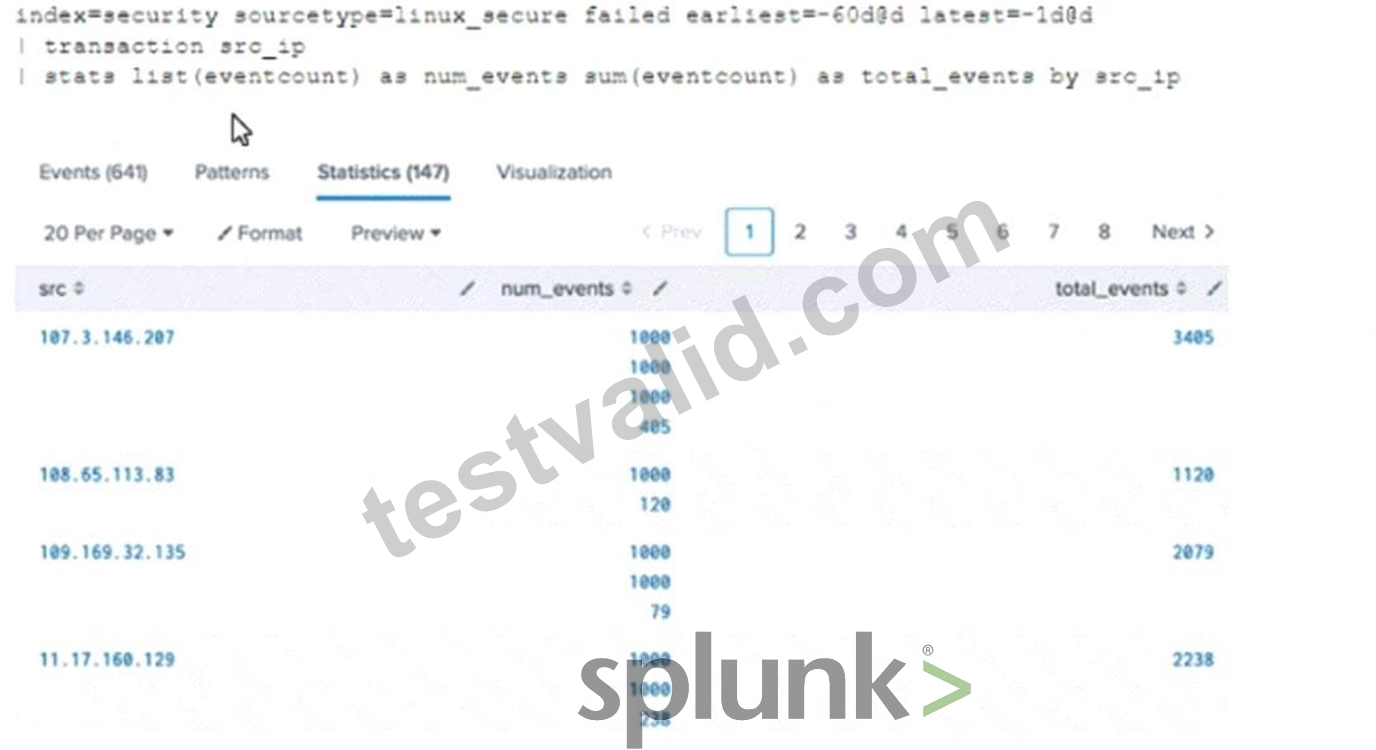
- A. The maxspan option is not included.
- B. The stats list () function is used.
- C. The transaction command has a limit of 1000 events per transaction.
- D. The transaction and commands cannot be used together.
Answer: A
Explanation:
In Splunk, thetransactioncommand is used to group events that share common characteristics into a single transaction1.By default, thetransactioncommand groups all matching events into a single transaction1.
However, you can use themaxspanoption to limit the time span of the transactions1.If the time span between the first and last event in a transaction exceeds themaxspanvalue, thetransactioncommand will start a new transaction1.
Therefore, if themaxspanoption is not included in the search, thetransactioncommand might produce multiple transactions instead of one if the time span between the first and last event in a transaction exceeds the defaultmaxspanvalue1.
Here is an example of how you can use themaxspanoption in a search:
index=main sourcetype=access_combined | transaction someuniqefield maxspan=1h In this search, thetransactioncommand groups events that share the samesomeuniqefieldvalue into a single transaction, but only if the time span between the first and last event in the transaction does not exceed 1 hour1.If the time span exceeds 1 hour, thetransactioncommand will start a new transaction1.
NEW QUESTION # 138
What is the correct syntax to search for a tag associated with a value on a specific fields?
- A. Tag-<field?
- B. Tag=<filed>::<tagname>
- C. Tag::<filed>=<tagname>
- D. Tag<filed(tagname.)
Answer: C
Explanation:
Reference:
A tag is a descriptive label that you can apply to one or more fields or field values in your events2. You can use tags to simplify your searches by replacing long or complex field names or values with short and simple tags2. To search for a tag associated with a value on a specific field, you can use the following syntax: tag::<field>=<tagname>2. For example, tag::status=error will search for events where the status field has a tag named error. Therefore, option D is correct, while options A, B and C are incorrect because they do not follow the correct syntax for searching tags.
NEW QUESTION # 139
Marty has multiple data sources that contain fields with IP Address values. What knowledge object should he use to normalize the fields so his data is CIM compliant?
- A. Field alias
- B. Field extraction
- C. Event type
- D. Tag
Answer: A
Explanation:
Field aliases are used to normalize different field names that contain the same type of data (like IP addresses) across multiple sourcetypes or sources, making the data CIM compliant without re-extracting the fields.
Reference:
Splunk Power User Study Guide, CIM Compliance
Splunk Docs: Field Aliases for CIM
"Field aliases normalize field names across data sources for CIM compliance."
NEW QUESTION # 140
......
Splunk is a powerful platform that enables organizations to gain valuable insights from their machine data. As the use of Splunk continues to grow, there is an increasing demand for skilled professionals who can make the most out of this platform. The Splunk Core Certified Power User (SPLK-1002) certification exam is designed to validate the skills and knowledge of professionals who are experienced in using Splunk to analyze and visualize data.
Check your preparation for Splunk SPLK-1002 On-Demand Exam: https://lead2pass.testvalid.com/SPLK-1002-valid-exam-test.html