

Updated Dec-2024 100% Cover Real VMCE_v12 Exam Questions - 100% Pass Guarantee
Use Real Veeam Dumps - 100% Free VMCE_v12 Exam Dumps
NEW QUESTION # 40
Due to an unexpected power outage, Site A is completely down. The disaster recovery strategy was implemented (see diagram). What is the correct way to start replicated VMs on Site B, while ensuring you can failback after Site A comes back online?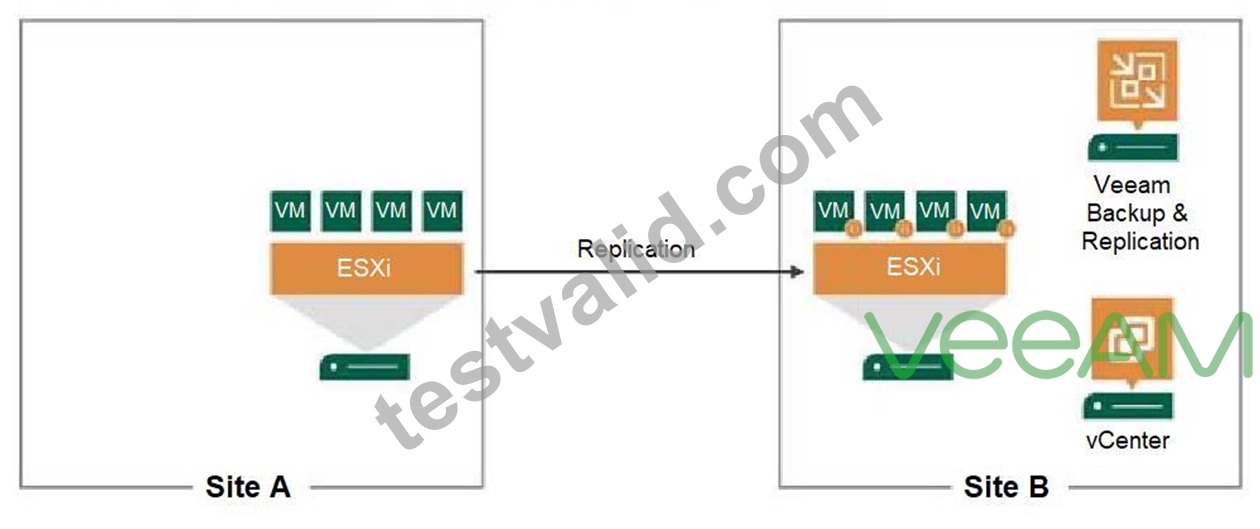
- A. Perform "Failover".
- B. Execute "Permanent failover" from vCenter.
- C. Power on VMs manually through vCenter.
- D. Execute "Planned failover".
Answer: A
Explanation:
Explanation
"Failover Now: Failover now refers to an immediate response to an unexpected system or service failure. In this case, the primary system or service experiencesan unplanned outage or becomes unavailable, and the failover process is triggered immediately to shift the workload to a secondary system or service."
NEW QUESTION # 41
Which feature can be used in Veeam Explorer for Oracle database?
- A. Recover from litigation and in-place hold items
- B. Export to .BAK file
- C. Restore original password for account objects
- D. Restore databases from backups created with Veeam RMAN plug-in
Answer: D
Explanation:
Explanation
According to the Veeam Backup Explorers Guide1, Veeam Explorer for Oracle allows you to restore and export Oracle databases and Data Guard from backups created by Veeam Backup & Replication or Veeam Plug-in for Oracle RMAN.
NEW QUESTION # 42
A Veeam engineer creates a Scale-Out Backup Repository (SOBR) that uses AWS S3 as the Performance Tier. The backup job is configured to "Keep monthly full backups for: 12 months".
The engineer wants the backups to move to Glacier after 90 days. What should the engineer do first to achieve this goal?
- A. Create a Vault in S3 Glacier
- B. Add an Archive Tier with the appropriate Bucket from S3
- C. Add AWS S3 as a Capacity Tier before they can use Glacier
- D. Reconfigure the SOBR to use block storage as the Performance Tier
Answer: B
Explanation:
Archive tier is an additional tier of storage that can be attached to a scale-out backup repository.
You can transport data to the archive tier for archive storage from the following extents:
From performance extents that consist of Amazon S3, Microsoft Azure or S3 compatible with data archiving object storage repositories.
From capacity extents.
*************************
It is not required to have a capacity tier before using archive tier.
https://helpcenter.veeam.com/docs/backup/vsphere/archive_tier.html?ver=120
NEW QUESTION # 43
An administrator Is asked to change a backup copy Job from periodic mode to immediate mode. How can this be accomplished?
- A. Copy the original backup copy job to a different folder and remap the job.
- B. Right click on the job name and choose immediate.
- C. Create a new backup copy job and delete the original job.
- D. Enable immediate in the backup copy job settings drop down.
Answer: C
Explanation:
Explanation
https://helpcenter.veeam.com/archive/backup/110/vsphere/backup_copy_modes.html
NEW QUESTION # 44
A Veeam administrator Is restoring a user object from Active Directory using the Veeam Explorer for Microsoft Active Directory. They want to restore the user object including the password. What options exist for restoring the object with a password? (Choose 2)
- A. Send password to user account via email
- B. Restore the user object to the source domain
- C. Show password
- D. Allow user to set password
- E. Use "Restore objects to" and choose the "Restore password" option
Answer: E
NEW QUESTION # 45
A number of VMs are running as interdependent applications. They need to fail over, one by one, as a group. What method should be used to do this?
- A. Planned failover
- B. Failover plan
- C. Replication plan
- D. Replica failover
Answer: B
Explanation:
To ensure VMs running interdependent applications fail over one by one, as a group, the method to use is D: Failover plan. In Veeam Backup & Replication, a failover plan allows for the orchestration of a group of replicas to fail over in a predefined sequence. This includes the capability to set up delays between starting each VM, which is crucial for interdependent applications that must be started in a specific order to function correctly. The failover plan ensures that dependencies among the group are respected and that the startup sequence follows the correct order, enabling a smooth and organized transition to the failover state.
NEW QUESTION # 46
An engineer needs to test the impact of operating system updates on app functionality in an isolated non-production environment.
What Veeam Backup and Replication feature can be used to facilitate this?
- A. Replication
- B. Direct Storage Snapshots
- C. Virtual Labs
- D. Instant Recovery
Answer: C
Explanation:
Virtual Labs is the ideal feature for testing the impact of operating system updates in an isolated environment.
Virtual Labs allow you to create a secure, isolated copy of your production environment where you can test updates, patches, and other changes without affecting the live environment.References:Veeam Backup & Replication Documentation, Veeam Virtual Lab Guide
NEW QUESTION # 47
What transport mode does the Linux backup proxy support?
- A. Virtual appliance
- B. Network
- C. Direct storage access
- D. Automatic
Answer: A
Explanation:
Reference: https://helpcenter.veeam.com/docs/backup/vsphere/backup_proxy.html?ver=100
NEW QUESTION # 48
Which of the following statements regarding the Backup from Storage Snapshots feature when backing up virtual machines from a VMware vSphere environment are true? (Choose two.)
- A. Reduce the impact of consolidating VM snapshots
- B. A virtual machine with one virtual drive on shared storage and another drive on local storage will failover to a different transport mode
- C. Lower impact on WAN link during off-site backups
- D. A virtual machine with one virtual drive on shared storage and another drive on local storage will be processes with Backup from Storage Snapshots transport mode
- E. Higher transfer speed from production NFS datastores
Answer: A,E
NEW QUESTION # 49
An end user has deleted a business-critical document and they need it back right away. The IT team has been doing hypervisor-level backups of the VM that the document was on. What is the fastest option for this backup administrator to get the user's document back?
- A. Virtual disks restore
- B. Entire VM restore
- C. Guest files restore
- D. Instant VM Recovery
Answer: C
NEW QUESTION # 50
When planning to back up files and folders from shared sources, that is the correct method to connect to the file share from the Veeam backup server?
- A. Add the file share into the inventory
- B. Add the file share into the store infrastructure
- C. Add the file share into the physical infrastructure
- D. Add the file share into the managed servers
Answer: A
NEW QUESTION # 51
A Windows VM running on Microsoft Hyper-V is protected using the file indexing option. The guest interaction proxy is offline. Which of the following Veeam servers will be used to deploy the runtime during the backup process?
- A. Indexing database server
- B. File proxy server
- C. Backup & Replication server
- D. Virtual lab server
Answer: C
Explanation:
Explanation
https://helpcenter.veeam.com/archive/backup/110/hyperv/guest_interaction_proxy.html According to the Veeam Software Help Center1, Veeam Backup & Replication deploys runtime components on a VM guest OS to perform file indexing. These components can be either non-persistent or persistent depending on whether you have enabled application-aware processing for the VM.
If you have enabled application-aware processing for the VM, Veeam Backup & Replication uses a persistent agent component that is installed on the VM guest OS during backup job session and remains on the VM after that. In this case, if the guest interaction proxy is offline, Veeam Backup & Replication will use another available guest interaction proxy or fail over to the backup server.
If you have not enabled application-aware processing for the VM, Veeam Backup & Replication uses a non-persistent runtime component that is deployed on the fly and removed after indexing is complete. In this case, if the guest interaction proxy is offline, Veeam Backup & Replication will use another available guest interaction proxy or fail over to the backup server.
NEW QUESTION # 52
When restoring Linux or Unix guest OS files, which components can be used to mount the volume containing files to be restored? (Choose 2)
- A. Helper appliance
- B. Guest Interaction proxy
- C. Helper host
- D. Enterprise Manager server
- E. NFS mount
Answer: A,C
Explanation:
Explanation
https://helpcenter.veeam.com/docs/backup/vsphere/guest_restore_linux.html?ver=120
NEW QUESTION # 53
A physical Windows server has failed Windows updates and Is now showing an error message. The server has several volumes: C (60GB), D (2TD) and E (600GB). You urgently need this server up and running again.
Which of the following would bring the server back up and running the fastest on the same hardware?
- A. Perform Instant Disk recovery erf the C drive.
- B. Insert the Veeam Recovery Media and restore the entire computer.
- C. Use Restore Guest OS files to restore the bootable image erf the system drive.
- D. Insert the Veeam Recovery Media and restore using "System volumes only".
Answer: D
Explanation:
Explanation
https://helpcenter.veeam.com/docs/agentforwindows/userguide/baremetal_mode.html?ver=60
NEW QUESTION # 54
What is a Recovery Point Objective (RPO) in regards to disaster recovery?
- A. The acceptable data loss measured in time that can be tolerated
- B. The maximum amount of time it takes to restore a system
- C. The number of recovery points created during the backup process
- D. The total cost associated with recovering a system
Answer: A
Explanation:
In the context of disaster recovery, the Recovery Point Objective (RPO) is best defined by option B:
The acceptable data loss measured in time that can be tolerated. RPO is a critical metric in disaster recovery and business continuity planning that specifies the maximum amount of data (measured in time) that an organization can afford to lose in the event of a disaster or system failure. It effectively sets the limit for how frequently data backups or replications should occur.
For instance, an RPO of 4 hours means that the organization must be able to recover data from no more than 4 hours prior to the disaster, implying that backup or replication operations should occur at least every 4 hours. Establishing an RPO is essential for developing an effective data protection strategy, as it guides the choice of backup methodologies and technologies to meet the organization's tolerance for data loss.
NEW QUESTION # 55
Which Veeam Backup & Replication job type offers the shortest recovery time objective (RTO)?
- A. File to tape
- B. Replication
- C. Backup to tape
- D. Backup copy
Answer: B
Explanation:
Reference: https://helpcenter.veeam.com/docs/backup/vsphere/replication.html?ver=100
NEW QUESTION # 56
......
VMCE_v12 Dumps PDF - VMCE_v12 Real Exam Questions Answers: https://lead2pass.testvalid.com/VMCE_v12-valid-exam-test.html