


Our experts have made their best efforts to provide you current exam information about Managing and Maintaining a Microsoft Windows Server 2003 Environment practice test for your exam preparation. The contents of our training materials applied to every stage of candidates who have no or rich experience in the Microsoft lead4pass review. A little attention to these study materials will improve your ability to get through Managing and Maintaining a Microsoft Windows Server 2003 Environment test questions with high pass rate. Our Managing and Maintaining a Microsoft Windows Server 2003 Environment valid vce is the best alternative to your time and money to get an excellent career in the IT filed. Our valid Managing and Maintaining a Microsoft Windows Server 2003 Environment test answers contain everything you want to overcome the difficulties of the real exam, that's the reason that we keep the popularity among the vendors of 070-290 lead4pass dumps.

Our MCSE pass guide is designed to solve all the difficulties of the candidates in the best possible way. For this reason we offer pdf format and online test engine version for complete preparation of Managing and Maintaining a Microsoft Windows Server 2003 Environment practice test. With the help of our learning materials, especially the online practice exam, you can practice Managing and Maintaining a Microsoft Windows Server 2003 Environment test questions in the formal test environment and test your skills regarding Managing and Maintaining a Microsoft Windows Server 2003 Environment pass guaranteed. In this way we assure you with 100% result and full refund guarantee on our Managing and Maintaining a Microsoft Windows Server 2003 Environment lead4pass review. Besides, our online version will also remark your mistakes made in the Managing and Maintaining a Microsoft Windows Server 2003 Environment practice test and thus you can learn from your mistakes and avoid them in the real exam.
Our website offers you the best solutions for 070-290 pass guaranteed in an easy and smart way. The latest Managing and Maintaining a Microsoft Windows Server 2003 Environment test questions are written by our certified trainers who have studied IT certification exam study guide for long time. You can totally rest assured the accuracy of our Managing and Maintaining a Microsoft Windows Server 2003 Environment test answers because we keep check the updating of Managing and Maintaining a Microsoft Windows Server 2003 Environment lead4pass review every day. If you still doubt our products, you can download the free demo to have a try.
Comparing to attending training classes, choose our Managing and Maintaining a Microsoft Windows Server 2003 Environment valid vce as your exam preparation materials will not only save your time and money, but also save you from the failure of Managing and Maintaining a Microsoft Windows Server 2003 Environment practice test. One or two days' preparation will be enough to the test and you just need to remember the Managing and Maintaining a Microsoft Windows Server 2003 Environment test answers in-depth, you will get good result finally. Please feel free to contact us if you have any questions.
Instant Download 070-290 Exam Braindumps: Upon successful payment, Our systems will automatically send the product you have purchased to your mailbox by email. (If not received within 12 hours, please contact us. Note: don't forget to check your spam.)
Microsoft 070-290 Exam Syllabus Topics:
| Section | Objectives |
|---|---|
| Managing Network Services | - Core network services configuration
|
| Managing Users, Computers, and Groups | - Active Directory user and group administration
|
| Managing and Maintaining Server Resources | - File and print services
|
| Managing Backup and Restore | - Data protection strategies
|
| Maintaining Server Security | - Security configuration and updates
|
| Managing Physical and Logical Disks | - Disk management and storage configuration
|
Microsoft Managing and Maintaining a Microsoft Windows Server 2003 Environment Sample Questions:
1. You have two servers named Server1 and Server2 that run Windows Server 2003 Service Pack (SP2).
You connect a USB drive to Server1 and copy several files to the USB drive.
You connect the USB drive to Server2.
You receive a message that the drive installed successful and is ready to use.
You open Windows Explorer and the USB drive does not appear.
You need to ensure that you can access the files stored on the USB drive.
What should you do?
A) From the command prompt, run Convert.exe.
B) From the Disk Management snap in, change the drive letter.
C) From the Device Manager snap in, scan for a hardware change.
D) From the Services snap in, restart the Removable Storage service.
2. Your network consists of a single Active Directory domain. The functional level of the domain is Windows
Server 2003.
All servers run Windows Server 2003 Service Pack 2 (SP2).
The network contains 10 file servers. Each file server hosts a share named Apps.
On each file server, a local group named App install local has permissions to the Apps share.
A global group named App install global belongs to the App install local group on each file server.
App install global is used only to control permissions for the Apps share.
You create a global group named Helpdesk.
You need to provide the Helpdesk group access to the Apps share on each file server.
The Helpdesk group must have the same permissions as the App install global group.
You must achieve this goal by using the minimum amount of administrative effort.
What should you do?
A) Add the Helpdesk group to the App install local group on each file server.
B) Convert the App install global group to a universal group. Add the App install global group to the Helpdesk group.
C) Add the Helpdesk group to the App install global group.
D) Convert the Helpdesk group to a universal group. Add the Helpdesk group to the App install local group on each file server.
3. You have two servers named Server1 and Server2 that run Windows Server 2003 Service Pack (SP2).
You connect a USB drive to Server1 and copy several files to the USB drive.
You connect the USB drive to Server2.
You receive a message that the drive installed successful and is ready-to-use.
You open Windows Explorer and the USB drive does not appear.
You need to ensure that you can access the files stored on the USB drive.
What should you do?
A) From the command prompt, run Convert.exe.
B) From the Services snap-in, restart the Removable Storage service.
C) From the Disk Management snap-in, change the drive letter.
D) From the Device Manager snap-in, scan for a hardware change.
4. You are the network administrator for your company. The network consists of a single Active Directory
domain. All network servers run Windows Server 2003.
Some client computers run Windows 2000 Professional, and the rest run Windows XP Professional.
All user accounts in the sales department are located in the Sales organizational unit (OU).
To store roaming user profiles, you create a shared folder named Profiles on a member server named
File1.
You assign the Allow - Full Control permission on the Profiles folder to the Everyone group.
Now you need to create roaming user profiles for the user accounts in the Sales OU.
What should you do?
A) Create a Group Policy object (GPO) and link it to the Sales OU. In the User Configuration section of the GPO, configure Folder Redirection to use \\File1\Profiles.
B) Select all user accounts in the Sales OU. Modify the account properties to specify \\File1\Profiles as the profile path.
C) Create a Group Policy object (GPO) and link it to the Domain Controllers OU. In the User Configuration section of the GPO, configure Folder Redirection to use \\File1\Profiles.
D) Select all user accounts in the Sales OU. Modify the account properties to specify \\File1\Profiles\%username% as the profile path.
5. Your network consists of a single Active Directory domain. All network servers run Windows Server 2003
Service Pack 2 (SP2).
You share a folder named Research. A user named User1 reports that he cannot access files in the
Research share.
You confirm that the Domain Users group is granted the Change permission for the Research share.
You run the Cacls command as shown in the exhibit. (Click the Exhibit button.)
You need to ensure that User1 can modify files in the Research share.
You must prevent User1 from modifying permissions for the Research folder.
To which group should you add User1?
Exhibit: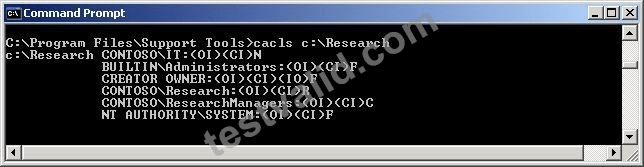
A) ResearchManagers
B) Research
C) IT
D) Administrators
Solutions:
| Question # 1 Answer: B | Question # 2 Answer: C | Question # 3 Answer: C | Question # 4 Answer: D | Question # 5 Answer: A |

 Betsy
Betsy 
 Joshua
 Freda
Freda 
 Harry
Harry  Olivia
  Mignon
  Jill
Jill  Winston
  Ivan
Ivan  Caroline
  Jonas
Jonas  Jean
Jean  Priscilla
  Magee
Magee  Kerwin
  Amy
Amy  Randolph


