

PAM-DEF PDF Dumps 2025 Exam Questions with Practice Test
Dumps for Free PAM-DEF Practice Exam Questions
CyberArk PAM-DEF Certification Exam is ideal for cybersecurity professionals, system administrators, and IT managers who want to advance their careers in the field of privileged access security. PAM-DEF exam is designed to test practical skills and knowledge, so individuals who pass the exam will have the confidence to implement and manage CyberArk PAS solutions in real-world scenarios. Additionally, the certification is recognized by industry leaders and can help individuals stand out in a competitive job market.
CyberArk PAM-DEF exam covers a wide range of topics related to PAM, including access control, credential management, session isolation, auditing and reporting, and integration with other security solutions. Candidates who pass the exam will demonstrate a deep understanding of the best practices and techniques for securing privileged accounts and preventing unauthorized access to critical systems and data. The CyberArk PAM-DEF certification is highly valued in the industry and can open up new career opportunities for individuals looking to advance their careers in cybersecurity.
NEW QUESTION # 65
Which report shows the accounts that are accessible to each user?
- A. Entitlement report
- B. Privileged Accounts Compliance Status report
- C. Applications Inventory report
- D. Activity report
Answer: A
Explanation:
Explanation
The report that shows the accounts that are accessible to each user is the Entitlement report. According to the web page in the edge browser, the Entitlement report provides information about users' entitlement rights in PAM - Self-Hosted regarding user, Safe, active platform, target machine, target account, etc. This report includes each user's effective access control and authorization level on each account that the user has access to in PAM - Self-Hosted. The Entitlement report can be generated in PVWA or PrivateArk1.
NEW QUESTION # 66
When should vault keys be rotated?
- A. when it is copied to file systems outside the vault
- B. annually
- C. whenever a CyberArk user leaves the organization
- D. when migrating to a new data center
Answer: B
NEW QUESTION # 67
In order to connect to a target device through PSM, the account credentials used for the connection must be stored in the vault?
- A. False. Because if credentials are not stored in the vault, the PSM will prompt for credentials.
- B. True.
- C. False. Because if credentials are not stored in the vault, the PSM will log into the target device as PSM Connect.
- D. False. Because the user can also enter credentials manually using Secure Connect.
Answer: A
NEW QUESTION # 68
PTA can automatically suspend sessions if suspicious activities are detected in a privileged session, but only if the session is made via the CyberArk PSM.
- A. True
- B. False, the PTA can suspend sessions whether the session is made via the PSM or not
Answer: B
Explanation:
Explanation
The PTA can automatically suspend sessions if suspicious activities are detected in a privileged session, regardless of the session method. The PTA can suspend sessions that are made via the PSM, the PVWA, or directly to the target system. The PTA can also suspend sessions that are made via SSH, RDP, or other protocols. References:
* Defender PAM Sample Items Study Guide, page 24
* PTA User Guide, page 17
NEW QUESTION # 69
It is possible to control the hours of the day during which a user may log into the vault.
- A. TRUE
- B. FALSE
Answer: A
NEW QUESTION # 70
You want to generate a license capacity report.
Which tool accomplishes this?
- A. DiagnoseDB Report
- B. Password Vault Web Access
- C. RestAPI
- D. PrivateArk Client
Answer: D
Explanation:
Explanation
The license capacity report is a tool that provides information about the licensed user types and objects in the Vault. It enables users to see the maximum number of licenses for each user type or object, and the number of used licenses for each one. Only user types and objects that are limited by the license are displayed in this report. To generate a license capacity report, users need to use the PrivateArk Client, which is a graphical user interface that allows users to manage safes and their properties. Users can access the report from the Tools menu in the PrivateArk Client. References: Reporting License Usage, Manage the CyberArk License
NEW QUESTION # 71
Can the 'Connect' button be used to initiate an SSH connection, as root, to a Unix system when SSH access for root is denied?
- A. No, it is not possible.
- B. Yes, if a logon account is associated with the root account.
- C. Yes, only if a logon account is associated with the root account and the user connects through the PSM-SSH connection component.
- D. Yes, when using the connect button, CyberArk uses the PMTerminal.exe process which bypasses the root SSH restriction.
Answer: C
Explanation:
Explanation
The 'Connect' button is a feature of the PVWA that allows users to initiate a privileged session to a target system through PSM without revealing the account credentials. The 'Connect' button can be used to initiate an SSH connection, as root, to a Unix system when SSH access for root is denied, but only if a logon account is associated with the root account and the user connects through the PSM-SSH connection component. A logon account is a linked account that contains the password required to log on to a remote machine in order to perform a task using the regular account. A common use case for using a logon account is managing root accounts on a Unix system. The best practice for Unix systems is to disallow the root user from logging in using SSH. However, SSH is what the PSM uses to sign in to a system to manage the password. To manage the root password without violating this practice, the PSM establishes the session with a non-root account and then SUs to root (the target account). This is done using a linked account called a logon account. The PSM-SSH connection component is a predefined connection component that enables users to connect to Unix systems through PSM using SSH. The PSM-SSH connection component supports the use of logon accounts to access root accounts on Unix systems1.
The other options are not correct, because:
* A. Yes, when using the connect button, CyberArk uses the PMTerminal.exe process which bypasses the root SSH restriction. This is not correct, because PMTerminal.exe is a process that is used by the PSM-RDP connection component, not the PSM-SSH connection component. PMTerminal.exe is a terminal emulator that enables users to connect to Windows systems through PSM using RDP. PMTerminal.exe does not bypass the root SSH restriction, but rather uses the credentials stored in the Vault to authenticate to the target system2.
* C. Yes, if a logon account is associated with the root account. This is not correct, because a logon account alone is not sufficient to initiate an SSH connection, as root, to a Unix system when SSH access for root is denied. The user also needs to connect through the PSM-SSH connection component, which supports the use of logon accounts to access root accounts on Unix systems1.
* D. No, it is not possible. This is not correct, because it is possible to initiate an SSH connection, as root, to a Unix system when SSH access for root is denied, as explained in option B.
References:
* 1: Logon Accounts for SSH and Telnet Connections
* 2: Connect through PSM for SSH
NEW QUESTION # 72
Match each key to its recommended storage location.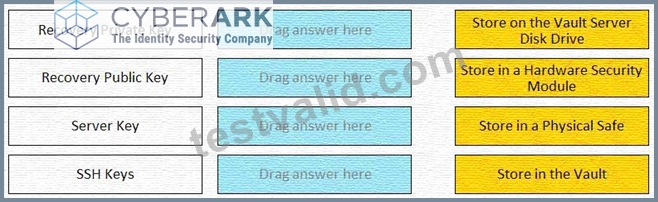
Answer:
Explanation:
Explanation
* The recommended storage locations for each key are as follows:
* Recovery Private Key: It is recommended to store the Recovery Private Key on the Vault Server Disk Drive. This is because the Recovery Private Key is used to decrypt the data stored in the Vault.
* Recovery Public Key: It is recommended to store the Recovery Public Key in a Hardware Security Module. This is because the Recovery Public Key is used to encrypt the data stored in the Vault.
* Server Key: It is recommended to store the Server Key in a Physical Safe. This is because the Server Key is used to open the Vault, much like the key of a physical Vault. The key is required to start the Vault, after which the Server Key can be removed until the Server is restarted. When the Vault is stopped, the information stored in the Vault is completely inaccessible without that key.
* SSH Keys: It is recommended to store the SSH Keys in the Vault. This is because the SSH Keys are used to connect to remote machines using the SSH protocol. The Vault can manage the passwords and sessions for the SSH Keys and provide secure access to the target systems.
References: Server keys - CyberArk, Cyberark Key Storage Plugin (Enterprise) - Rundeck
NEW QUESTION # 73
You need to enable the PSM for all platforms.
Where do you perform this task?
- A. Master Policy > Privileged Access Workflows
- B. Master Policy > Session Management
- C. Administration > Options > Connection Components
- D. Platform Management > (Platform) > UI & Workflows
Answer: B
NEW QUESTION # 74
Which of the following options is not set in the Master Policy?
- A. Password Complexity
- B. The use of "One-Time-Passwords"
- C. Enabling and Disabling of the Connection Through the PSM
- D. Password Expiration Time
Answer: A
Explanation:
Explanation
Password Complexity is not set in the Master Policy, but in the Platform Management settings for each platform. The Master Policy is a set of rules that define the security and compliance policy of privileged accounts in the organization, such as access workflows, password management, session monitoring, and auditing1. The Master Policy does not include any technical settings that determine how the system manages accounts on various platforms1. Password Complexity is a technical setting that defines the minimum requirements for the length and composition of the passwords that are generated by the CPM for the accounts associated with the platform2. Password Complexity can be configured in the Platform Management settings, which are independent of the Master Policy and can be customized according to the organization's environment and security policies1.
The other options are set in the Master Policy, as follows:
* A. Password Expiration Time: This is a policy rule that determines how often passwords are changed. It can be set in the Master Policy under the Password Management section1.
* B. Enabling and Disabling of the Connection Through the PSM: This is a policy rule that determines whether users can connect to target systems through the PSM. It can be set in the Master Policy under the Session Management section1.
* D. The use of "One-Time-Passwords": This is a policy rule that determines whether passwords are changed every time they are retrieved by a user. It can be set in the Master Policy under the Password Management section1. References:
* 1: The Master Policy
* 2: Platform Management, Password Complexity subsection
NEW QUESTION # 75
What is the purpose of the Immediate Interval setting in a CPM policy?
- A. To control how often the CPM looks for User Initiated CPM work.
- B. To Control the maximum amount of time the CPM will wait for a password change to complete.
- C. To control how often the CPM rests between password changes.
- D. To control how often the CPM looks for System Initiated CPM work.
Answer: A
Explanation:
Explanation
The Immediate Interval setting in a CPM policy is used to control how often the CPM looks for User Initiated CPM work, such as manual password changes, retrievals, or requests. The Immediate Interval setting defines the frequency, in minutes, that the CPM will check the accounts that are associated with the policy and perform the actions that were initiated by the users. For example, if the Immediate Interval is set to 2, the CPM will check the accounts every 2 minutes and change, retrieve, or authorize the passwords according to the user requests. The Immediate Interval setting does not affect System Initiated CPM work, such as password changes, verifications, or reconciliations that are triggered by the policy settings, such as Expiration Period or One Time Password. These actions are controlled by the Interval setting in the CPM policy. The Immediate Interval setting also does not control how often the CPM rests between password changes or the maximum amount of time the CPM will wait for a password change to complete. These parameters are configured in the CPM.ini file, which is stored in the root folder of the <CPM username> Safe. References:
* [Defender PAM eLearning Course], Module 5: Password Management, Lesson 5.1: CPM Policies, Slide
9: CPM Policy Settings
* [Defender PAM Sample Items Study Guide], Question 6: CPM Policy Settings
* [CyberArk Documentation Portal], CyberArk Privileged Access Security Implementation Guide, Chapter 5: Managing Passwords, Section: CPM Policy Settings, Subsection: Immediate Interval
NEW QUESTION # 76
Your organization requires all passwords be rotated every 90 days.
Where can you set this regulatory requirement?
- A. Safe Templates
- B. PVWAConfig.xml
- C. Platform Configuration
- D. Master Policy
Answer: C
Explanation:
Explanation
The platform configuration defines the password management settings for each type of account, such as the password complexity, rotation frequency, verification method, and reconciliation options. You can set the regulatory requirement for password rotation in the platform configuration by specifying the number of days in the Password Change Interval parameter. This parameter determines how often the CPM will change the passwords of the accounts that are associated with the platform. For example, if you set the Password Change Interval to 90, the CPM will change the passwords every 90 days. References: Credentials Rotation - CyberArk, How do I manage or change passwords stored in CyberArk?
NEW QUESTION # 77
Where can you check that the LDAP binding is using TCP/636?
- A. in PrivateArk Client, under "Tools" => "Administrative Tools" => "Directory Mapping" => ""
- B. in PVWA, under "LDAP Integration" => "LDAP" => "Directories" => "" => "Hosts" => "Host"
- C. From the PVWA, connect to the domain controller using Test-NetConnection on Port 636.
- D. in Active Directory under "Users OU" => "User Properties" => "External Bindings" => "Port"
Answer: C
Explanation:
Explanation
To check that the LDAP binding is using TCP/636, you can use the Test-NetConnection cmdlet from the PVWA to connect to the domain controller on Port 636. This method allows you to verify that the LDAP service is listening on the secure port and that the connection can be established using SSL/TLS, which is typically associated with port 6361.
References:
* CyberArk Docs - LDAP Integration2
* CyberArk Knowledge Article - How to test outgoing LDAP external directory connectivity to the vault
NEW QUESTION # 78
Platform settings are applied to _________.
- A. Individual Accounts
- B. Network Areas
- C. The entire vault.
- D. Safes
Answer: D
NEW QUESTION # 79
Users who have the 'Access Safe without confirmation' safe permission on a safe where accounts are configured for Dual control, still need to request approval to use the account.
- A. TRUE
- B. FALSE
Answer: B
Explanation:
Explanation
Users who have the 'Access Safe without confirmation' safe permission on a safe where accounts are configured for Dual control, do not need to request approval to use the account. The 'Access Safe without confirmation' safe permission is a special permission that allows a user to bypass the Dual control mechanism and access the accounts in the safe without requiring confirmation from other authorized users. This permission can be useful for emergency situations or trusted users who need immediate access to the accounts. However, this permission also increases the risk of unauthorized or malicious access, so it should be granted with caution and monitored closely1.
References:
* 1: Access without confirmation
NEW QUESTION # 80
Where can PTA be configured to send alerts? (Choose two.)
- A. EVD
- B. SIEM
- C. Google Analytics
- D. Email
- E. PAReplicate
Answer: B,D
NEW QUESTION # 81
Which user is automatically added to all Safes and cannot be removed?
- A. Auditor
- B. Master
- C. Administrator
- D. Operator
Answer: B
Explanation:
Explanation
The user that is automatically added to all Safes and cannot be removed is the Master user. The Master user is a predefined user that is created during the Vault installation and has full permissions on all Safes and accounts. The Master user is the only user that can perform certain tasks, such as creating other predefined users, managing the Vault configuration, and restoring the Vault from a backup. The Master user cannot be deleted or modified by any other user, and is always a member of every Safe12. References:
* Predefined users and groups - CyberArk, section "Master"
* Safes and Safe members - CyberArk, section "Safe members overview"
NEW QUESTION # 82
You want to give a newly-created group rights to review security events under the Security pane. You also want to be able to update the status of these events.
Where must you update the group to allow this?
- A. in the PTAAuthorizationGroups parameter, found in Administration > Options > PTA
- B. in the PTAAuthorizationGroups parameter, found in Administration > Options > General
- C. in the SecurityEventsAuthorizationGroups parameter, found in Administration > Security > Options
- D. in the SecurityEventsFeedAuthorizationGroups parameter, found in Administration > Options > General
Answer: D
NEW QUESTION # 83
Which parameter controls how often the CPM looks for Soon-to-be-expired Passwords that need to be changed.
- A. HeadStartInterval
- B. The CPM does not change the password under this circumstance
- C. ImmediateInterval
- D. Interval
Answer: A
NEW QUESTION # 84
Which usage can be added as a service account platform?
- A. PowerShell Libraries
- B. Kerberos Tokens
- C. Loosely Connected Devices
- D. IIS Application Pools
Answer: D
Explanation:
Explanation
A service account platform is a type of platform that defines how CyberArk manages passwords for service accounts, which are accounts that run applications or services on remote machines. A usage is a configuration that allows CyberArk to manage passwords for files, such as XML or INI files, that are stored on remote machines. A usage is associated with a parent account, which is the account that has access to the file. A usage can be added as a service account platform if the file contains the password of a service account. For example, IIS Application Pools is a usage that can be added as a service account platform, because it manages the passwords of the application pools that run on IIS servers. The other options, Kerberos Tokens, PowerShell Libraries, and Loosely Connected Devices, are not usages that can be added as service account platforms, because they do not manage passwords for service accounts. References: Usages, Service Account Platforms
NEW QUESTION # 85
When on-boarding account using Accounts Feed, Which of the following is true?
- A. You can specify the name of a new Platform that will be created and associated with the account
- B. Any account that is on boarded can be automatically reconciled regardless of the platform it is associated with.
- C. You can specify the name of a new sale that will be created where the account will be stored when it is on-boarded to the Vault.
- D. You must specify an existing Safe where are account will be stored when it is on boarded to the Vault
Answer: C
Explanation:
Explanation
When on-boarding accounts using Accounts Feed, you can either select an existing safe or create a new one to store the accounts. You can also specify the platform, policy, and owner for each account. However, you cannot create a new platform using Accounts Feed, and not all platforms support automatic reconciliation.
References:
* Accounts Feed - CyberArk
* CyberArk University
* [Defender-PAM Sample Items Study Guide]
NEW QUESTION # 86
A user is receiving the error message "ITATS006E Station is suspended for User jsmith" when attempting to sign into the Password Vault Web Access (PVWA). Which utility would a Vault administrator use to correct this problem?
- A. PVWA
- B. cavaultmanager.exe
- C. createcredfile.exe
- D. PrivateArk
Answer: D
NEW QUESTION # 87
......
CyberArk PAM-DEF certification exam is an advanced-level certification program that is offered by CyberArk. CyberArk Defender - PAM certification exam is designed to validate the skills and knowledge of professionals in the field of privileged access management. CyberArk’s PAM solution is widely used by organizations to secure their privileged accounts and prevent cyber attacks. The CyberArk PAM-DEF certification exam is designed to assess the proficiency of professionals in the use of CyberArk’s PAM solutions and their ability to secure privileged accounts effectively.
Check your preparation for CyberArk PAM-DEF On-Demand Exam: https://lead2pass.testvalid.com/PAM-DEF-valid-exam-test.html