

Updated Real Estate Licensing Virginia-Real-Estate-Salesperson Dumps – Check Free Virginia-Real-Estate-Salesperson Exam Dumps (2025)
Updated Virginia-Real-Estate-Salesperson exam with Real Estate Licensing Real Exam Questions
NEW QUESTION # 38
Disclosure is an important part of a brokerage's duties and responsibilities. Which of the following is NOT an important disclosure all brokerages should make?
- A. disclosure of financial condition
- B. disclosure of an area's demographics of race and ethnicity
- C. disclosure of agency
- D. disclosure of all offers
Answer: B
Explanation:
Brokerages have legal and ethical disclosure obligations, including:
Disclosure of agency (who the licensee represents).
Disclosure of financial condition (as it pertains to ability to complete transaction).
Disclosure of all offers (must present promptly).
However, disclosing demographics of race and ethnicity violates the Fair Housing Act because it could encourage steering or discrimination. This type of disclosure is explicitly prohibited.
Reference (Virginia Real Estate):
Federal Fair Housing Act (42 U.S.C. §§ 3601-3619)
Virginia Fair Housing Law, Code of Virginia Title 36, Ch. 5.1
Real Estate Board Regulations (18 VAC 135-20-300) - Standards of conduct
NEW QUESTION # 39
What form of co-ownership features individual, undivided interest in the property and includes rights of inheritance rather than survivorship?
- A. tenancy by the entirety
- B. severalty
- C. tenancy in common
- D. joint tenancy
Answer: C
Explanation:
Forms of co-ownership:
Tenancy in Common (TIC): Each owner holds an undivided interest and has inheritance rights (interest passes to heirs, not surviving co-owners).
Joint Tenancy: Includes right of survivorship (interest passes to surviving co-owners).
Tenancy by the Entirety: For married couples, includes right of survivorship.
Severalty: Ownership by a single individual.
Thus, the correct form with inheritance rights (not survivorship) is tenancy in common.
Reference (Virginia Real Estate):
Code of Virginia § 55.1-134 (Tenancy in Common)
Virginia Real Estate Principles - Ownership & Estates section
A490-02REGS.pdf - Ownership types
NEW QUESTION # 40
The government sends Ken a notice stating that his house and neighborhood will be demolished to build a much- needed water treatment plant. What is the government required to offer Ken in exchange for taking his property?
- A. nothing, since it is for the public good
- B. just compensation
- C. whatever Ken asks for
- D. whatever they decide is reasonable
Answer: B
Explanation:
U. S. Constitution, 5th Amendment
Code of Virginia Title 25.1 (Eminent Domain)
A490-02REGS.pdf - Government rights in land
Explanation:
The government has the power of eminent domain, allowing it to take private property for public use (e.g., building a water treatment plant).
Under the Fifth Amendment of the U.S. Constitution, the government must provide "just compensation" to the property owner.
This typically means fair market value of the property.
Other options:
(A) Nothing = unconstitutional.
(B) Whatever Ken asks = not guaranteed.
(D) Whatever they decide = incorrect; compensation must be fair and just.
Reference (Virginia Real Estate):
NEW QUESTION # 41
Alex is supposed to decide by 6 p.m. Tuesday if she wants to exercise her option to terminate the purchase agreement of the home she is buying. Alex can't make up her mind, but on Wednesday, 10 a.m., she finally makes a decision: She wants to terminate. Can she?
- A. Yes, because the phrase "subject to" is included in the contract.
- B. No, because the phrase "time is of the essence" is included in the contract.
- C. No, because the phrase "as is" is included in the contract.
- D. Yes, because the phrase "caveat emptor" is included in the contract.
Answer: B
Explanation:
In Virginia real estate contracts, when the phrase "time is of the essence" is included, all deadlines must be met exactly as stated.
Alex's right to terminate expired at 6 p.m. Tuesday.
By waiting until Wednesday 10 a.m., she missed the deadline.
Therefore, she cannot terminate the contract.
Other options:
(A) "Subject to" refers to contingencies, not deadlines.
(B) "As is" refers to property condition, not timing.
(D) "Caveat emptor" means buyer beware, not about contract timing.
Reference (Virginia Real Estate):
Code of Virginia Title 11 - Contracts
Virginia Real Estate Principles - Contract law, contingencies & time requirements A490-02REGS.pdf - Contracts section
NEW QUESTION # 42
What is the legal doctrine by which the decedent's property will pass to the state without their consent if that individual dies without a will, a surviving spouse, lineal descendants, or other known heirs?
- A. eminent domain
- B. variance
- C. escheat
- D. police power
Answer: C
Explanation:
The doctrine of escheat applies when a person dies intestate (without a will) and has no surviving spouse, descendants, or heirs. In such cases, ownership of the property passes to the state.
Other doctrines:
(A) Police power = government authority to regulate land use.
(B) Eminent domain = taking private property for public use with just compensation.
(D) Variance = zoning exception.
Reference (Virginia Real Estate):
Virginia Code § 55.1-2400 et seq. (Escheats)
A490-02REGS.pdf - Government powers in real estate
NEW QUESTION # 43
What is the purpose of the Do Not Call Registry?
- A. It governs the use of commercial email advertising.
- B. It bans bait-and-switch ads.
- C. It regulates telemarketing activities from commercial organizations.
- D. It has three main truth-in-advertising provisions.
Answer: C
Explanation:
The National Do Not Call Registry, enforced by the Federal Trade Commission (FTC), regulates telemarketing practices:
Prohibits commercial telemarketers from calling registered phone numbers.
Exceptions: political calls, charitable organizations, debt collectors, and businesses with an established relationship.
Real estate agents must comply and check the registry before making solicitation calls, unless the call falls under an exemption.
Other options confuse it with advertising regulations (truth-in-advertising, CAN-SPAM Act, etc.), which are separate.
Reference (Virginia Real Estate):
Telephone Consumer Protection Act (TCPA)
FTC Do Not Call Registry Rules
Virginia Real Estate Board continuing education on Advertising & Ethics
NEW QUESTION # 44
In Virginia, the grantor tax rate is currently $0.50 per $500 of the sales price. How much would the taxes be on a $756,000 home purchase?
- A. $756
- B. $7,560
- C. $1,512
- D. $15,120
Answer: A
Explanation: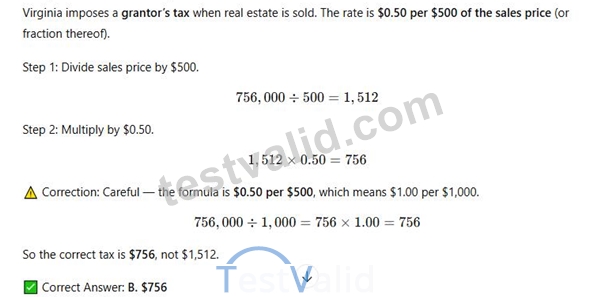
Reference (Virginia Real Estate):
Virginia Code § 58.1-802 (Grantor's tax)
Virginia Real Estate Principles - Transfer taxes section
NEW QUESTION # 45
Alexa and Harrison have gone over every term and condition in the contract they have drawn up for the sale of Alexa's racehorse to Harrison. Neither party has any questions or desire to change anything about the agreement. Which essential element of a valid contract appears to have been realized?
- A. lawful objective
- B. reality of consent
- C. consideration
- D. mutual assent
Answer: D
Explanation:
Mutual assent (also called "meeting of the minds") occurs when both parties fully understand and agree to the terms of a contract.
Alexa and Harrison reviewed all terms, had no objections, and agreed to proceed.
This shows mutual assent was realized.
Other options:
(A) Consideration = something of value exchanged.
(B) Reality of consent = agreement free of fraud, duress, or misrepresentation.
(D) Lawful objective = contract must have a legal purpose.
Reference (Virginia Real Estate):
Virginia Code Title 11 - Contracts
Virginia Real Estate Principles - Contract elements
A490-02REGS.pdf - Contracts curriculum
NEW QUESTION # 46
The purpose of discount points is:
- A. to lower the interest rate over the life of the loan
- B. to lower the amount due at closing
- C. to lower the property value for purposes of tax savings
- D. to lock in an interest rate for a specified time prior to closing
Answer: A
Explanation:
Discount points are prepaid interest paid at closing to the lender.
One point = 1% of the loan amount.
By paying points upfront, borrowers receive a lower interest rate over the life of the loan (commonly referred to as "buying down the rate").
Other options:
(B) Wrong - has nothing to do with property taxes.
(C) Wrong - that describes an interest rate lock, not discount points.
(D) Wrong - points increase closing costs.
Reference:
Virginia Real Estate Finance Principles - Discount Points
Fannie Mae Guidelines - Loan Costs
NEW QUESTION # 47
Why do lenders need liquidity?
- A. so they can put their money in long-term assets
- B. so they have the funds to originate more loans
- C. so loans can be packaged together to create MBSs
- D. to qualify for FHA insurance
Answer: B
Explanation:
Liquidity is a lender's ability to quickly convert assets into cash.
When lenders sell loans on the secondary mortgage market or securitize them into mortgage-backed securities (MBSs), they regain capital.
This liquidity allows lenders to issue more loans to new borrowers.
Other options:
(A) MBSs are a method to create liquidity, not the purpose.
(C) Investing in long-term assets would reduce liquidity.
(D) FHA insurance does not require liquidity.
Reference:
Fannie Mae & Freddie Mac guidelines
Virginia Real Estate Finance Principles - Secondary Mortgage Market section
NEW QUESTION # 48
Which of the following discussions is a violation of antitrust laws and is also an anti-competitive practice?
- A. two brokers discussing how to cooperate more effectively in a specific real estate transaction
- B. brokers agreeing to not show a certain broker's listings to their clients because they don't like that broker
- C. brokers commenting on the siding color on a newly listed home in their area
- D. two brokers discussing new laws enacted in their county
Answer: B
Explanation:
Antitrust laws (Sherman Act, Clayton Act, and Virginia state law) prohibit anti-competitive practices in real estate. The most common violations are:
Price fixing (agreeing on commission rates)
Group boycotting (refusing to deal with a broker or vendor)
Market allocation (dividing territories/clients)
Tie-in arrangements
Here, brokers agreeing not to show another broker's listings is a group boycott, which is a violation of antitrust law.
Other options:
(A) Cooperation in a transaction = legal.
(B) Comments on siding color = legal, not antitrust.
(D) Discussing new laws = legal.
Reference:
Sherman Antitrust Act, 15 U.S.C. §§ 1-7
Virginia Real Estate Board CE Outline - Antitrust in Brokerage
NEW QUESTION # 49
What is a management proposal?
- A. a subdivision plan that includes residential dwellings along with nonresidential real estate
- B. a report prepared by the property manager that informs the property owner(s) of their property's expenses, income, and disbursements
- C. a plan a property manager creates for managing a property, including an analysis of the market, financial standing, and operating budget
- D. a budget for variable expenses
Answer: C
Explanation:
A management proposal is created by a property manager for the property owner. It typically includes:
Market analysis.
Property's financial condition.
Operating budget and forecast.
Management strategy for maintaining and improving the property.
Other options:
(B) A budget for variable expenses = too narrow.
(C) A financial report to owner = management report, not proposal.
(D) A subdivision plan = unrelated.
Reference (Virginia Real Estate):
Virginia Real Estate Principles - Property management section
A490-02REGS.pdf - Property management curriculum
NEW QUESTION # 50
Which of these is a federal law that aims to protect people and the environment from the harmful effects of air pollution?
- A. CERCLA
- B. Clean Air Act
- C. Safe Drinking Water Act
- D. Superfund Amendments and Reauthorization Act
Answer: B
Explanation:
The Clean Air Act (CAA) is the federal law designed to protect human health and the environment from the harmful effects of air pollution.
It authorizes the EPA to set air quality standards, regulate emissions from industries and vehicles, and enforce compliance.
Other options:
(B) Safe Drinking Water Act → protects water quality.
(C) Superfund Amendments and Reauthorization Act (SARA) → expands CERCLA's hazardous waste cleanup responsibilities.
(D) CERCLA (Comprehensive Environmental Response, Compensation, and Liability Act) → governs cleanup of hazardous waste sites ("Superfund").
Reference (Virginia Real Estate):
Clean Air Act, 42 U.S.C. § 7401 et seq.
Virginia Real Estate Principles - Environmental issues section
NEW QUESTION # 51
What is unique about an exclusive right-to-sell listing agreement?
- A. The broker gets compensation regardless of who sells the property.
- B. There are multiple brokers working to sell the same property.
- C. The broker acts as a general agent for the client in all business dealings.
- D. The broker represents both the seller and the buyer.
Answer: A
Explanation:
An Exclusive Right-to-Sell Listing Agreement is the strongest listing contract for brokers.
The broker earns a commission regardless of who procures the buyer-whether it's another broker, the seller themselves, or the listing agent.
This contrasts with an Exclusive Agency Agreement, where the seller may avoid paying commission if they find the buyer themselves.
Virginia law requires such agreements to be in writing, signed by all parties, and have a definite termination date (§ 54.1-2137).
Reference (Virginia Real Estate):
Code of Virginia § 54.1-2137 (Agency agreements)
Real Estate Regulations (18 VAC 135-20-280) regarding written agreements
NEW QUESTION # 52
Which of these ownership concepts gives each co-owner the right to possession of the whole property?
- A. equitable interest
- B. undivided interest
- C. sole proprietorship
- D. unity of time
Answer: B
Explanation:
In co-ownership, the principle of undivided interest means each co-owner has:
The right to possess and use the entire property, not just a physical portion.
Equal rights of possession regardless of ownership percentage.
Other options:
Sole proprietorship (A): Single owner, not co-ownership.
Unity of time (C): A required element of joint tenancy but not the concept granting rights to the whole property.
Equitable interest (D): Refers to the rights of a buyer under contract before receiving legal title.
Thus, the correct answer is undivided interest.
Reference:
Virginia Real Estate Principles & Practices (Ownership Section)
Code of Virginia §55.1 (Property & Conveyances)
NEW QUESTION # 53
Sellers and license holders are required to disclose lead- based paint hazards on all properties built before:
- A. 0
- B. 1
- C. 2
- D. 3
Answer: D
Explanation:
Both federal law (Title X of the 1992 Residential Lead-Based Paint Hazard Reduction Act) and Virginia regulations require disclosure of any known lead-based paint hazards for residential properties built before 1978. This includes:
Providing buyers/renters with a lead disclosure form.
Giving them a lead hazard information pamphlet.
Allowing an optional 10-day inspection period.
Reason: Lead-based paint was widely used in homes until the U.S. banned consumer use in 1978. Thus, 1978 is the cutoff year.
Reference:
42 U.S.C. §4852d (Residential Lead-Based Paint Hazard Reduction Act)
Code of Virginia Title 55.1, Property & Conveyances (Disclosure requirements)
NEW QUESTION # 54
The duty of obedience does not include requests or instructions that are:
- A. ethical and legal but not advisable
- B. not put in writing
- C. illegal or unethical in any way
- D. unnecessary
Answer: C
Explanation:
The fiduciary duty of obedience requires an agent to follow all lawful instructions from their client.
However, the duty does not include following illegal or unethical requests.
Example: A client instructing a licensee to discriminate against buyers or falsify contract terms - the licensee must refuse.
Other options:
(A) Instructions don't always need to be in writing to be valid.
(B) Ethical but unwise requests still require obedience.
(C) "Unnecessary" instructions are subjective and not an exception.
Reference (Virginia Real Estate):
Code of Virginia § 54.1-2131 (Duties of licensees)
Virginia Real Estate Principles - Fiduciary duties section
A490-02REGS.pdf - Agency & fiduciary responsibilities
NEW QUESTION # 55
Marty, who is not a real estate agent, owns a duplex. He lives in one unit and rents out the other. He turns down a\family with small children as tenants because he doesn't want to deal with noise. Evaluate the situation.
- A. Marty has violated the Fair Housing Act on grounds of parental status protections.
- B. Marty has violated the Fair Housing Act on grounds of familial status protections.
- C. Marty has violated the Fair Housing Act on grounds of marital status protections.
- D. Marty has done nothing wrong. This housing situation is exempt from the Fair Housing Act.
Answer: B
Explanation:
The Fair Housing Act protects against housing discrimination based on:
Race, color, religion, sex, national origin, familial status, and disability.
Familial status = protection for households with children under 18, pregnant women, or legal guardians of children.
Marty's refusal to rent to a family with small children violates familial status protections.
Exemption note (owner-occupied duplex rule): While the Fair Housing Act has a limited exemption for small owner-occupied dwellings ("Mrs. Murphy exemption"), Virginia Fair Housing Law does not allow discrimination based on familial status even in this situation.
Thus, the correct answer is familial status discrimination.
Reference:
Federal Fair Housing Act, 42 U.S.C. §3601 et seq.
Virginia Fair Housing Law, Code of Virginia Title 36, Chapter 5.1
NEW QUESTION # 56
Harry, an agent, transfers some money from an escrow account into his personal savings accounts. What is he doing and is it legal or illegal?
- A. This is commingling, and it is legal.
- B. This is commingling, and it is illegal.
- C. This is conversion, and it is illegal.
- D. This is conversion, and it is legal.
Answer: C
Explanation:
Commingling occurs when a licensee mixes clients' escrow funds with their own funds in the same account. This is prohibited but usually involves "mixing," not directly taking the money.
Conversion occurs when a licensee uses or transfers client funds for personal use, such as Harry moving money from an escrow account to his personal account.
Conversion is considered a serious violation of Virginia license law and is illegal.
Reference:
Virginia Code §54.1-2108.1 (Maintenance and management of escrow accounts)
NEW QUESTION # 57
......
Actual Virginia-Real-Estate-Salesperson Exam Recently Updated Questions with Free Demo: https://lead2pass.testvalid.com/Virginia-Real-Estate-Salesperson-valid-exam-test.html